
 Request A Quote

solar street light pole
 FACEBOOK
 TWITTER
 LINKEDIN
The use of solar as a source of illumination has increasingly superseded the use of electricity from the grid for lighting up roads and lanes and hence the greater focus in the past years on solar panels, batteries and LED fixtures. But one very important aspect is missing—the foundation and pole system.
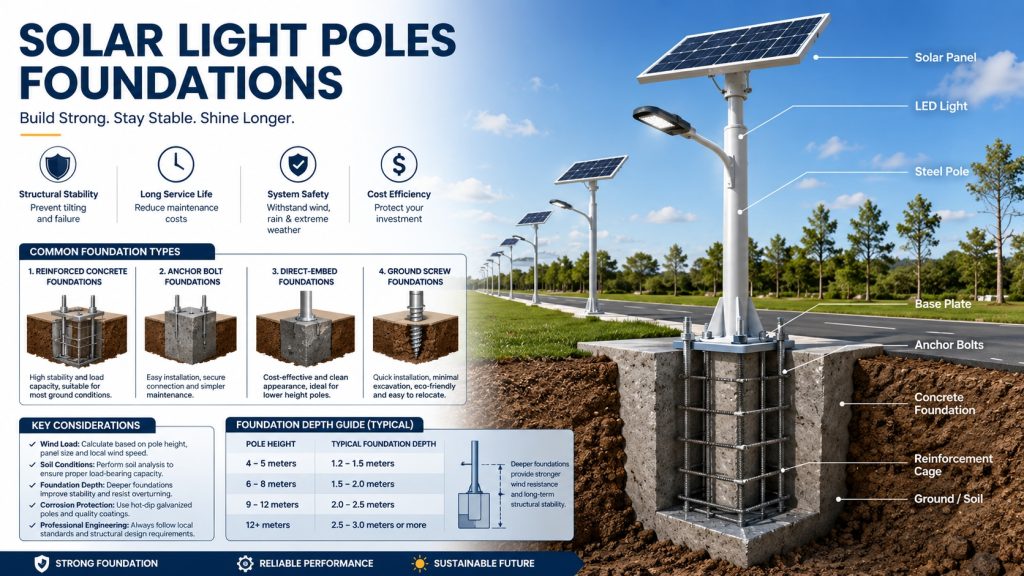
The strength of the solar lighting system is only as strong as the structure that holds it up. Even the highest of the solar light can fall if the pole is wrongly engineered or the foundation is not planned for the local environmental conditions. This knowledge is crucial for various stakeholders, including municipalities, contractors, developers, and facility managers, seeking effective and long-lasting outdoor lighting solutions.
Why Solar Light Pole Foundations Matter
The whole solar lighting system depends on the foundation, so it is the basic structure of the whole system. It should bear the load of the pole and fixture, as well as resist the impact of various environmental forces including:
- High winds
- Soil movement
- Ground settlement
- Rain and flooding
- Temperature fluctuations
- Vibration loads
Solar light poles are usually fitted with other components, such as solar panels, battery enclosures, controllers, and mounting brackets, which are not found in traditional streetlights. All of these elevate the wind resistance and wind effects on the structure, further reinforcing the need to have an appropriate foundation design.
A well-designed foundation helps:
- Prevent pole tilting
- Reduce maintenance costs
- Improve system safety
- Extend service life
- Protect expensive solar components
Choosing the Right Material for Solar Light Poles
Steel Poles
The superior strength and durability of steel make it the most commonly used material for solar street light poles.
The advantages of steel poles are:
- Excellent load-bearing capacity
- High resistance to wind forces
- Better vibration performance
- Long service life
- Compatibility with various foundation types
In areas subject to high winds, storms or coastal weather, steel poles are especially effective.
Aluminum Poles
Aluminum poles are lightweight and corrosion resistant, but might not be as suitable for large solar systems as other types of poles because they may be less structurally strong than other materials.
In terms of materials, steel may be the more reliable option for commercial and municipal lighting where long-term performance is a factor, while aluminum might be better for decorative uses or for shorter lighting structures.
Understanding Wind Load Requirements
One of the most important considerations when designing solar light pole foundations is wind loading.
The solar panels provide an expanded surface area, making it like a sail in the strong winds. When the wind pressure is high, a great force is conveyed by both the pole and foundation.
Engineers consider the following when designing:
- Pole height
- Solar panel dimensions
- Fixture weight
- Local wind speed
- Geographic location
- Exposure conditions
The following can result from the absence of wind load calculations:
- Pole bending
- Structural fatigue
- Foundation cracking
- Complete pole failure
Therefore, it is always important to have professional structural analysis prior to installation.
Common Foundation Types for Solar Light Poles
1. Reinforced Concrete Foundations
Most solar lighting projects are built with concrete foundations.
Advantages include:
- High structural stability
- Excellent load distribution
- Long service life
- Suitable for most soil conditions
To hold the pole base in place, the foundation is usually reinforced with steel rebar and anchor bolts.
There are several common applications of concrete foundations:
- Highways
- Parking lots
- Industrial facilities
- Municipal roadways
- Commercial developments
2. Anchor Bolt Foundations
Anchors with bolt systems that embed the bolts directly into the concrete foundation.
Benefits include:
- Easy pole installation
- Simplified maintenance
- Improved structural security
- Faster replacement if necessary
The anchor bolt foundation is especially used in large-scale solar street lighting projects.
3. Direct-Embed Foundations
This is one in which the lower part of the pole is set directly in concrete, below the grade.
Advantages include:
- Lower installation cost
- Reduced hardware requirements
- Clean appearance
But direct-embed systems tend to be more appropriate for shorter poles and lower wind loading applications.
4. Ground Screw Foundations
Screws on ground are becoming more popular for temporary installations as well as environmentally friendly projects.
Benefits include:
- Minimal excavation
- Fast installation
- Reduced environmental impact
- Easy removal and relocation
These systems work best in suitable soil conditions where sufficient load-bearing capacity exists.
How Deep Should a Solar Light Pole Foundation Be?
Foundation depth depends on several factors:
- Pole height
- Soil conditions
- Wind exposure
- Fixture weight
- Solar panel size
As a general guideline:
| Pole Height | Typical Foundation Depth |
|---|---|
| 4–5 meters | 1.2–1.5 meters |
| 6–8 meters | 1.5–2.0 meters |
| 9–12 meters | 2.0–2.5 meters |
Larger poles with integrated solar panels often require deeper foundations to resist overturning forces.
Site-specific engineering calculations should always determine final dimensions.
The Importance of Soil Analysis
Before constructing any foundation, soil testing should be completed.
Different soil types have different load-bearing capacities:
Sandy Soil
- Good drainage
- Lower stability
- May require larger foundations
Clay Soil
- Strong when dry
- Expansion and contraction risks
- Requires careful design
Rocky Soil
- Excellent bearing capacity
- May increase excavation costs
Fill Material
- Often unpredictable
- Usually requires additional reinforcement
Understanding soil conditions helps prevent future settlement and structural movement.
Hot-Dip Galvanization: Protecting Steel Poles
Corrosion is one of the leading causes of pole deterioration.
To maximize service life, quality manufacturers use hot-dip galvanization (HDG).
During this process:
- The steel pole is cleaned.
- It is submerged in molten zinc.
- A protective zinc coating forms.
- The coating chemically bonds to the steel.
Benefits include:
- Superior corrosion protection
- Longer lifespan
- Reduced maintenance
- Better performance in coastal environments
Compared with painted or cold-galvanized surfaces, HDG provides significantly greater durability.
Powder Coating for Additional Protection
Many premium solar light poles also receive a powder-coated finish.
Advantages include:
- Enhanced weather resistance
- Improved aesthetics
- UV protection
- Environmentally friendly manufacturing
Powder coating allows projects to match architectural styles while adding another layer of protection against harsh outdoor conditions.
Common Foundation Design Mistakes
Avoiding the following errors can significantly improve project success:
Insufficient Foundation Depth
Shallow foundations increase the risk of tilting and structural failure.
Poor Drainage Planning
Standing water can weaken soil and accelerate corrosion.
Ignoring Wind Loads
Wind forces are often underestimated in solar lighting projects.
Low-Quality Materials
Using inferior steel, bolts, or concrete may reduce lifespan and increase maintenance costs.
Lack of Professional Engineering
Every project location has unique environmental requirements. Professional structural design helps ensure compliance and long-term safety.
Best Practices for Long-Term Solar Lighting Performance
To maximize reliability:
- Use certified structural steel poles
- Conduct site-specific soil testing
- Perform wind load calculations
- Select hot-dip galvanized poles
- Use reinforced concrete foundations
- Follow local engineering standards
- Schedule regular inspections
These measures help to maintain solar lighting systems safe, stable and effective over the years.
Conclusion
While the solar panels and LED fixtures might be the ones that get the most attention, the foundation and pole system are ultimately the key to the success of a solar lighting project. An effective foundation design is critical for structural stability, safety and for the lifespan of solar technology investments.
When installing solar street lights, parking lot lights, pathway lighting, and commercial outdoor lighting, the selection of proper pole materials, foundation design and corrosion protection, installation method are essential. When dealing with the structural integrity aspect from the very beginning, project owners can expect to have solar lighting for many years to come.
- 10 Meters Lamp Post
- 10 Meters Pole
- 1000w Led Projector
- 100W LED Tunnel Light
- 12 Meters Lamp Post
- 12 Meters Pole
- 1200w Led Projector
- 15 Light Pole
- 1500w Led Projector
- 150W LED Tunnel Light
- 1800w Led Projector
- 2 In 1 Solar Flood Light
- 200w Led Tunnel Light
- 50w Led Tunnel Light
- 6 Meters Lamp Post
- 6 Meters Pole
- 8 Meters Lamp Post
- 8 Meters Pole
- 800w Led Projector
- 80w Led Tunnel Light
- Colourful Decorative Light
- Conical post
- Courtyard Lamp
- courtyard light
- courtyard lighting fixture
- Decorative Landscape Light
- Decorative road Light
- Flood Light For Courtyard
- Flood Light for Garden
- Flood Light For Outdoor
- Foot Led High Bay Lights
- high bay led lights 100w
- industrial lampshade
- industrial LED shed lights
- industrial magnifying glass with light
- Integrated Solar Flood Light
- led courtyard lamp
- led courtyard light
- led high bay light 100w
- LED Projector For Stadium
- Led UFO High Bay 150W 5000k
- Lighting Plants Mining Price
- Maintenance Free LED Street Light
- Pic Controlling Tunnel Light
- PLC controlling tunnel light
- Post Top Garden Light
- RGB Landscape Light
- Rgbw Decorative Light
- Smart Tunnel Light
- solar courtyard lamp
- solar courtyard light
- Solar LED Road Light
- Solar Street Light For 10 Meter Pole
- Solar Street Light For 12 Meter Pole
- Solar Street Light For 6 Meter Pole
- Solar Street Light For 8 Meter Pole
- Split Type Solar Flood Light
- Sporting Projector
- Stadium Led Projector
- Street Lighting Post
