
 Request A Quote

traffic signal pole types
 FACEBOOK
 TWITTER
 LINKEDIN
One of the most crucial parts of modern transportation infrastructure are traffic signal poles. The traffic light poles ensure visibility and durability, and provide long-term operational safety for the traffic light system, which is responsible for regulating traffic and pedestrian flow. The selection of the appropriate type of traffic signal pole can have a significant effect on traffic efficiencies, maintenance costs, and road safety. The type of pole is dependent on traffic flow, the intersection size, roadway conditions and environmental considerations.
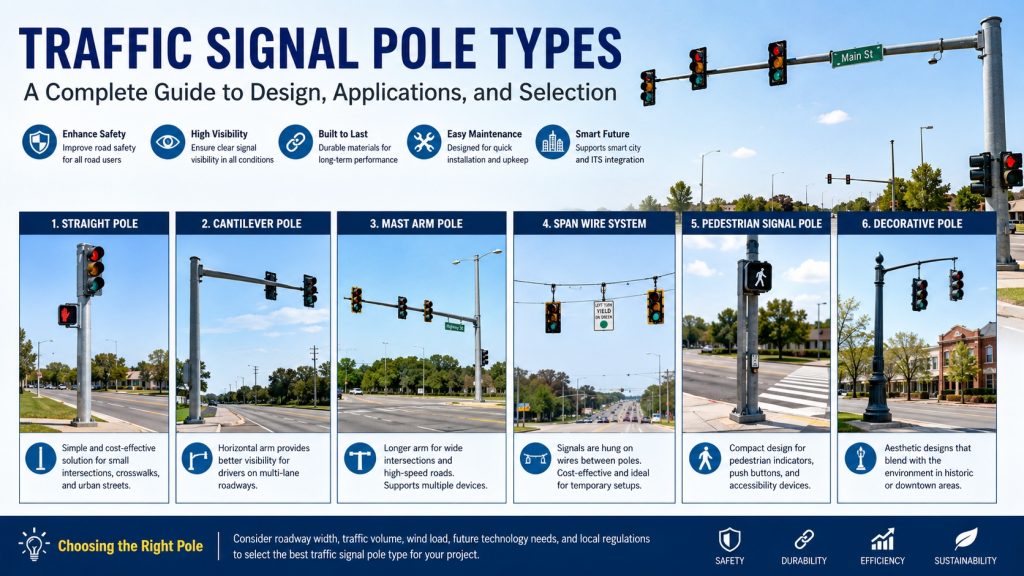
We’ll dive into the most popular types of traffic signal poles, explore the materials used, their applications, and advantages, and discuss the considerations an engineer should take into account when choosing the appropriate type.
What Is a Traffic Signal Pole?
Traffic Signal Pole is a structure that carries traffic light signals, pedestrian signals, roadway signs, cameras, sensors and other devices that can be used for smart transportation solutions. The poles are usually constructed of galvanized steel, aluminum or other weather and traffic resistant material and are designed to last for many years.
The modern traffic signal pole is designed to adhere to very specific safety requirements so that motorists and pedestrians can see the signal pole clearly.
Why Traffic Signal Pole Selection Matters
The type of traffic signal pole has a significant impact on a number of important factors in roadway performance:
- Signal visibility
- Traffic safety
- Structural stability
- Wind resistance
- Maintenance requirements
- Installation costs
- Future smart-city upgrades
Unsuitable pole positioning and poor design can decrease visibility and pose a safety risk to drivers. Selecting the appropriate pole ensures traffic signals can be seen in all conditions and environments.
Common Traffic Signal Pole Types
1. Straight Pole Traffic Signal
One of the most common designs is called a “monopole traffic signal pole. They are a vertical pole that is driven straight into a foundation or anchor base.
Features
- Simple design
- Easy installation
- Lower cost
- Minimal space requirements
Best Applications
- Urban streets
- Residential intersections
- Pedestrian crossings
- Parking facilities
For traffic signals that can be installed without overhead positioning, straight poles are best. They are also easy to use, which can help to minimize maintenance complexity.
2. Cantilever Traffic Signal Pole
In the case of cantilever poles a horizontal arm is attached to the main vertical tower. This arm extends traffic signals directly above the travel lanes.
Features
- Enhanced signal visibility
- Supports multiple signal heads
- Suitable for wider roadways
Best Applications
- Multi-lane intersections
- Urban arterial roads
- High-volume traffic corridors
Cantilever structures provide drivers with good visibility of signals from distances farther away, decreasing traffic confusion and the flow of traffic. They are especially useful for intersections that have a lot of traffic and where side mounted signals are blocked.
3. Mast Arm Traffic Signal Pole
Mast arm poles are like cantilever poles on a much longer and stronger horizontal arms that can support multiple traffic devices.
Features
- Long overhead reach
- Supports signals, signs, and cameras
- High structural strength
Best Applications
- Major intersections
- Highway interchanges
- Smart transportation systems
Mast arm systems are often employed to provide overhead traffic control devices in multiple lanes. They are designed to offer greater visibility and allow for future technology integration.
4. Span Wire Traffic Signal System
Whereas large overhead arms are used for traffic lights in some areas, in span wire systems, their cables are stretched between poles.
Features
- Lower installation costs
- Flexible positioning
- Faster deployment
Best Applications
- Temporary intersections
- Budget-sensitive projects
- Rural roadways
While span wire systems are not as prevalent in today’s developments, they are still a cost-effective choice in some areas.
5. Pedestrian Signal Pole
Pedestrian signal poles are specially made to accommodate pedestrian crossing indicators, push-button systems and accessibility devices.
Features
- Compact structure
- ADA-compatible equipment support
- Lower installation footprint
Best Applications
- Crosswalks
- School zones
- Transit stations
- Urban sidewalks
Many newer pedestrian poles also carry Accessible Pedestrian Signal (APS) technology which aids the visually impaired pedestrian.
6. Decorative Traffic Signal Pole
Decorative poles also serve a functional purpose and are pleasing to the eye. They are frequently finished in special materials and colors, and adorned with architectural details.
Features
- Attractive appearance
- Corrosion-resistant coatings
- Custom design options
Best Applications
- Downtown districts
- Tourist destinations
- Historic areas
- Smart city projects
Decorative Traffic Poles are often chosen by municipalities to be consistent with the other streetscape designs.
Traffic Signal Pole Materials
The ability of a traffic signal pole depends primarily on the material used in its production.
Galvanized Steel
The most commonly used material is galvanized steel because it provides the following:
- High strength
- Excellent durability
- Corrosion resistance
- Cost efficiency
In the urban space and in the highway, steel poles are used abundantly.
Aluminum
Aluminum poles provide:
- Lightweight construction
- Natural corrosion resistance
- Lower transportation costs
- Attractive appearance
They are especially favored in coastal areas where corrosion can occur more rapidly due to exposure to salt.
Stainless Steel
While the cost may be higher, stainless steel possesses a host of other qualities that make it ideal for specialized projects: durability, and a premium look.
Factors to Consider When Choosing Traffic Signal Pole Types
Roadway Width
For wider roads, cantilever or mast arm poles are sometimes necessary to ensure that signals are visible above all travel lanes.
Traffic Volume
The overhead signals at high-traffic intersections provide more visibility and time for drivers to react.
Wind Load Requirements
The local wind has to be accounted for when designing traffic signal poles. Wind resistance and structural performance are affected by the pole shape, material and foundation design.
Future Technology Integration
Modern traffic management increasingly relies on:
- Traffic cameras
- Vehicle detection sensors
- Smart city communication devices
- Connected transportation systems
Selecting a pole capable of supporting future upgrades can reduce long-term infrastructure costs.
Local Regulations
The height, placement and structure of traffic signal poles should meet local transportation and engineering requirements.
Maintenance and Safety Considerations
Periodic inspections help to ensure traffic signal poles stay structurally sound during their service life.
Maintenance activities that are important are:
- Corrosion inspection
- Bolt tightening
- Foundation evaluation
- Signal mounting checks
- Electrical equipment inspection
Properly maintained poles can last for decades and reduce safety hazards and downtime.
Conclusion
Traffic signal poles are not just support poles; they are essential elements in today’s transportation infrastructure. Each type of traffic signal pole has a different purpose from straight poles to cantilever design, mast arm to decorative solutions. Careful considerations of roadway geometry, traffic characteristics, environmental considerations and future infrastructure requirements are necessary to select the appropriate choice.
When designing a municipal intersection upgrade, a highway project or a smart city deployment, knowing about the different types of traffic signal poles will help increase safety on the road, enhance visibility and maximize the lifespan of infrastructure.



- 10 Meters Lamp Post
- 10 Meters Pole
- 1000w Led Projector
- 100W LED Tunnel Light
- 12 Meters Lamp Post
- 12 Meters Pole
- 1200w Led Projector
- 15 Light Pole
- 1500w Led Projector
- 150W LED Tunnel Light
- 1800w Led Projector
- 2 In 1 Solar Flood Light
- 200w Led Tunnel Light
- 50w Led Tunnel Light
- 6 Meters Lamp Post
- 6 Meters Pole
- 8 Meters Lamp Post
- 8 Meters Pole
- 800w Led Projector
- 80w Led Tunnel Light
- Colourful Decorative Light
- Conical post
- Courtyard Lamp
- courtyard light
- courtyard lighting fixture
- Decorative Landscape Light
- Decorative road Light
- Flood Light For Courtyard
- Flood Light for Garden
- Flood Light For Outdoor
- Foot Led High Bay Lights
- high bay led lights 100w
- industrial lampshade
- industrial LED shed lights
- industrial magnifying glass with light
- Integrated Solar Flood Light
- led courtyard lamp
- led courtyard light
- led high bay light 100w
- LED Projector For Stadium
- Led UFO High Bay 150W 5000k
- Lighting Plants Mining Price
- Maintenance Free LED Street Light
- Pic Controlling Tunnel Light
- PLC controlling tunnel light
- Post Top Garden Light
- RGB Landscape Light
- Rgbw Decorative Light
- Smart Tunnel Light
- solar courtyard lamp
- solar courtyard light
- Solar LED Road Light
- Solar Street Light For 10 Meter Pole
- Solar Street Light For 12 Meter Pole
- Solar Street Light For 6 Meter Pole
- Solar Street Light For 8 Meter Pole
- Split Type Solar Flood Light
- Sporting Projector
- Stadium Led Projector
- Street Lighting Post
