
 Request A Quote

Vintage street light Guide: History, Styles, Value & Buying Tips
 FACEBOOK
 TWITTER
 LINKEDIN
Old fashioned street lights are not only a source of lighting, but a universal epitome of city history, art, and design. Since 19th-century gas-lit lanterns through detailed Victorian lamp posts, these historic items have been used as inspiration by designers, collectors, and restorers of various parts of the world.
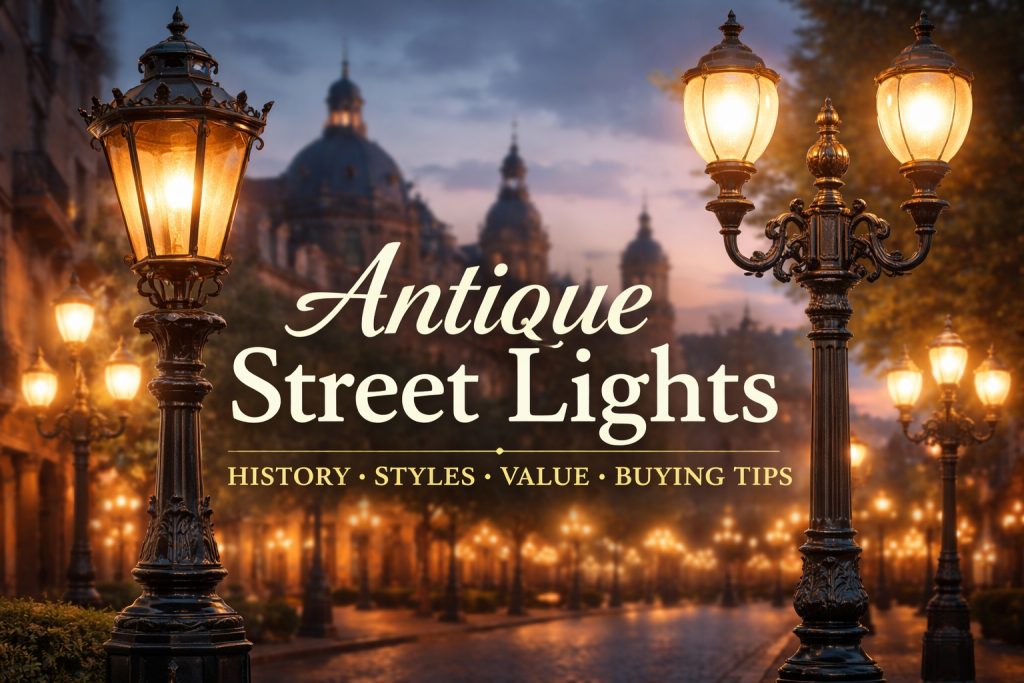
This complete reference will inform you on the history of street lights, styles, forms, and value, as well as the current applications of antique street lights so you can make the right choice of antique street lighting collectively, restoring, or decorating.
The History Of The Antique Street Lights.
The use of street lighting dates back to the centuries though it became common in the 19 th century. The systems used at the beginning of the lighting were oil lamps and candles which did not give much light and had to be operated manually.
By the early 19 th century, gas street lights started to change the urban settings in both Europe and America. These lights were much brighter than the oil lamps but still had to be lit by the lamplighters as they took part in the process of lighting them manually every night.
The actual breakthrough was when electric lighting in the streets was introduced in the late 19 th century. Arc lamps and incandescent bulbs became the new innovations that soon substituted the gas systems in order to make the city safer and more effective at night.
This was a significant change in the urban infrastructure as most of the cities began to modernize their systems of lighting and continue to maintain ornamentation in the previous designs.
Primary Classifications of Ancient Street Lights.
The street lights that were used in the past can be broadly divided into three main types:
- Utilitarian Street Lights
These were created because of functionality only. They were often suspended on wires, and as undecorated sources of simple illumination.
- Lamp Posts (Electroliers) in free standing.
These freestanding lamps are the most recognizable and most individuals imagine when they hear the terms antique street lighting. They are both functional and artistic.
- Wall-Mounted Street Lamps
These lamps were fitted on the exterior of the buildings, which were used to light inaccessible places with freestanding posts.
Fashionable Antique Street Lighting Styles by Period.
The antique street lighting has changed greatly over the years in terms of design as well as technology. The following are the most prominent styles:
Victorian Era (1850s–1870s)
The Victorian street lamps are unique due to their skilled workmanship. Common features include:
- Construction made of cast or wrought iron.
- Ornamental scrolling and fancy detailing.
- Metal-framed lanterns made of glass.
- Copper or brass tops
These lamps were usually over 10 feet tall and were very common in the large cities.
Late Victorian / Early Electric (1880s1910s)
With the advent of electricity the designs started to combine utility with beauty:
- Globe-shaped glass lights with a softer light.
- Wider coverage using twin-lamp posts.
- Ornamental pedestals like urn or garland patterns.
Such lamps are also known as luminaires or electroliers.
Edwardian Period (1900–1914)
These street lights were inspired by the Art Nouveau and consisted of:
- Flowing, organic shapes
- Lyre-shaped tops
- Metalwork that was inspired by nature.
This was a time that focused on beauty and not functionality.
Art Deco & Revival Styles (1920s–1930s)
Modernism came with new bold designs:
- Geometric designs and symmetry.
- Multi-bulb street lamps
- Heavy metal Lanterns in Spanish Revival.
These designs were based on the emerging urban tastes of fast modernising cities.
Substances employed in Street Lights of Antiquity.
Real antique street lights have been made of very strong material and of durable quality:
- Cast iron and wrought iron – when strong work is needed, and much detailing is required.
- Copper and brass – to resist corrosion and decorative finishes
- Aluminum – as an economical material, and iron – for decorative purposes.
- Glass balls, or windows – to diffuse light.
Such materials also helped to make them long-lived and some of them have lasted more than one hundred years.
Are Old Time Street Lamps Worth Anything?
Street lights do not have a large market compared to smaller antiques since they are very bulky and if they are installed, they need a niche. Nevertheless, they are still capable of being of great value, based on a number of factors:
Key Value Factors
- State and degree of restoration.
- Originality and authenticity.
- Aesthetic design and historicism.
- Installation and transportation charges.
Collectors often include:
- Historical preservationists
- Architects and designers
- Moviemaking and television production firms.
Due to these niche buyers prices may be highly diverse.
Old vs. Replica Street Lights.
It is not easy to find a complete antique street light. This has led to a large number of buyers resorting to the quality reproductions.
Reproductions have advantages.
- Lower priced and less expensive.
- Constructed using modern materials such as steel or aluminum.
- Lighting compatible with LED lighting that is energy efficient.
- Reduced maintenance needs.
Reproduction is also a common thing in modern reproduction where the style is usually Victorian, Edwardian, or Art Deco with the addition of the new technology.
Antique Street Lights in the Modern World.
Currently, antique and antique-style street lights are being used in non-city streets:
- Residential Landscaping
They are used by homeowners to decorate the driveways, gardens and entrances in a vintage style.
- Commercial Spaces
The antique lighting is used in hotels, shopping districts and restaurants to give the feeling and to attract the shoppers.
- Restoration Projects of historic buildings.
To keep original street lamps in the heritage areas, preservationists reconstruct the old lamps.
- Film and Media Production
Real street lights are also common props in historical movies and television programs.
Trends in Sustainability and Restoration.
As environmental consciousness increases, an increasing number of cities and owners of property are opting to keep and restore, instead of replacing, old street lighting.
The new modernizations frequently involve:
- Energy efficiency retrofitting with LED.
- Safety structural reinforcement.
- The maintenance of original design features.
This will be a hybrid of sustainability and heritage conservation, as antique lighting can still be used in the contemporary settings.
Antique Lighting Purchase tips.
In case you are thinking of buying one, remember the following:
✔ Check Authenticity
Search original materials, marks of manufacture and historical consistency.
✔ Assess Condition
Examine rust, corrosion or structural damage.
✔ Take into Account Costs of Installation.
Such lights are bulky and must be installed by professionals.
✔ Choose the Right Style
Adapt the lamp design to your theme of property/project.
✔ Explore Reproductions
Reproductions have more durability and efficiency when authenticity is not a necessity.
The reason behind the popularity of Antique Street Lights.
Street lights that were used in the past still appeal to people due to the fact that it is a rare combination of:
- Historical significance
- Artistic craftsmanship
- Functional design
These fixtures have their charm and cultural value even in the present day age of intelligent lighting and LED technology.
Conclusion
The use of old street lights is not just a thing of the past, it is a continuity of design, which links history to the contemporary lifestyle. These fixtures are of impeccable character and style, either to a collector, designer or a homeowner.
Since they were gas-lit, they have advanced into electric innovations, and their development is the development of the modern cities. and through the prospective restoration and reproduction, antique street lights will still be relevant to the future generations.
- 10 Meters Lamp Post
- 10 Meters Pole
- 1000w Led Projector
- 100W LED Tunnel Light
- 12 Meters Lamp Post
- 12 Meters Pole
- 1200w Led Projector
- 15 Light Pole
- 1500w Led Projector
- 150W LED Tunnel Light
- 1800w Led Projector
- 2 In 1 Solar Flood Light
- 200w Led Tunnel Light
- 50w Led Tunnel Light
- 6 Meters Lamp Post
- 6 Meters Pole
- 8 Meters Lamp Post
- 8 Meters Pole
- 800w Led Projector
- 80w Led Tunnel Light
- Colourful Decorative Light
- Conical post
- Courtyard Lamp
- courtyard light
- courtyard lighting fixture
- Decorative Landscape Light
- Decorative road Light
- Flood Light For Courtyard
- Flood Light for Garden
- Flood Light For Outdoor
- Foot Led High Bay Lights
- high bay led lights 100w
- industrial lampshade
- industrial LED shed lights
- industrial magnifying glass with light
- Integrated Solar Flood Light
- led courtyard lamp
- led courtyard light
- led high bay light 100w
- LED Projector For Stadium
- Led UFO High Bay 150W 5000k
- Lighting Plants Mining Price
- Maintenance Free LED Street Light
- Pic Controlling Tunnel Light
- PLC controlling tunnel light
- Post Top Garden Light
- RGB Landscape Light
- Rgbw Decorative Light
- Smart Tunnel Light
- solar courtyard lamp
- solar courtyard light
- Solar LED Road Light
- Solar Street Light For 10 Meter Pole
- Solar Street Light For 12 Meter Pole
- Solar Street Light For 6 Meter Pole
- Solar Street Light For 8 Meter Pole
- Split Type Solar Flood Light
- Sporting Projector
- Stadium Led Projector
- Street Lighting Post
