
 Request A Quote

How Much Does a Street Light Cost in 2026?
 FACEBOOK
 TWITTER
 LINKEDIN
The light in the streets is critical to the safety of the people, urban growth and infrastructure effectiveness. As a planner, contractor, or developer of any municipality in question, it is important to have a sense of the real cost of street lights before embarking on any project.
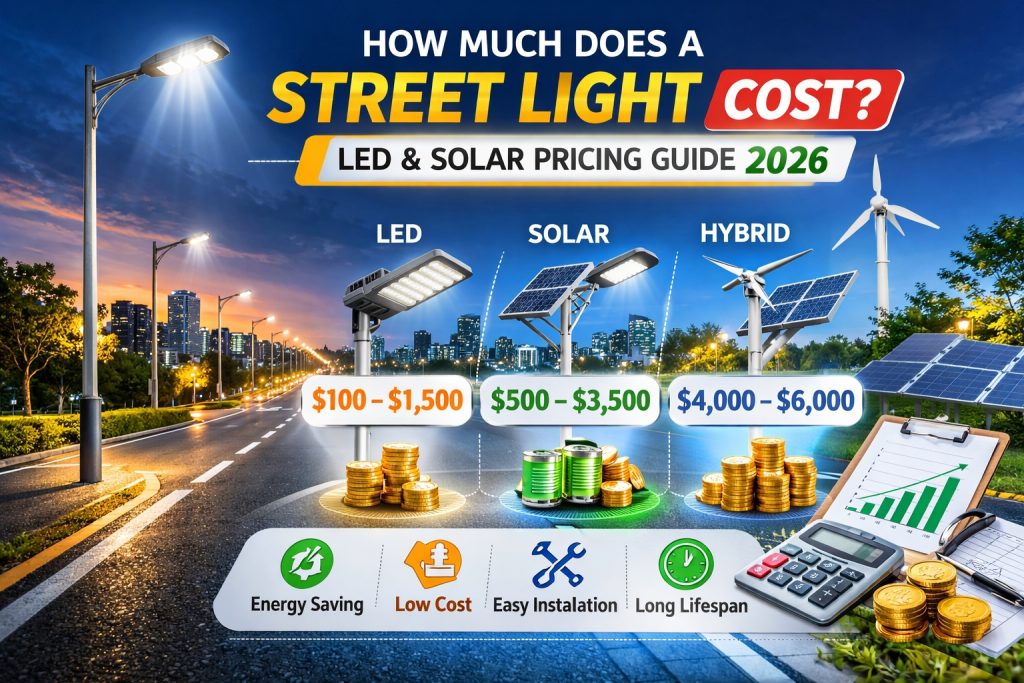
We have de-consolidated the actual price of street lighting systems, such as equipment, cost of installation, and long-run cost in this guide, so that you can be smarter.
Mean cost of a Street Light.
The prices of a street light also differ heavily on the kind of system, technology and the installation needs.
- LED Street Light Cost
The most popular type of street lights used today is the modern LED lights because of its energy saving nature.
- Simple LED street lighting lighting: $80 150.
- Mid-range systems: $150 – $500
- High performance/ smart LED lights: 500-1500.
As an example, the 150W LED street light may be priced at approximately 99 dollars depending on the quality and features.
- Solar Street Light Cost
Solar street lights are also gaining popularity particularly in remote or off-grid locations.
- Minor solar street lights: $500-1500.
- Normal solar solutions (battery and panel): 1500-3000.
- High tech solar systems: $2,500 and above.
A standard smart solar street light with installation will be around 2,500 dollars, which is usually lower than the old systems which need to be connected to the grid.
- Solar-Wind Street Lights Hybrid.
Hybrid systems are used to combine wind and solar energy to achieve high-performance and sustainability.
- Typical price range: $4,000 – $6,000 per unit
Wholesale data indicate that hybrid systems in the order of 4,036-5,900 are available in terms of capacity.
Installation Cost of Street Lights.
The overall price of a street light project is significantly more than the price of the light. One of the most expensive parts may be installation.
Key Installation Costs:
- Pole and foundation: $500 – $2,000
- Wiring and trenching: $1,000 – $5,000
- Labor and equipment: $500 – $3,000
👉 Unit cost of installation of each traditional street light:
$2,000 – $10,000+
That is why people pay more attention to solar street lights, which do not need trenching and other expenses on grid connection.
Total Cost Comparison
Type of Street Light Equipment Cost Installation Cost Total Cost.
- LED (Grid-connected) $100 – $1,500 $2,000 – $10,000 $2,100 – $11,500
- Solar Street Light $500 -3,000 Low (minimal wiring) 500-3,500
- Hybrid Solar/Wind $4,000 – $6,000 Moderate $4,500 – $7,000
Constituents that influence the Cost of Street lights.
There are a number of factors that affect the end price of a street lighting system:
- Lighting Technology
- LED lights are energy saving and long lasting.
- Electricity bills are removed by the use of solar lights.
- Smart lights have sensors and automation capabilities.
- Wattage & Brightness
Higher wattage means:
- Higher upfront cost
- Further brightness and coverage.
The common street lights are between 30W and 150W+ depending on the size of the road.
- Location and Geography
Location will greatly influence price:
- Cities/places of low density: increased labor expenses.
- Rural/off-grid → increased cost of installation of conventional systems.
- Sunny areas are where solar lighting will be better ROI.
To illustrate, in areas where the sun is abundant (such as in South East Asia or Africa), the solar street lights produce quicker payback.
- Infrastructure Requirements
The conventional street lights need:
- Electrical grid access
- Underground wiring
- Transformer connections
But solar systems, on the other:
- Require no grid
- Install faster
- Minimize complexity of infrastructure.
- Maintenance & Lifespan
Modern street lights using LEDs have a life span of 50,000+ hours and hence the cost of maintenance is reduced considerably.
Solar street lights:
- Every 5 8 years battery change is required.
- Have low electricity fees (almost zero).
Long-Term Cost Savings
Initial costs are significant but long term saving can be more significant.
Energy Savings
The illumination in the streets may take up to 40 percent of the power in a city.
Replacement with LED or solar is capable of reducing:
- Energy consumption
- Carbon emissions
- Operational costs
Maintenance Savings
- The duration of LED lights is 3- 5 times longer compared to conventional lighting.
- Solar systems minimize wiring faults and outage.
Smart City Advantages & Government.
Cities are investing in smart street lighting and can achieve:
- Adaptive controls: save up to 40 percent of energy.
- Reduced maintenance costs
- Improved public safety
What Street Light Should You use in your Project?
The installation of the appropriate street light is based on your requirements in the project:
Choose LED Street Lights If:
- There is current electrical infrastructure.
- Highways or cities require a lot of brightness.
- You want lower upfront costs
Select Solar Street Lights When:
- You live in distant or countryside regions.
- You wish it to be installed faster.
- You want to have no electricity bills.
Choose Hybrid Systems If:
- Variable weather requires you good lighting.
- Your desire is high sustainability.
- Budget is less of a concern
Final Thoughts
What is the price of a street light then?
It will be based on your objectives:
- Budget projects: $100 – $500 (LED only)
- Standard installations: $2,000 – $10,000
- Solar solutions: $500 – $3,500
- Advanced systems: $4,000+
Although conventional street lights might look cheaper in the short run, solar and LED systems will have more best value in the long-term particularly when the energy saving and maintenance are put into consideration.
- 10 Meters Lamp Post
- 10 Meters Pole
- 1000w Led Projector
- 100W LED Tunnel Light
- 12 Meters Lamp Post
- 12 Meters Pole
- 1200w Led Projector
- 15 Light Pole
- 1500w Led Projector
- 150W LED Tunnel Light
- 1800w Led Projector
- 2 In 1 Solar Flood Light
- 200w Led Tunnel Light
- 50w Led Tunnel Light
- 6 Meters Lamp Post
- 6 Meters Pole
- 8 Meters Lamp Post
- 8 Meters Pole
- 800w Led Projector
- 80w Led Tunnel Light
- Colourful Decorative Light
- Conical post
- Courtyard Lamp
- courtyard light
- courtyard lighting fixture
- Decorative Landscape Light
- Decorative road Light
- Flood Light For Courtyard
- Flood Light for Garden
- Flood Light For Outdoor
- Foot Led High Bay Lights
- high bay led lights 100w
- industrial lampshade
- industrial LED shed lights
- industrial magnifying glass with light
- Integrated Solar Flood Light
- led courtyard lamp
- led courtyard light
- led high bay light 100w
- LED Projector For Stadium
- Led UFO High Bay 150W 5000k
- Lighting Plants Mining Price
- Maintenance Free LED Street Light
- Pic Controlling Tunnel Light
- PLC controlling tunnel light
- Post Top Garden Light
- RGB Landscape Light
- Rgbw Decorative Light
- Smart Tunnel Light
- solar courtyard lamp
- solar courtyard light
- Solar LED Road Light
- Solar Street Light For 10 Meter Pole
- Solar Street Light For 12 Meter Pole
- Solar Street Light For 6 Meter Pole
- Solar Street Light For 8 Meter Pole
- Split Type Solar Flood Light
- Sporting Projector
- Stadium Led Projector
- Street Lighting Post
