
 Request A Quote

what do purple street lights mean
 FACEBOOK
 TWITTER
 LINKEDIN
Over the last few years, an odd occurrence has been observed by the people and transportation officials in the United States: LED street lights turning purple rather than white. What appears to be a futuristic lighting upgrade is in fact the outcome of a large scale technical problem with thousands of streetlights.
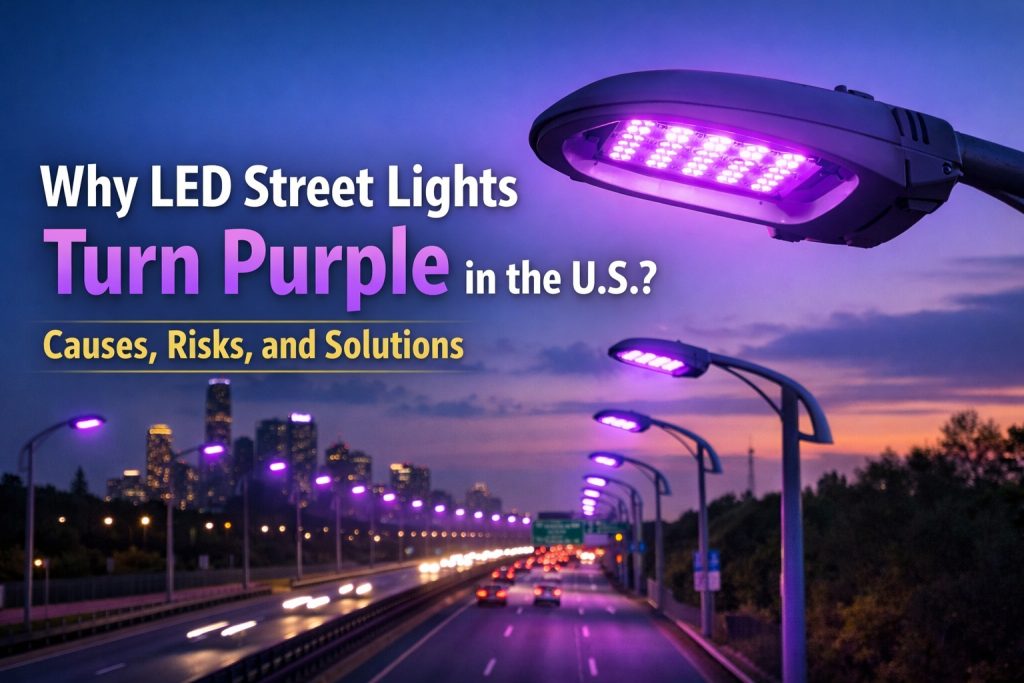
In Florida on highways and in California in the neighborhoods, this bizarre change in color has cast doubt on the safety, the quality of the product, and its long-term durability. In this paper we discuss the underlying causes, geographical distribution, risks and remedies of faulty LED streetlights turning purple.
The Increasing Purple Streetlights in the United States.
The purple LED streetlights problem was initially noticed in or around 2021 and has since expanded to over 30 states in the United States of America, and even portions of Canada and Europe. Whole sets of streetlights have been affected, frequently in the same city or highway system.
It is not an intentional lighting design or smart-city technology, but a product defect associated with a particular set of batches of LED fixtures produced between 2017 and 2019.
Municipalities and utility companies have confirmed that it is replacing these lights under warranty programs, but the magnitude of the issue has made it a sluggish and expensive endeavor.
The functionality of LED Street Lights.
To explain the reason why streetlights appear purple, one should be aware of the manner in which LED lighting technology works.
The majority of the white LED street lights are not white. Instead, they use:
- The main source of light is a blue LED chip.
- Phosphor coating layer which changes blue light into white light.
Such a combination creates the bright, energy saving white light that is widespread in the present day street lighting systems.
Real Cause: Failure in Phosphor Layer.
The loss of phosphor coating is the main cause that makes LED streetlights purple.
Once this layer is degraded, cracked or peeled off (a process called delamination) the blue light beneath it is no longer converted properly. Consequently, the light emitted is blue, violet, or purple rather than white .
The problem is connected with in most situations:
- Manufacturing defects
- Poor material quality
- Layers are weakly held together.
- Inconsistent production processes
This is why complete batches of streetlights in particular areas go down at the same time.
Factors that contributed to the failure.
Although the root cause is manufacturing defects, a number of environmental and operational factors can enhance the issue:
1.Heat and Thermal Stress.
LED streetlights do not go out and produce heat. Overheating may satirize the phosphor coating and trigger its peeling off as time passes.
2.Weather and Exposure to the Environment.
Outdoor lighting systems are subjected to:
- UV radiation
- Humidity
- Temperature fluctuations
These will accelerate material degradation beyond the anticipated level particularly when the quality of products is poor.
3.Vibration and Mechanical Stress.
Internal components may become gradually loose due to traffic vibrations and structural movement, which may cause coating failure.
4.Aging and Material Degradation.
Even the well-produced LEDs may wear over time. Nevertheless, failure that occurs prematurely is a sign of quality control and not aging.
The reason why Purple Streetlights are a Concern.
On the surface, purple streetlights might appear harmless, or even aesthetically pleasing, however, there are a number of real-life issues with it.
Less Visibility and Safety Factors.
Light spectra of purple and blue can be reduced:
- Color recognition
- Depth perception
- Clarity to the drivers and pedestrians.
This may have an adverse effect on road safety particularly in busy roads.
Lack of Conformity to Lighting Standards.
The lighting in the streets should be of high quality in terms of brightness and color temperature. The faulty lights are not within these specifications, which may cause regulatory and legal problems.
Increased Maintenance Costs
Cities must:
- Identify faulty fixtures
- Substitute or service units.
- Manage warranty claims
This poses great financial and operational strains.
Geographic Impact: Clusters Why and How.
A conspicuous trend is that purple streetlights tend to be found in groups and not in one instance.
This is due to the fact that municipalities usually buy lighting systems in large quantities at the hands of one manufacturer. When a faulty batch is installed in an area, the failures will be experienced in the same area at once.
That is why there are streets and streets covered in purple overnight.
Response and Replacement Efforts in the Industry.
Manufacturers and utilities have known of the problem and have acted to resolve it:
- Warranty-based replacement programs
- Better quality control guidelines.
- Improved testing (LM-80 testing of LED reliability)
Other manufacturers have admitted the defect publicly and have assured that later product lines would not use the defective components any more.
Purple LED Failures Prevention.
To municipalities, contractors, and lighting purchasers, this problem can be avoided by quality assurance and the correct choice of products.
Key Best Practices:
1.Select LED Manufacturers of High-Quality.
Collaborate with trusted suppliers that have rigorous testing procedures and they present proven performance reports.
2.Check LM-80 and TM-21 Test.
Make sure that LEDs have gone through long-run lumen maintenance and color stability.
3.Take Durable Phosphor Materials.
Phosphor coatings that are more adhesive and better thermal resistant may also greatly decrease failure rates.
4.Conduct Regular Inspections
Regular service prevents the occurrence of color shifts before it becomes widespread.
5.Have Proper Thermal Control.
The fixtures of high quality are expected to have efficient designs of heat dissipation.
Is the Problem Fading Away?
The good thing is that the problem is already deteriorating. With the replacement of defective units and the quality of production being enhanced, the number of purple streetlights is therefore likely to decline.
Nevertheless, due to millions of LED fixtures installed during the world adoption of the energy-efficient lighting process, it is possible that replacement programs will last several years.
Final Thoughts
The reason behind the phenomenon of LED streetlights going purple in the U.S. is not a secret or a design decision, it is a technical glitch based on the degradation of phosphor coating and defective manufacturing.
Although the concern on safety and reliability has been raised, the problem has also propelled the lighting industry to superior standards, enhanced materials, and quality control.
To the cities and businesses who invest in LED infrastructure, the lesson is simple: not every LED is created equal. To guarantee a long-term performance and the safety of the population, it is necessary to choose high-quality products and provide their proper testing.

- 10 Meters Lamp Post
- 10 Meters Pole
- 1000w Led Projector
- 100W LED Tunnel Light
- 12 Meters Lamp Post
- 12 Meters Pole
- 1200w Led Projector
- 15 Light Pole
- 1500w Led Projector
- 150W LED Tunnel Light
- 1800w Led Projector
- 2 In 1 Solar Flood Light
- 200w Led Tunnel Light
- 50w Led Tunnel Light
- 6 Meters Lamp Post
- 6 Meters Pole
- 8 Meters Lamp Post
- 8 Meters Pole
- 800w Led Projector
- 80w Led Tunnel Light
- Colourful Decorative Light
- Conical post
- Courtyard Lamp
- courtyard light
- courtyard lighting fixture
- Decorative Landscape Light
- Decorative road Light
- Flood Light For Courtyard
- Flood Light for Garden
- Flood Light For Outdoor
- Foot Led High Bay Lights
- high bay led lights 100w
- industrial lampshade
- industrial LED shed lights
- industrial magnifying glass with light
- Integrated Solar Flood Light
- led courtyard lamp
- led courtyard light
- led high bay light 100w
- LED Projector For Stadium
- Led UFO High Bay 150W 5000k
- Lighting Plants Mining Price
- Maintenance Free LED Street Light
- Pic Controlling Tunnel Light
- PLC controlling tunnel light
- Post Top Garden Light
- RGB Landscape Light
- Rgbw Decorative Light
- Smart Tunnel Light
- solar courtyard lamp
- solar courtyard light
- Solar LED Road Light
- Solar Street Light For 10 Meter Pole
- Solar Street Light For 12 Meter Pole
- Solar Street Light For 6 Meter Pole
- Solar Street Light For 8 Meter Pole
- Split Type Solar Flood Light
- Sporting Projector
- Stadium Led Projector
- Street Lighting Post
