
 Request A Quote

How Does a Street Light Work?
 FACEBOOK
 TWITTER
 LINKEDIN
Lighting in the streets is critical to the contemporary infrastructure, as it provides security, visibility, and safety to roads, social areas, and communities. But have you ever wondered how street lights automatically switch on at night and switch off in the daytime?
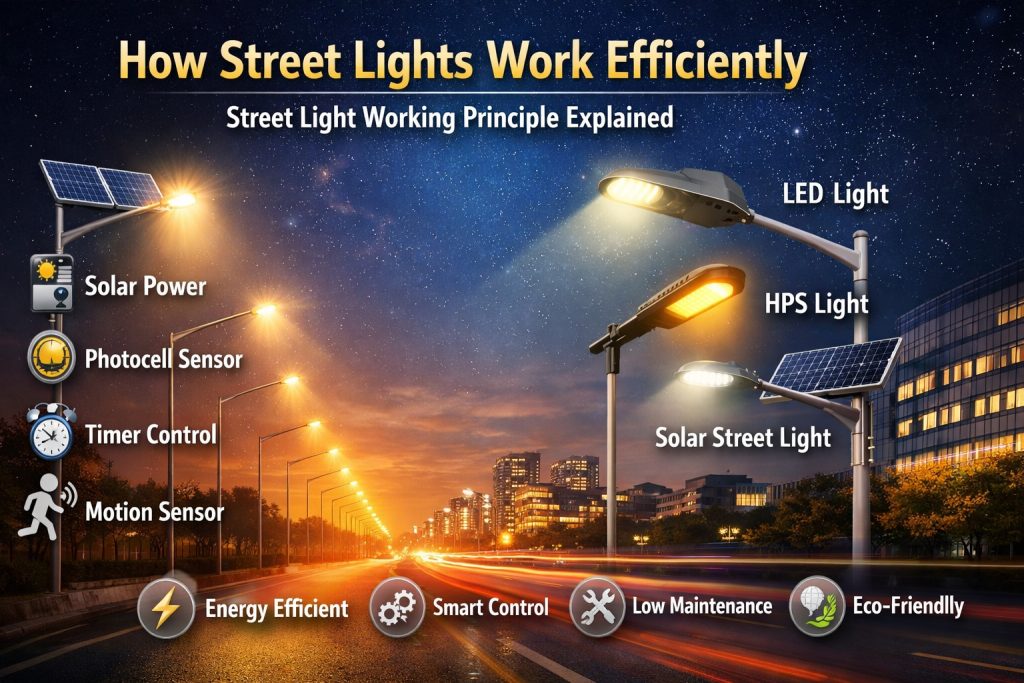
In this all-purpose guide, we will discuss the principle of operation of street lights, their major components, the various types and the latest energy efficient technology.
What Is the Working Principle of a Street Light?
The principle of a street light is simple to work out: it illuminates when the natural light is low and turns off when it becomes day time. Sensors, timers, or intelligent control are typically automated to carry out this process.
As night sets in, the system switches the electrical circuit on and the power gets into the lamp. The circuit is cut off during the day, and the light is switched off.
Such automation makes it economical in terms of energy usage and no longer requires manual control.
The Essentials of a Street Light System.
A street lighting system is a set of several important components in cooperation with each other:
- Power Source
The street lights are either run on the electrical system or renewable power sources such as solar panels.
- Light Source (Lamp)
Common types include:
- LED lights (most energy efficient)
- High pressure sodium (HPS) lamps.
- Metal halide lamps
The reason why LED technology has been highly favored is because of its longevity and low energy consumption.
- Control System
This includes:
- Photocells (light sensors)
- Timers
- Motion sensors
These parts control the light on and off time.
- Pole and Housing
The pole helps to bear the lighting item and to prevent the internal wiring to be damaged by the environmental factors.
- Electric Wiring and Ballast.
All components are connected by wiring and the current supplied to lamp is regulated by the ballast.
How do Street Lights go on automatically?
The contemporary lights of the streets employ photocell sensors to sense the quantity of light around.
Photocell (Light Sensor) Theory:
- Daytime: The sensor picks up the sun and maintains the circuit open (light off).
- Night: When the light is decreased, the resistance increases and the circuit is closed with the light on.
- Morning: Light breaks the circuit turning the light off once more.
This system will make sure that the street lights turn on when required which will save on energy levels.
Street Lighting Systems Timer-Based.
There are timers that control some of the street lights that have preset schedules.
How it works:
- Lights are made on at a certain time (e.g. 6:00 PM).
- The lights are switched off at a specific time (e.g. 6:00 AM).
Simple systems are less efficient due to the fact that they are not regulated to seasonal daylight.
Motion Sensor Street Lights.
Motion sensor street lights will save on energy usage as they will only be used when someone is passing.
Working mechanism:
1.When there is no movement, the light is either dim or off.
2.Sensor picks up motion through infrared or microwave.
3.Light brightens instantly
4.Delayed dim/off returns.
Benefits:
- Reduced energy consumption
- Prolonged usage of illumination elements.
- Improved security in poorly frequented places.
Principle of Solar Street Light Working.
The use of solar street lights is becoming very popular based on their sustainability and affordability.
Key Components:
- Solar panels
- Rechargeable batteries
- LED light source
- Smart controller
The principle of Solar Street Lights:
- Daytime: Solar panels receive the sunlight and transform it into electricity which is stored in batteries.
- Night: The controller identifies darkness and activates the LED with the help of stored energy.
Advantages:
- No electricity bills
- Environmentally friendly
- Superset to fit remote or off-grid locations.
- Low maintenance
Street Lights.
The street lights have greatly developed. The following are the key types:
1.LED Street Lights
- Energy-efficient
- Extended life span (up to 100,000 hours)
- Low maintenance
2.High-Pressure Sodium (HPS) Lights.
- High efficiency
- Yellow-orange light
- Routine in older systems.
3.Metal Halide Lights
- Bright white light
- Inefficient as compared to LEDs.
4.Solar Street Lights
- Renewable energy.
- Self-sufficient of electrical grid.
State of the Art Smart Street Lighting Systems.
Smart street lighting systems are being implemented in modern cities with a combination of IoT (Internet of Things).
Features include:
- Remote monitoring and control.
- Automatic fault detection
- Traffic-driven adaptive brightness.
- Wireless communication systems
These innovations enhance efficiency in operations and maintenance costs are lowered.
Light Problems and Solutions of Common Street.
Street lights may fail even though they are reliable.
1.The issue is that the street light is not turning on.
Causes:
- Faulty sensor
- Power supply issues
- Damaged wiring
Solution:
- Replace sensor
- Check electrical connections
2.Flickering Lights
Causes:
- Loose wiring
- Aging bulbs
- Voltage fluctuations
Solution:
- Tighten connections
- Replace defective components
3.Lights that remain on during the day.
Causes:
- Faulty photocell
- Incorrect timer settings
Solution:
- Fix or change sensor.
- Adjust timer configuration
The Importance of Street Lights.
The street lighting is necessary in:
- Accident prevention and road safety.
- Reduction of crimes and enhanced security.
- Improved pedestrian and driver visibility.
- Favoring night economic and social activities.
Correct lighting infrastructure is a major spur of smart city development.
The Future of Street Lighting.
The next generation of street lighting has been hyped on energy efficiency and intelligent automation.
Emerging trends:
- AI-powered lighting systems
- Solar-powered smart poles
- Connection with smart city networks.
- Weather and traffic adaptive lighting.
With the current development of technology, the street lights will become smarter, sustainable, and affordable.
Conclusion
The principle of operation of street lights is based on the rule of automatic control, effective source of light, and stable power supply. Street lighting has greatly developed in terms of the old timer-based systems to the new sophisticated smart and solar-powered systems.
Knowing the mechanics behind street lights makes them important to not only know how it works but also to select the appropriate lighting system in an urban and rural setting.
With the further modernization of cities, smart and energy-efficient street lighting will be an important component of sustainable infrastructure.


- 10 Meters Lamp Post
- 10 Meters Pole
- 1000w Led Projector
- 100W LED Tunnel Light
- 12 Meters Lamp Post
- 12 Meters Pole
- 1200w Led Projector
- 15 Light Pole
- 1500w Led Projector
- 150W LED Tunnel Light
- 1800w Led Projector
- 2 In 1 Solar Flood Light
- 200w Led Tunnel Light
- 50w Led Tunnel Light
- 6 Meters Lamp Post
- 6 Meters Pole
- 8 Meters Lamp Post
- 8 Meters Pole
- 800w Led Projector
- 80w Led Tunnel Light
- Colourful Decorative Light
- Conical post
- Courtyard Lamp
- courtyard light
- courtyard lighting fixture
- Decorative Landscape Light
- Decorative road Light
- Flood Light For Courtyard
- Flood Light for Garden
- Flood Light For Outdoor
- Foot Led High Bay Lights
- high bay led lights 100w
- industrial lampshade
- industrial LED shed lights
- industrial magnifying glass with light
- Integrated Solar Flood Light
- led courtyard lamp
- led courtyard light
- led high bay light 100w
- LED Projector For Stadium
- Led UFO High Bay 150W 5000k
- Lighting Plants Mining Price
- Maintenance Free LED Street Light
- Pic Controlling Tunnel Light
- PLC controlling tunnel light
- Post Top Garden Light
- RGB Landscape Light
- Rgbw Decorative Light
- Smart Tunnel Light
- solar courtyard lamp
- solar courtyard light
- Solar LED Road Light
- Solar Street Light For 10 Meter Pole
- Solar Street Light For 12 Meter Pole
- Solar Street Light For 6 Meter Pole
- Solar Street Light For 8 Meter Pole
- Split Type Solar Flood Light
- Sporting Projector
- Stadium Led Projector
- Street Lighting Post
