
 Request A Quote

do street lights have sensors
 FACEBOOK
 TWITTER
 LINKEDIN
The lighting in the streets is well developed past basic manual switches or timers. Modern cities today use sophisticated street light sensors to automatically regulate the outdoor lighting in order to increase energy efficiency and low costs as well as increasing the safety of people.
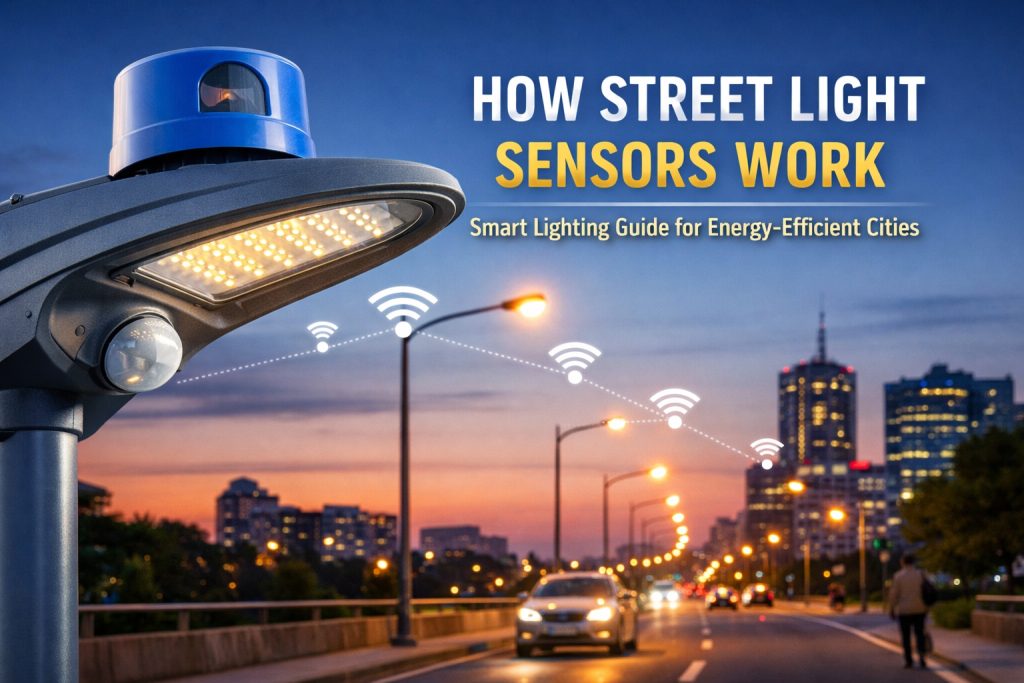
However, what are street light sensors? We will dissect the technology behind them, discuss the various types of sensors and why they are so necessary in smart city infrastructure in this guide.
Street Light Sensors? What Are They?
Street light sensors are smart gadgets that regulate automatically when a street light is switched on, off or the brightness. These sensors are not programmed to run on a fixed schedule, but they react to the real-time changes in the environment like:
- Light levels in the room.
- Movement (moving cars or people)
- Time of the day.
- Weather conditions (in developed systems)
Their main aim is a very basic one, which is to give out light when and where required cutting down unnecessary energy use.
Street lights used to be regulated by timers traditionally which could be quite ineffective. An example is that lights may be turned on too soon on a cloudy day or they may be left on longer than needed. The sensor-based systems overcomes these problems as they respond dynamically to the real situation.
Principles of Street Light Sensors.
The most common type of street lighting systems contains a light-detecting sensor at the core, also referred to as a photocell. This sensor keeps on monitoring the quantity of natural light present in the surroundings.
This is the way it works:
- The sensor checks the intensity of ambient light.
- When the daylight becomes lower than a preset level (at dusk), the sensor activates the light to be on.
- As the sunlight rises once again (at dawn), the sensor turns the light off.
It is an automatic process that is done without any human intervention.
A photosensitive material is the most important part within the sensor, it alters its electrical properties based on the exposure to light. As light falls upon the material, the electrical resistance to it decreases; when it gets dark, the resistance to it increases.
An electronic circuit detects this change and therefore turns on or off the lighting system.
There are several types of Street Light Sensors.
There are various kinds of sensors employed in the current modern street lighting systems based on the use. The most common ones are as follows:
1.Photocell Sensors (Light Sensors)
The most popular sensor of street light is the photocell sensor. They identify the amount of light present in the environment and regulate the lighting on-off feature of streetlights.
- Turn on lights during the evening.
- Switch off lights early in the morning.
- Minimal maintenance is required.
- Very dependable and affordable.
These sensors are like automatic switches which will ensure that the lighting is not on most of the time.
Due to their simplicity and durability, photocells are usually integrated into LED street lights and outdoor lights systems.
- Motion Sensors
Motion sensors goes a notch higher in that street lighting is equipped with sensors that detect any movement within its vicinity.
They operate by determining:
- Passing vehicles
- Pedestrian activity
- Motion patterns close to one another.
Upon detection of movement, the light either becomes on or brighter. In the absence of activity, the light becomes dim or it is turned off.
This kind of sensor finds particular application in:
- Residential streets
- Parking areas
- Greenways and streets.
Motion sensors help to save a lot of energy by lighting only active places and they do not compromise on safety.
- Intelligent Sensors (IoT-Based Systems).
Smart street lighting systems incorporate several sensors with networking and centralized control capabilities like wireless networks and centralized control platforms.
These systems have the ability to:
- Automatic brightness depending on the traffic.
- Reaction to weather conditions.
- Be able to be monitored and controlled remotely.
- Gather information about urban planning.
Smart sensors have been used to form a vital part of smart city projects where municipalities have been able to streamline the performance of lights in the whole area.
Elements of a Street Light Sensor System.
A typical street lighting system consists of some of the main components:
- Sensor Unit
Senses changes in the environment (light, movement, etc.)
- Control Circuit
Analyses sensor data and results in on/off of lights.
- Source of Light (Typically LED)
Offers the light that is efficient and has a long lifespan.
- Power Supply
Introduces power into the system.
- Smart Systems Only: Communication Module.
Remote monitoring and control are possible.
The combination of these elements forms an all-automated lighting system.
The advantages of Street Light Sensors.
- Energy Efficiency
The use of street light sensors has greatly minimized the electricity usage by making sure that lights are only turned on when it is necessary. An example is that lights are dimmed during low traffic time or they are completely off during the day.
This will create great power conservation in cities and municipalities.
- Cost Reduction
Less energy consumption also equates to less operational expenses. Additionally:
- Lights will have a longer lifespan because of minimal usage.
- There is a reduction in maintenance expenses.
- Elimination of manual monitoring is minimized.
Sensor-based systems are highly rewarding in the long-run.
- Better Citizen Security.
Road safety and prevention of crimes requires proper lighting. Street lights have sensors so that during the time that people are around the lights are turned on.
Specifically motion-based systems make road operations safer by making it brighter when the activity is sensed.
- Environmental Sustainability
Street light sensors reduce carbon emission and environmental impact by using less energy.
Smart lighting systems help make cities more sustainable and green since they enable optimum use of resources.
Timer-Based Systems vs. Street Light Sensors.
Property Sensor-based Lighting timer-based Lighting.
- Accuracy High (real-time response) Low (fixed schedule)
- Energy Efficiency Optimized Often wasteful.
- Adaptability Adaptable to environment Unadaptable.
- Maintenance Reduced Increased.
Although this use of timers was the norm in the past, the majority of modern systems have been developed to use sensors-based solutions, which are flexible and efficient.
Uses of Street Light Sensors.
Street light sensors are employed in a large spectrum of places such as:
- Roads and highways in the city.
- Residential neighborhoods
- Industrial zones
- Parking lots
- Parks and open spaces.
They are also finding application in solar powered street lights systems where there is a pressing need to ensure proper use of energy.
The Future of Intelligent Street Lighting.
The future of street lighting is smart connected and data-driven systems.
There are emerging trends such as:
- Optimization of lighting with the help of AI.
- Interconnection with traffic management systems.
- Online control and predictive maintenance.
- Human behavior based adaptive lighting.
With the cities ever-expanding, street lights that are smart will contribute significantly to creating safer and more efficient cities.
Conclusion
The modern outdoor lighting systems are based on street light sensors. They make the use of energy more efficient and cost-effective and increase safety through the automatic reaction to environmental conditions.
These technologies have changed the way cities handle their infrastructure starting with simple photocell sensors to high-tech smart lighting networks.
With the urban centers still implementing smart solutions, street light sensors will still be among the critical elements in the development of sustainable and smart cities.


- 10 Meters Lamp Post
- 10 Meters Pole
- 1000w Led Projector
- 100W LED Tunnel Light
- 12 Meters Lamp Post
- 12 Meters Pole
- 1200w Led Projector
- 15 Light Pole
- 1500w Led Projector
- 150W LED Tunnel Light
- 1800w Led Projector
- 2 In 1 Solar Flood Light
- 200w Led Tunnel Light
- 50w Led Tunnel Light
- 6 Meters Lamp Post
- 6 Meters Pole
- 8 Meters Lamp Post
- 8 Meters Pole
- 800w Led Projector
- 80w Led Tunnel Light
- Colourful Decorative Light
- Conical post
- Courtyard Lamp
- courtyard light
- courtyard lighting fixture
- Decorative Landscape Light
- Decorative road Light
- Flood Light For Courtyard
- Flood Light for Garden
- Flood Light For Outdoor
- Foot Led High Bay Lights
- high bay led lights 100w
- industrial lampshade
- industrial LED shed lights
- industrial magnifying glass with light
- Integrated Solar Flood Light
- led courtyard lamp
- led courtyard light
- led high bay light 100w
- LED Projector For Stadium
- Led UFO High Bay 150W 5000k
- Lighting Plants Mining Price
- Maintenance Free LED Street Light
- Pic Controlling Tunnel Light
- PLC controlling tunnel light
- Post Top Garden Light
- RGB Landscape Light
- Rgbw Decorative Light
- Smart Tunnel Light
- solar courtyard lamp
- solar courtyard light
- Solar LED Road Light
- Solar Street Light For 10 Meter Pole
- Solar Street Light For 12 Meter Pole
- Solar Street Light For 6 Meter Pole
- Solar Street Light For 8 Meter Pole
- Split Type Solar Flood Light
- Sporting Projector
- Stadium Led Projector
- Street Lighting Post
