
 Request A Quote

how much does a street light cost?
 FACEBOOK
 TWITTER
 LINKEDIN
The importance of street lighting in urban infrastructure is that it improves road safety, increases visual perception, and allows the economy to continue after the sun sets. The question that most people ask, whether you are a municipal planner, contractor, or commercial buyer is; how much does a street light cost?
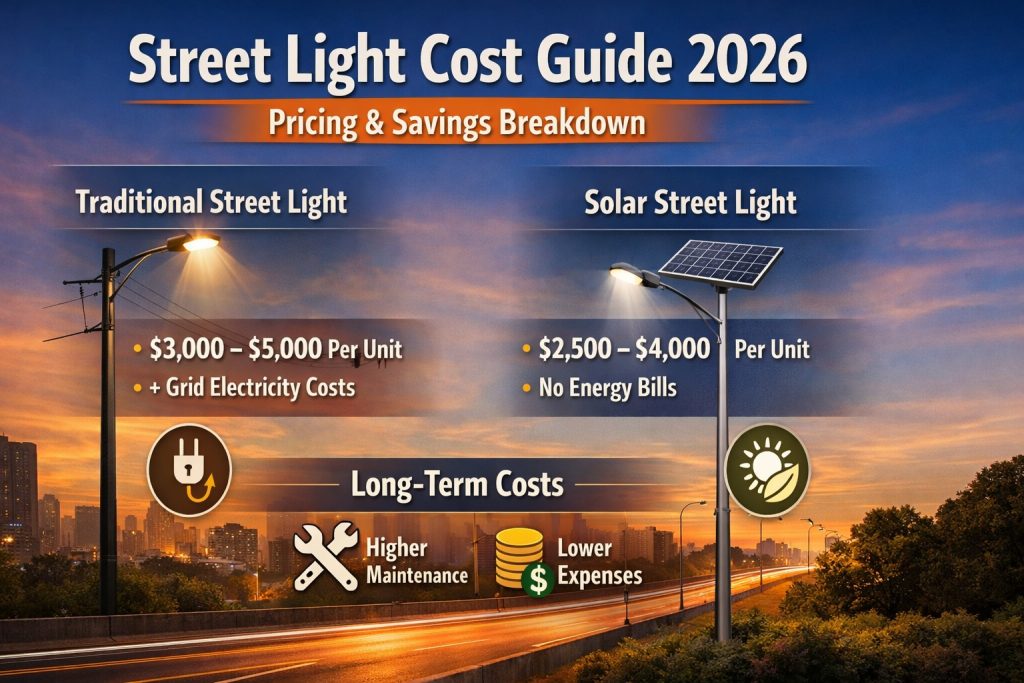
It will depend on a number of factors such as the nature of lighting technology, installation need, and operating costs in the long term. We simplify the costs of street lights in 2026 in this guide, so that you can know how to optimize your investment, the components, and the cost.
Average Street Light Cost in 2026
The street light prices are different according to the technology. General comparison of ordinary types of lighting is shown below:
- High-Pressure Sodium (HPS): $80 – $200
- Metal Halide: $120 – $300
- LED Street Lights: $120 – $500
- Solar LED Street Lights: $300 – $1,000+
Although conventional lighting solutions might be cheaper at the initial stage, LED street lights prevail in the contemporary projects because of their energy-saving and continued existence.
Actually, LED systems have a life span of up to 50,000-80,000 hours and therefore, maintenance and replacement costs are minimized in the long run.
The overall price to get a street light installed.
A budget of a street lighting should also consider more than the price of a light. The total installed price per street lighting is usually between:
👉 700-3500 per unit based on the complexity of the project.
Key Cost Components:
- LED Fixture: $120 – $520
- Pole & Mounting Hardware: $400 – $1,600
- Installation Labor: $600 – $3,000
- Electrical Wiring and Material $150-800.
- Permits & Fees: $100 – $1,200
The cost of the light is less than the cost of installation since labor, trenching and electrical work are usually higher.
What Are the Considerations that Impact the Cost of Street Lights?
By being aware of the major cost drivers, you will be in a position to make better buying decisions.
- Wattage and Brightness
Available street lights come in various wattages based on the use:
- 30W–60W: Residential streets
- 60W–100W: Urban roads
- 100W-200W or more: Highways and industrial.
The greater the wattage the greater the brightness- however the higher the cost since more material and energy is needed.
- Pole Height and Material
One of the most costly components is the light poles in the streets.
- They include steel and aluminum poles.
- Tall poles need more materials and stronger foundations.
The average prices are between 200 and 1000 and above per pole depending on the height and design.
- Installation Complexity
The cost of installation depends on:
- Terrain (urban vs rural)
- Requirements of underground wiring.
- Accessibility of the site
When it comes to big projects, labor will cost between $400 and 2500 per light alone.
- Smart Controls and Sensors
The current street lights are now usually fitted with:
- Motion sensors
- Dimming controls
- Remote monitoring systems
These are energy-saving features that may make the price of the unit increase by five to six hundred dollars.
- Solar vs. Grid-Powered Systems.
Solar street lights have high initial expenses because they:
- Solar panels
- Batteries
- Controllers
But they do not require electricity and minimise long-term operation expenses, and that makes them the best in remote or off-grid locations.
Operation and Maintenance expenses.
The actual cost of a street light does not necessarily mean the initial purchase price but it is the overall cost of ownership (TCO).
Energy Costs
- Conventional lights: More energy usage.
- LED bulbs: 50-80 percent reduced energy consumption.
For example:
- The cost of LED street lights per annum energy: ~52.
- Conventional lighting: approx. 130 dollars/year.
Maintenance Costs
- Traditional lights: $100–$200 per year
- LED lights: $20–$50 per year
LED technology lowers the cost of maintaining because it takes a long time and there are a few changes.
Competition between LED and Traditional Street Lights: Cost Comparison.
Characteristic LED Street Lights Traditional Lights.
- Initial Cost Medium Low
- Energy Consumption Low High
- Lifespan 50,000–100,000 hours ~20,000 hours
- Maintenance Cost Low High
- Total Long-Term Cost Minimum Maximum.
Though LEDs cost more to invest in at the initial stages, they provide high savings in the long term, so they are more accepted by the majority of contemporary projects.
How to save on light costs in the streets.
When you have a plan of street lighting, the following are sure ways of streamlining the costs:
- Choose the Right Wattage
Avoid over-lighting. Choose wattage depending on road and real needs.
- Use LED Technology
LEDs offer the most suitable combination of performance, efficiency, and life.
- Optimize Pole Placement
Proper spacing creates less requirement of fixtures.
- Take into consideration Smart Lighting Systems.
Dimming and sensors can be automated to greatly save on energy usage.
- Plan for Long-Term ROI
Avoid attention to initial price and concentrate on lifecycle cost.
Final Thoughts
And then how expensive is a street light?
- Basic fixture: $120 – $500
- Fully installed system: $700 – $3,500+
- Solar systems: $300 – $1,000+ per unit
The overall cost will be based on your project size, lighting needs and technology decisions.
The LED street lights are the most appropriate when it comes to the best value in terms of energy efficiency, durability, and low maintenance costs.
- 10 Meters Lamp Post
- 10 Meters Pole
- 1000w Led Projector
- 100W LED Tunnel Light
- 12 Meters Lamp Post
- 12 Meters Pole
- 1200w Led Projector
- 15 Light Pole
- 1500w Led Projector
- 150W LED Tunnel Light
- 1800w Led Projector
- 2 In 1 Solar Flood Light
- 200w Led Tunnel Light
- 50w Led Tunnel Light
- 6 Meters Lamp Post
- 6 Meters Pole
- 8 Meters Lamp Post
- 8 Meters Pole
- 800w Led Projector
- 80w Led Tunnel Light
- Colourful Decorative Light
- Conical post
- Courtyard Lamp
- courtyard light
- courtyard lighting fixture
- Decorative Landscape Light
- Decorative road Light
- Flood Light For Courtyard
- Flood Light for Garden
- Flood Light For Outdoor
- Foot Led High Bay Lights
- high bay led lights 100w
- industrial lampshade
- industrial LED shed lights
- industrial magnifying glass with light
- Integrated Solar Flood Light
- led courtyard lamp
- led courtyard light
- led high bay light 100w
- LED Projector For Stadium
- Led UFO High Bay 150W 5000k
- Lighting Plants Mining Price
- Maintenance Free LED Street Light
- Pic Controlling Tunnel Light
- PLC controlling tunnel light
- Post Top Garden Light
- RGB Landscape Light
- Rgbw Decorative Light
- Smart Tunnel Light
- solar courtyard lamp
- solar courtyard light
- Solar LED Road Light
- Solar Street Light For 10 Meter Pole
- Solar Street Light For 12 Meter Pole
- Solar Street Light For 6 Meter Pole
- Solar Street Light For 8 Meter Pole
- Split Type Solar Flood Light
- Sporting Projector
- Stadium Led Projector
- Street Lighting Post
