
 Request A Quote

Exterior Outdoor LED Lights for Commercial Sites
 FACEBOOK
 TWITTER
 LINKEDIN
Exterior outdoor LED lights should be selected as a coordinated site system, not as unrelated fixtures bought zone by zone. Roads, pedestrian entrances, loading areas, facades and boundaries all need different optical distributions and maintained illuminance. A dependable commercial design starts with a scaled plan, assigns a visual task to each area and verifies the final Dawn Lighting fixture files in DIALux before quantities and mounting points are fixed.
Use road or area luminaires for vehicle routes, shielded floodlights for loading and perimeter tasks, and landscape fixtures for pedestrian zones. Set maintained lux, uniformity, glare, colour and control criteria for every zone. Then verify IP rating, thermal limits, surge coordination, wind load, corrosion protection, wiring and maintenance access as one engineering package.
Divide the Site by Visual Task
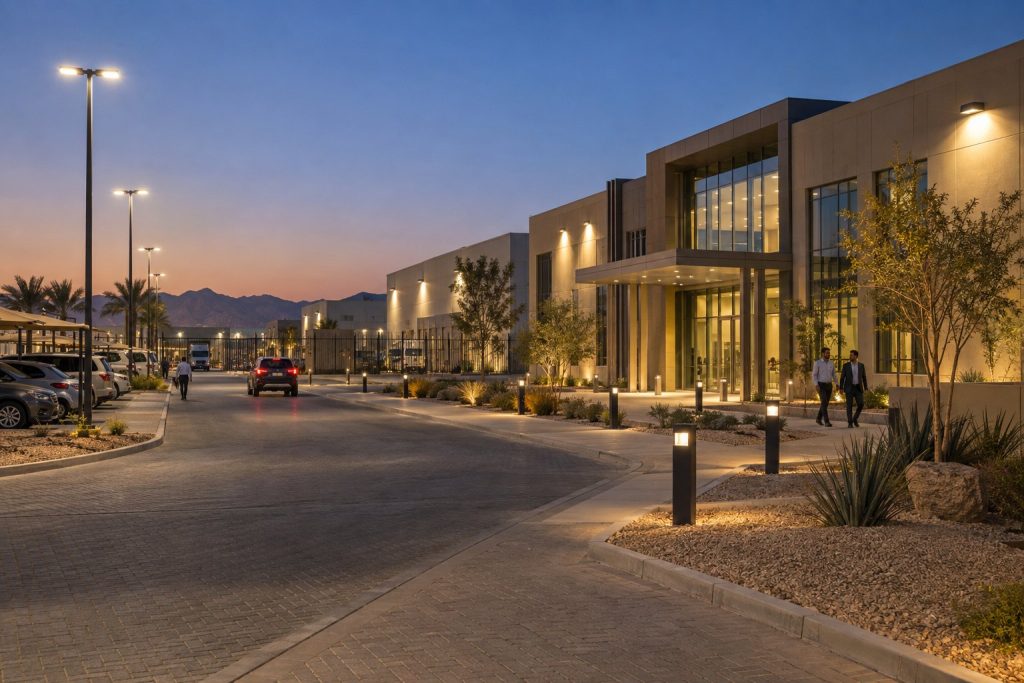
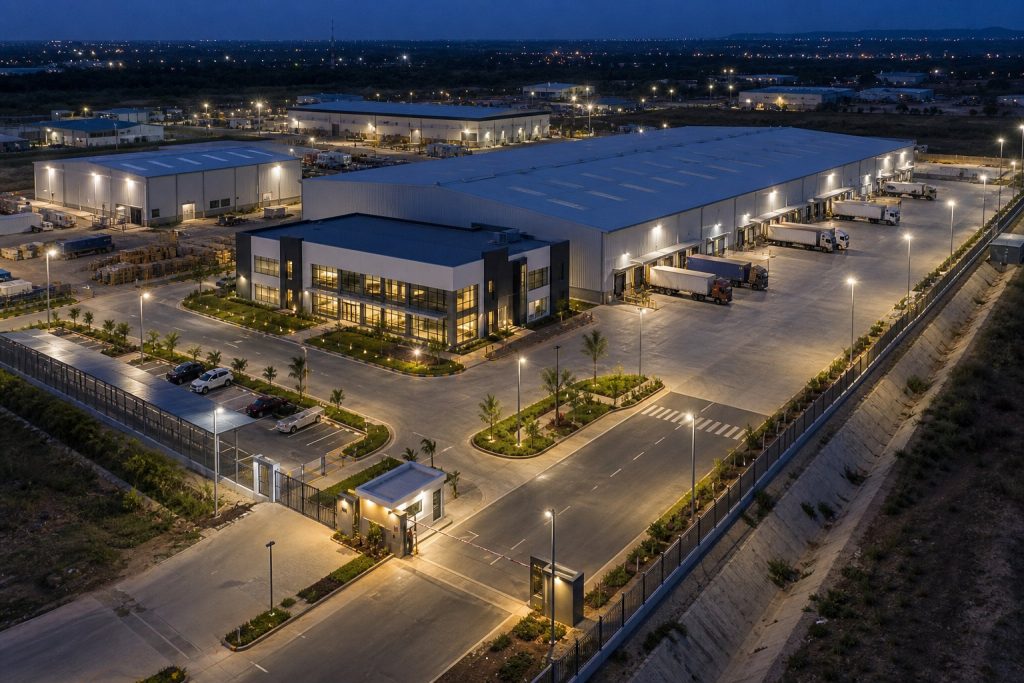
When discussing projects with contractors, I ask for the operating map before the fixture schedule. A delivery road used by articulated trucks is not the same task as a hotel entrance or security gate. The brief should identify traffic speed, pedestrian activity, CCTV viewpoints, property boundaries, operating hours and emergency routes.
| Site zone | Concept range | Suitable approach | Main design check |
| Internal roads | 10 to 30 lux | Road or asymmetric area luminaire | Uniformity, glare and pole spacing |
| Pedestrian entrances | 20 to 50 lux locally | Low-glare landscape and canopy lighting | Vertical light, faces and transitions |
| Loading and service yards | 30 to 50 lux | Pole or facade-mounted floodlights | Vehicle shadows and aiming |
| Perimeter and gate | 10 to 30 lux or security value | Controlled flood or area lighting | CCTV contrast and boundary spill |
These ranges support concept planning only. The client, authority, insurer and applicable standard must approve the final criteria.
Choose Distribution Before Wattage
Watts describe electrical input, not where light lands. A lower-wattage asymmetric optic can outperform a larger symmetrical floodlight on a road because less output is wasted behind the pole. Near a facade, a medium or wide distribution may produce a more even wash. At the boundary, shielding and low tilt often matter more than total lumens.
Request the IES or LDT file for the exact Dawn Lighting product and optic under consideration. Model actual pole height, outreach, fixture tilt, wall position, trees, canopies and parked vehicles. Apply a maintenance factor that reflects dust, cleaning frequency and lumen depreciation. Our project reviews treat maintained performance as the acceptance target, not the first-night reading.
Control Glare and Light Trespass
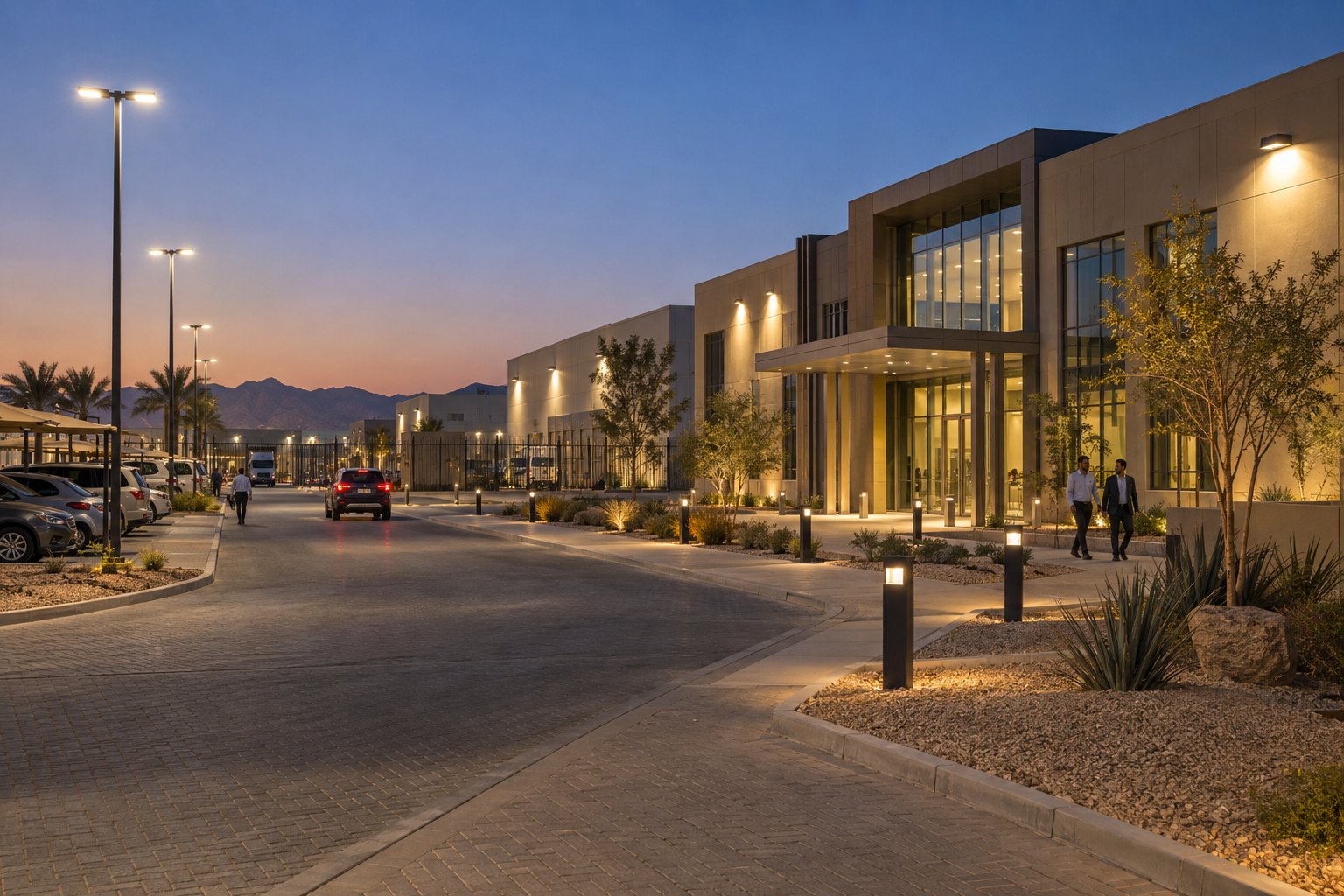
High-angle light can hide pedestrians behind a bright source and create nuisance spill outside the property. Check driver sightlines at bends and gates, views from offices or hotels, nearby roads and security-camera exposure. Keep floodlight tilt as low as practical. Louvres and visors change output and wind area, so they must appear in photometric and structural calculations.
Specify Heat Water Impact and Corrosion
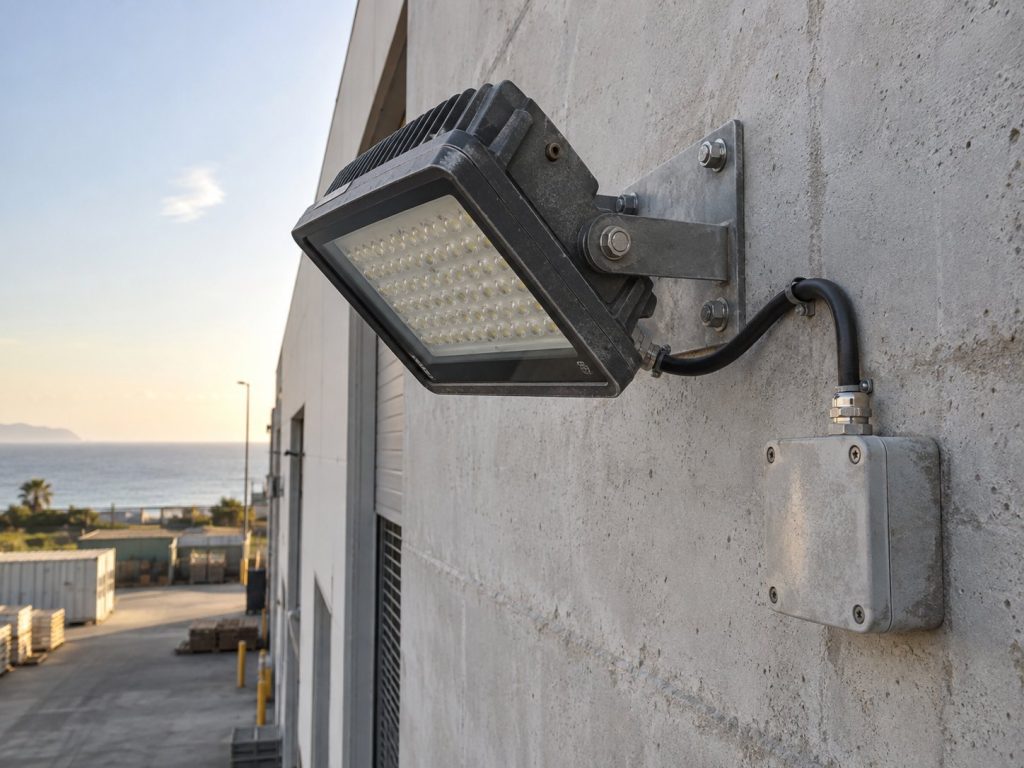
IP65 outdoor lights may suit controlled exposure, while IP66 is often the safer target for wind-driven rain, dust and washdown. The rating must apply to the delivered assembly, including cable entry and covers. IK08 is a useful reference where service vehicles, tools or vandalism create an impact risk, but the project assessment controls the final requirement.
High ambient temperatures reduce driver and LED life when the heat sink cannot reject heat. Ask for thermal limits in the approved mounting orientation and leave clearance around cooling surfaces. Coastal or industrial atmospheres also need a defined coating system, compatible fasteners, sealed connectors and isolation between dissimilar metals.
Coordinate Surge Protection and Earthing
A luminaire marked with a 10 kV or 20 kV surge value is only one part of the protection path. Distribution-board SPDs, conductor routing, pole bonding, earth resistance and lead length determine whether transient energy is discharged safely. Long outdoor feeders also need voltage-drop and fault-loop checks. Record insulation, continuity and earth measurements before handover.
Check Poles Brackets and Foundations
The structural engineer needs the mass and projected area of every luminaire, visor, camera, arm and bracket. Use the governing wind speed and terrain category, not a generic pole chart. Foundations must consider soil data, drainage, anchor templates and vehicle impact. Adding a camera or banner later changes wind demand and requires review.
Reduce Energy Without Creating Dark Zones
Energy efficient outdoor lighting comes from optical control, zoning and operating logic. Photocells prevent daytime operation; schedules and dimming can reduce output during low activity while keeping routes safe. Do not save energy by deleting fittings after the DIALux calculation. Recalculate every change and preserve the required minimum and uniformity.
Commercial Exterior Lighting Procurement Checklist
- Scaled site plan with roads, paths, buildings, loading zones, boundaries and CCTV locations
- Maintained lux, minimum lux, uniformity, glare, CRI and control requirements by zone
- DIALux model using exact Dawn Lighting photometric files and final mounting geometry
- IP, IK, thermal, surge, driver, dimming and service data for each fixture
- Pole, bracket and foundation calculations using final EPA, wind and soil inputs
- Cable routes, voltage drop, earthing, installation tests and maintenance access
Common Design Errors
The most expensive mistakes are coordination failures: one floodlight optic used across the site, poles inside truck swept paths, decorative fixtures expected to light vehicle routes, or drawings changed after the calculation. A proposal listing only watts and lumens without maintained lux, minimum values or optical codes is incomplete.
Frequently Asked Questions
What are the best exterior outdoor LED lights for a commercial site
There is no single best fixture. Use road or area lights for vehicle routes, controlled floodlights for work and security zones, and landscape fixtures for pedestrian areas.
Is IP65 enough for outdoor LED lighting
IP65 can suit controlled exposure. IP66 is often preferred for severe dust, wind-driven rain or washdown, but connectors and cable entries must also be protected.
How many lux are needed outside a commercial building
The value depends on the task. Concept ranges may run from about 10 lux at low-risk circulation areas to 50 lux or more at active loading or entrance points.
How can outdoor LED glare be reduced
Use suitable optics, lower tilt, sensible mounting height, shielding and a calculation from critical viewing directions.
Request a Project Lighting Review
For a commercial compound, send the site plan, zone descriptions, operating schedule, mounting limits, wind data, electrical supply and environmental exposure. Dawn Lighting can review a coordinated mix from its current road, flood and landscape lighting categories.
Send the site drawings and operating requirements through the Dawn Lighting official inquiry page. The engineering team can prepare a project-specific DIALux proposal and B2B quotation.
- 10 Meters Lamp Post
- 10 Meters Pole
- 1000w Led Projector
- 100W LED Tunnel Light
- 12 Meters Lamp Post
- 12 Meters Pole
- 1200w Led Projector
- 15 Light Pole
- 1500w Led Projector
- 150W LED Tunnel Light
- 1800w Led Projector
- 2 In 1 Solar Flood Light
- 200w Led Tunnel Light
- 50w Led Tunnel Light
- 6 Meters Lamp Post
- 6 Meters Pole
- 8 Meters Lamp Post
- 8 Meters Pole
- 800w Led Projector
- 80w Led Tunnel Light
- Colourful Decorative Light
- Conical post
- Courtyard Lamp
- courtyard light
- courtyard lighting fixture
- Decorative Landscape Light
- Decorative road Light
- Flood Light For Courtyard
- Flood Light for Garden
- Flood Light For Outdoor
- Foot Led High Bay Lights
- high bay led lights 100w
- industrial lampshade
- industrial LED shed lights
- industrial magnifying glass with light
- Integrated Solar Flood Light
- led courtyard lamp
- led courtyard light
- led high bay light 100w
- LED Projector For Stadium
- Led UFO High Bay 150W 5000k
- Lighting Plants Mining Price
- Maintenance Free LED Street Light
- Pic Controlling Tunnel Light
- PLC controlling tunnel light
- Post Top Garden Light
- RGB Landscape Light
- Rgbw Decorative Light
- Smart Tunnel Light
- solar courtyard lamp
- solar courtyard light
- Solar LED Road Light
- Solar Street Light For 10 Meter Pole
- Solar Street Light For 12 Meter Pole
- Solar Street Light For 6 Meter Pole
- Solar Street Light For 8 Meter Pole
- Split Type Solar Flood Light
- Sporting Projector
- Stadium Led Projector
- Street Lighting Post
