
 Request A Quote

Aluminum Lamp Pole vs Steel: Which Material Fits the Project?
 FACEBOOK
 TWITTER
 LINKEDIN
An aluminum lamp pole is often chosen for low mass, a clean metallic finish and good atmospheric corrosion resistance, while galvanized steel is valued for stiffness, fabrication flexibility and familiar structural practice. The better choice depends on wind loading, pole height, arm and luminaire EPA, fatigue exposure, coastal salts, foundation strategy, finish expectations, electrical bonding, logistics and maintenance capability.
| DIRECT ANSWER Choose aluminum where lower transport and erection mass, appearance and corrosion performance support the lifecycle case. Choose galvanized steel where stiffness, heavy attachments, custom fabrication or local familiarity dominate. In both cases, require a project-specific structural calculation and define the complete corrosion, isolation, earthing and foundation details. |
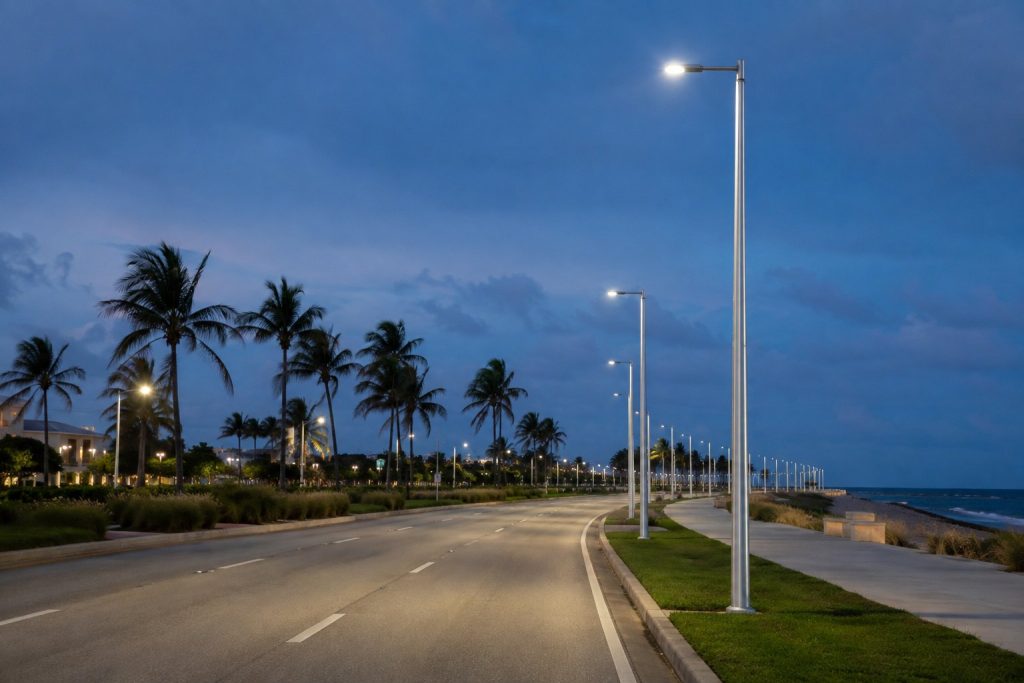
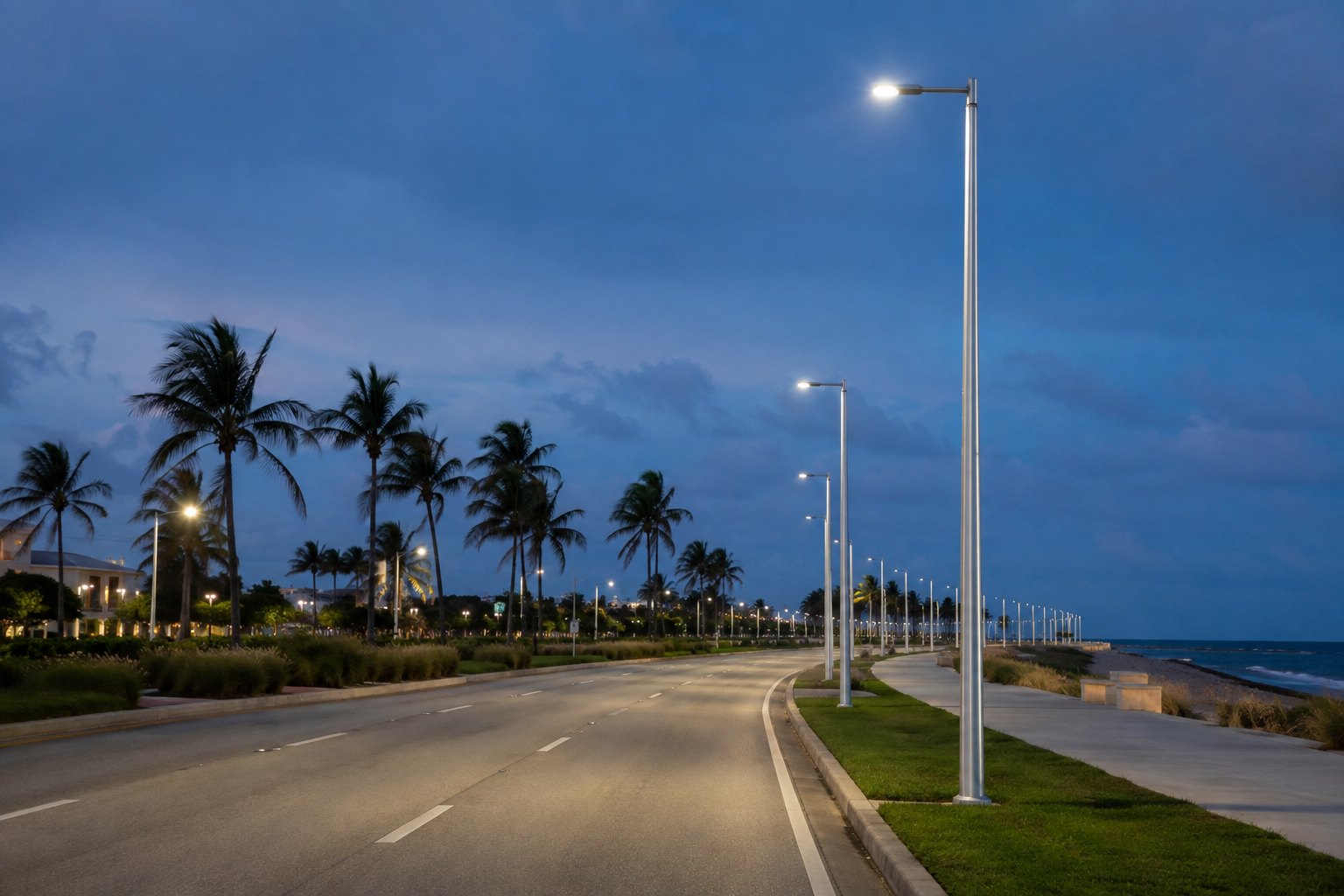
Coastal projects make material, finish, drainage and maintenance decisions more important than the nominal pole height.
What Changes When the Pole Material Changes
Two poles with the same height can behave differently. Aluminum has a lower elastic modulus than steel, so deflection and vibration may govern even when strength is adequate. Steel is stiffer but heavier and depends strongly on its galvanizing or paint system in aggressive environments. Our engineering team found that procurement comparisons become clearer when clients separate structural performance, corrosion behavior, installation logistics and appearance instead of asking which material is ‘best.’
| Criterion | Aluminum lamp pole | Galvanized steel pole | Procurement check |
| Mass | Lower for comparable concepts | Higher | Transport, crane and handling plan |
| Stiffness | Lower modulus; check deflection | Higher modulus | Tip deflection and vibration limits |
| Corrosion | Protective oxide; isolate dissimilar metals | Relies on zinc/paint system | Exposure class and repair method |
| Fabrication | Alloy and welding control are critical | Wide shape and attachment flexibility | Qualified procedures and inspection |
| Appearance | Natural satin or finished surface | Galvanized or painted | Color, gloss and weathering expectations |
| Electrical | Bonding detail required | Bonding detail required | Earth continuity and cable protection |
Aluminum Lamp Pole Design for Coastal and Humid Sites
Salt spray, humidity and airborne industrial contaminants can accelerate corrosion at joints, fasteners, base plates and damaged coatings. An aluminum shaft can be a strong option, but it is not maintenance-free. Specify the alloy and temper, surface finish, allowable weld process, drainage, isolation washers or sleeves where dissimilar metals meet, and compatible fasteners. Avoid details that hold salty water at the base or behind decorative collars.
For steel, define hot-dip galvanizing and any duplex paint system, including surface preparation, zinc thickness or governing standard, paint layers, repair of transport damage and treatment of internal surfaces. A generic ‘anti-corrosion’ note is too vague for a coastal tender. If a salt-spray test is requested, state the test method and acceptance criteria; test hours alone do not predict field life.
Wind, Deflection and Vibration
The structural model must include shaft taper, section thickness, openings, welds, bracket outreach, luminaire EPA and every accessory. In cyclone, typhoon or exposed desert locations, use the project’s governing wind code and recurrence interval. Check strength, base moment, anchor bolts, foundation and allowable deflection. Slender poles may also require fatigue and vortex-shedding review. Do not add banners, cameras or solar panels after approval without recalculation.
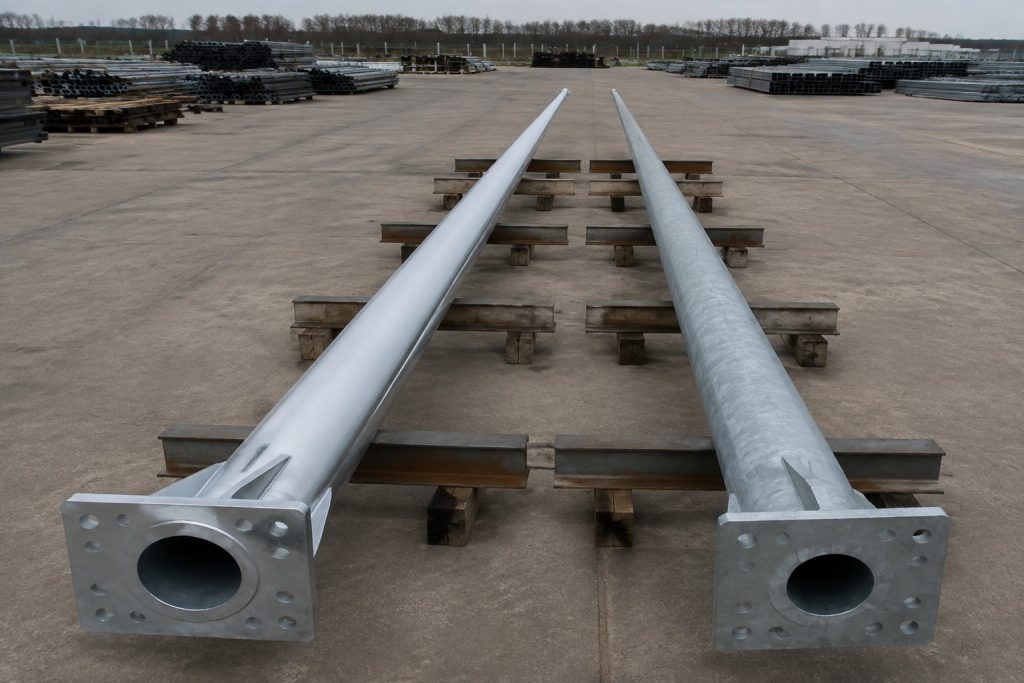
A full-length comparison makes material finish, taper and transport implications easier to assess.
Installation and Foundation Consequences
Lower pole mass can simplify transport and lifting, especially on islands, remote roads and constrained promenades. It does not remove the need for engineered rigging or a designed foundation. The foundation still resists overturning, shear and uplift generated by wind. Verify soil bearing and lateral response, concrete strength, reinforcement, drainage, conduit entry, anchor template, grout and finished ground level.
At erection, protect the shaft from chain marks and uncontrolled bending. Use soft slings and the approved lifting points. Check plumb, nut tightening, earth continuity and door orientation. In hot climates, crews should also protect cable insulation and avoid leaving unsealed handholes where dust or monsoon rain can enter.
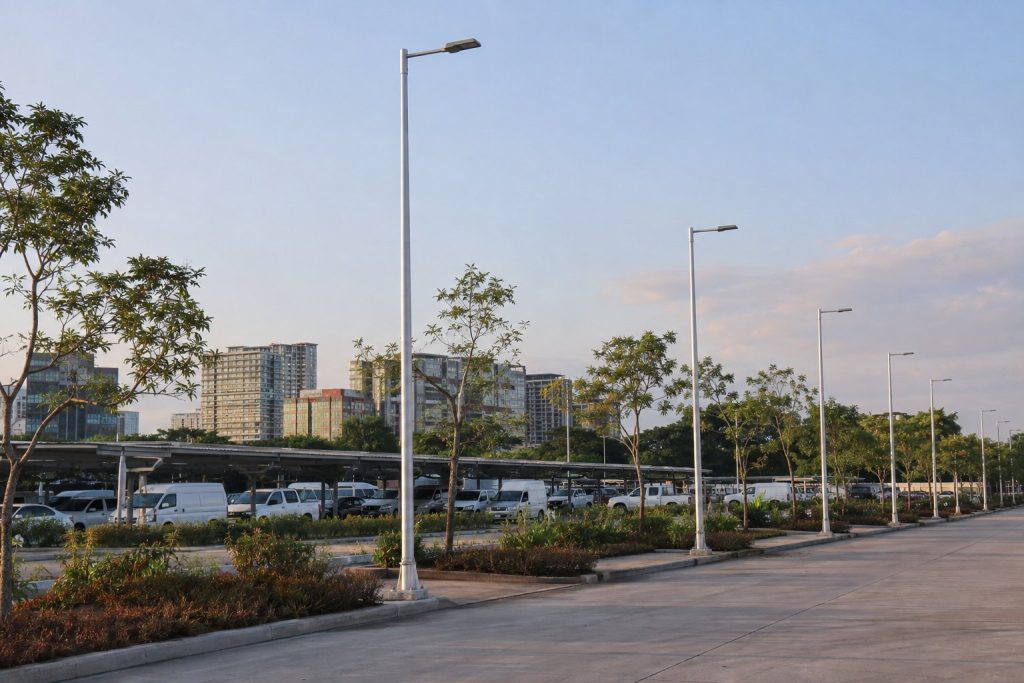
Installed aluminum poles should maintain consistent height, spacing, vertical alignment and luminaire orientation.
Lighting Performance Is Material-Neutral – Geometry Is Not
Lux and uniformity come from the luminaire distribution, mounting height, spacing and aiming, not from the shaft material. However, pole deflection, arm rotation and spigot tolerances can change the installed aim. Coordinate the aluminum lamp pole with the LED luminaire’s mass, EPA, spigot size, beam angle, IP65/IP66 rating, IK requirement, CRI and surge/earthing arrangement. Validate maintained illuminance and glare in DIALux using the final geometry.
A Practical Material-Selection Matrix
| Project condition | Likely starting option | Reason | Do not skip |
| Coastal promenade | Aluminum or duplex-coated steel | Corrosion and appearance | Isolation, drainage, exposure specification |
| Heavy multi-arm road pole | Engineered steel | Stiffness and fabrication | EPA, welds, fatigue and foundation |
| Remote island delivery | Aluminum | Lower transport and lifting mass | Packaging, alloy and local repair plan |
| Architectural city center | Either, project-finished | Appearance and custom geometry | Color samples and maintenance cycle |
Submittals to Request Before Approval
- Material grade or alloy and temper, section dimensions, welding qualifications, inspection plan and traceability documents.
- Structural calculation for wind, attachments, base plate, anchor bolts, deflection and fatigue where required.
- Coating or finish specification, dissimilar-metal isolation detail, drainage, packaging, touch-up method and maintenance guidance.
- Foundation drawing coordinated with geotechnical data, conduit, earthing, finished levels and installation sequence.
- DIALux report using the final mounting geometry and photometric files, including maintained lux, minimum lux, uniformity and glare checks.
FAQ: Questions Buyers Ask
Do aluminum light poles rust?
Aluminum does not rust like carbon steel, but it can corrode, pit or suffer galvanic attack in aggressive environments. Correct alloy selection, drainage, surface finish and isolation from dissimilar metals remain necessary.
Are aluminum lamp poles suitable for coastal roads?
They can be suitable when the alloy, welding, finish, fasteners, isolation, base detail and maintenance plan match the marine exposure. A coastal location still needs project-specific structural and corrosion design.
Are steel light poles stronger than aluminum poles?
Strength cannot be judged by material name alone. Grade, alloy, section shape, thickness, welds, openings, height and loading control capacity. Steel is generally stiffer, while an engineered aluminum section can meet its design brief.
Does an aluminum pole need grounding?
The electrical installation needs protective bonding and earthing in accordance with the applicable code and system design. Coordinate the pole, door, luminaire, cables, protective devices and surge protection as one system.
Compare Lifecycle Risk, Not Only Material Price
| PROJECT REVIEW For an aluminum or steel pole comparison, share the site environment, pole schedule, wind criteria, luminaire and arm data, finish requirement, soil report, applicable standards and logistics constraints. |
Send the site plan, target lux, mounting heights, operating schedule, environmental conditions, and electrical data through the Dawn Lighting official inquiry page. The engineering team can review the design basis and prepare a project-specific DIALux proposal and B2B quotation.
- 10 Meters Lamp Post
- 10 Meters Pole
- 1000w Led Projector
- 100W LED Tunnel Light
- 12 Meters Lamp Post
- 12 Meters Pole
- 1200w Led Projector
- 15 Light Pole
- 1500w Led Projector
- 150W LED Tunnel Light
- 1800w Led Projector
- 2 In 1 Solar Flood Light
- 200w Led Tunnel Light
- 50w Led Tunnel Light
- 6 Meters Lamp Post
- 6 Meters Pole
- 8 Meters Lamp Post
- 8 Meters Pole
- 800w Led Projector
- 80w Led Tunnel Light
- Colourful Decorative Light
- Conical post
- Courtyard Lamp
- courtyard light
- courtyard lighting fixture
- Decorative Landscape Light
- Decorative road Light
- Flood Light For Courtyard
- Flood Light for Garden
- Flood Light For Outdoor
- Foot Led High Bay Lights
- high bay led lights 100w
- industrial lampshade
- industrial LED shed lights
- industrial magnifying glass with light
- Integrated Solar Flood Light
- led courtyard lamp
- led courtyard light
- led high bay light 100w
- LED Projector For Stadium
- Led UFO High Bay 150W 5000k
- Lighting Plants Mining Price
- Maintenance Free LED Street Light
- Pic Controlling Tunnel Light
- PLC controlling tunnel light
- Post Top Garden Light
- RGB Landscape Light
- Rgbw Decorative Light
- Smart Tunnel Light
- solar courtyard lamp
- solar courtyard light
- Solar LED Road Light
- Solar Street Light For 10 Meter Pole
- Solar Street Light For 12 Meter Pole
- Solar Street Light For 6 Meter Pole
- Solar Street Light For 8 Meter Pole
- Split Type Solar Flood Light
- Sporting Projector
- Stadium Led Projector
- Street Lighting Post
