
 Request A Quote

LED Stadium Light Retrofit: How to Replace Metal Halide on Football Fields
 FACEBOOK
 TWITTER
 LINKEDIN
1. Why Watt-for-Watt Replacement Often Fails
A 1,000 W LED fixture is not automatically a direct replacement for a 1,000 W metal halide floodlight. The two systems may have different lumen maintenance, reflectors, beam spread, colour quality, start-up behavior, and aiming points. Stadium lighting is judged on the field, not at the fixture face.
Our engineering team treats the existing installation as a measured baseline. We review pole height, floodlight elevation, fixture tilt, field dimensions, seating lines, camera positions, electrical panels, and the current lux map. The replacement model then tests whether each zone receives enough light without pushing excessive intensity toward players, spectators, neighboring properties, or cameras.
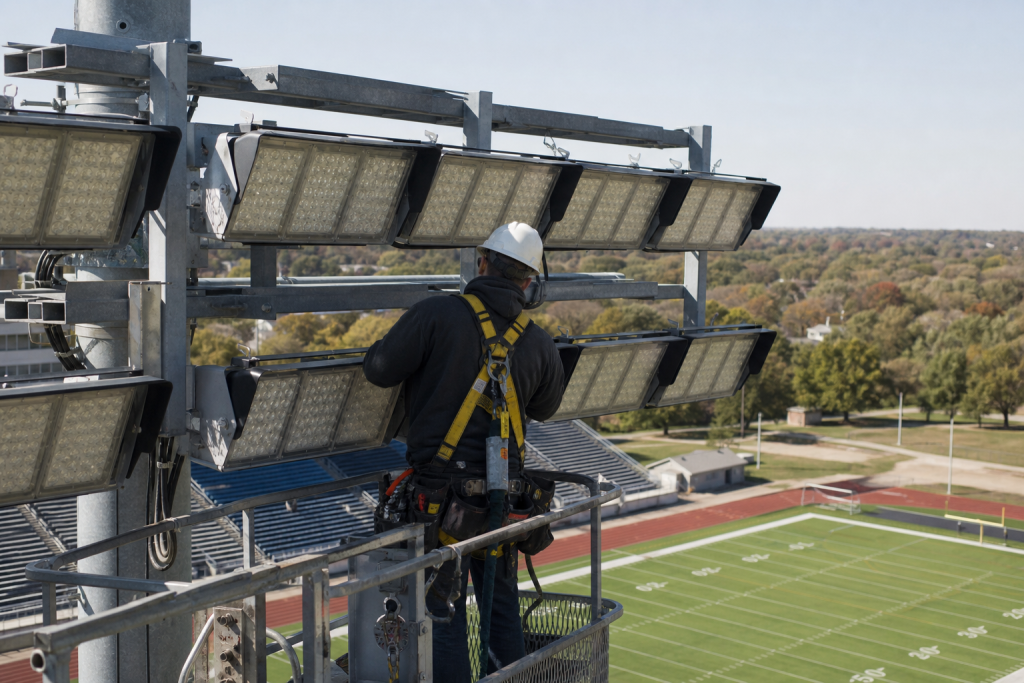
A technician inspecting stadium floodlights during a retrofit survey.
2. Set the Performance Brief Before Choosing Wattage
The client should state whether the field is for training, community matches, local competition, national competition, or broadcast use. The required average lux, minimum lux, uniformity, glare control, colour temperature, flicker behavior, and emergency lighting arrangement can change substantially between those uses.
| Use case | Preliminary average lux band | Uniformity focus | Additional review |
| Training and community use | 75-200 lux | Avoid visible dark patches | Glare, operating cost, simple controls |
| Local or regional competition | 200-500 lux | Stable coverage across the pitch | Player sightlines and spectator comfort |
| Higher-level competition | 500-750 lux | Tighter minimum-to-average ratio | Colour consistency and aiming tolerances |
| Broadcast or high-speed video | 750 lux and above where specified | Field and vertical illumination | Flicker, TLCI, camera angles, slow motion |
These are preliminary planning bands, not a universal competition standard. The federation, broadcaster, venue owner, and local authority may define different requirements. A photometric report should show the calculation grid, point-by-point results, average, minimum, maximum, uniformity, and any vertical-plane checks.
3. Use Optics to Improve Uniformity and Reduce Glare
Sports floodlights need controlled intensity. Narrow optics can project light from a high corner to the far side of the field. Wider optics can fill near zones, but they also increase spill light if the fixture is tilted too far outward. A good LED stadium light retrofit usually mixes beam angles rather than using one lens for every position.
Beam angle selection
Typical sports-lighting options include 10°, 25°, 45°, 60°, 90°, and asymmetric distributions. The correct combination depends on pole geometry and the aiming point. Dawn Lighting’s published modular stadium light range lists rotatable modules and multiple beam options, including narrow, medium, wide, and asymmetric distributions. See the modular LED stadium light product page.
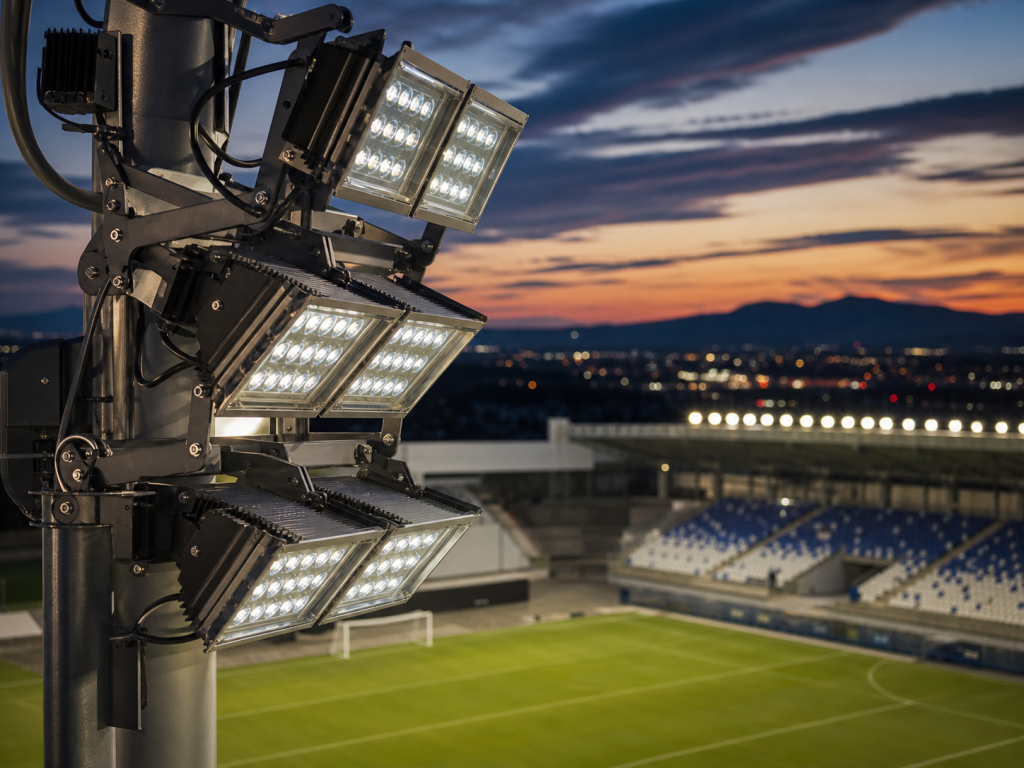
Close-up view of modular LED stadium floodlights arranged for controlled sports-field aiming.
Do not use beam angle as a substitute for a DIALux model. Two fixtures with the same wattage and lens can produce different results because of LED package, optical efficiency, tilt, mounting height, and aiming accuracy.
4. LED Versus Metal Halide in a Retrofit
LED usually offers faster start-up, better controllability, and longer maintenance intervals, but the product must be specified as a complete optical and electrical system. The driver, surge protection, heat path, enclosure, and mounting bracket all affect the final result.
| Factor | LED stadium light | Metal halide floodlight | Retrofit decision point |
| Start-up | Immediate or programmable | Warm-up and restrike delay | Can the venue restart quickly after an interruption? |
| Optical control | Multiple beam angles and precise modules | Reflector and lamp optics | Can the new aiming points match the existing poles? |
| Dimming | Usually practical with the correct driver | Limited and often inefficient | Are training and event scenes required? |
| Colour quality | CRI/TLCI options available | Changes as the lamp ages | What do players, cameras, and venue screens need? |
| Maintenance | Driver, module, lens, and SPD service plan | Lamp, ballast, and reflector service | Can the venue stock the critical spares? |
| Power system | Lower load may be possible, but model it | High starting and operating load | Check panels, cables, protection, and generator capacity |
| ENGINEERING NOTE Energy savings should be calculated from the existing connected load, operating schedule, control scenes, and achieved field performance. A lower wattage that creates dark areas is not a successful retrofit. |
5. Check Flicker, CRI, TLCI, and Camera Requirements
For a community field, visual comfort and colour consistency may be the main concern. For broadcast or high-speed video, flicker behavior and vertical illumination become more important. CRI describes colour rendering in a general sense; TLCI is more closely related to television camera evaluation. Neither number replaces a review of driver modulation, shutter speeds, camera positions, and the broadcaster’s acceptance criteria.
Ask the supplier for driver information, flicker test data where required, colour temperature tolerance, and the proposed scene settings. If the venue will add LED screens, cameras, or slow-motion replay later, include that future use in the initial design brief.
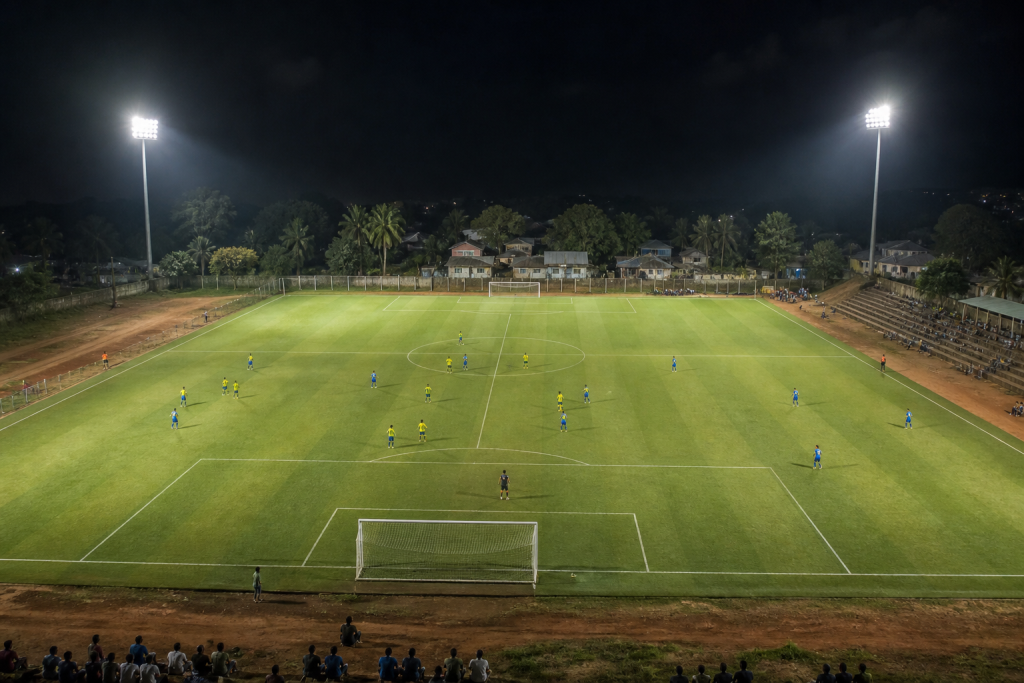
A football pitch with even LED illumination across the playing area.
6. Do Not Ignore Heat, Dust, Rain, and Surge Protection
Stadiums in the Middle East, Africa, and tropical Asia can face high ambient temperature, dust, monsoon rain, humidity, and lightning exposure. The retrofit should assess the existing brackets, junction boxes, cable condition, drainage, and electrical protection before the new fixtures arrive.
- Choose IP65 or IP66 according to the mounting position and cleaning exposure. Verify that glands, connectors, and access covers maintain the enclosure rating.
- Review the heat sink and driver temperature limit for the actual ambient condition. Dust on fins or blocked airflow can shorten service life even when the fixture is correctly rated.
- Specify surge protection suitable for the site’s lightning and switching environment. Confirm whether the SPD is replaceable and how failure is indicated.
- For coastal venues, check galvanic compatibility between brackets, fasteners, poles, and fixture bodies. Salt and dissimilar metals can create a maintenance problem that a luminaire IP rating does not solve.
7. Retrofit Workflow That Protects the Venue Schedule
- Survey the existing field, poles, floodlights, cable routes, electrical panels, and maintenance access.
- Record the current lux and uniformity where possible, including the measurement conditions and fixture operating state.
- Build the replacement model with accurate pole coordinates, mounting heights, fixture photometry, beam angles, and aiming points.
- Review glare, spill light, camera sightlines, vertical illumination, control scenes, and structural loading before approval.
- Run a pilot or staged installation when the venue schedule allows, then re-aim and verify the field with a calibrated lux meter.
- Hand over aiming records, circuit labels, control settings, spare parts, maintenance instructions, and the final as-built lighting report.
8. Can You Retrofit Without Replacing the Poles?
Often yes, but only after a structural and optical check. Existing poles may have enough capacity for the new fixtures, or the new arrangement may reduce total weight. The bracket, bolt pattern, wind area, cable route, and aiming range still need review. The retrofit may also expose old corrosion, seized adjustment hardware, or a foundation that no longer matches the current wind requirement.
The phrase “without new poles” should therefore mean “reuse the poles after verification,” not “fit a new luminaire onto an uninspected structure.” A measured survey and load review are cheaper than correcting a misaligned or unsafe installation after the event season begins.
FAQ: LED Stadium Light Retrofit
FAQ: Questions Buyers Ask Before Ordering
Can I replace metal halide stadium lights with LED without moving the poles?
In many projects the existing poles can be reused, but the bracket, wind load, weight, cable route, aiming range, and foundation condition must be checked. The DIALux model should use the actual pole coordinates rather than assuming that the old aiming points will work.
What wattage LED replaces a metal halide stadium light?
There is no reliable watt-for-watt answer. Delivered lux, uniformity, beam angle, optical efficiency, mounting height, and lamp depreciation all matter. A 1,000 W LED fixture may be right for one pole and wrong for another, so specify the field result first and the wattage second.
Do LED stadium lights flicker on camera?
They can if the driver and control settings are not suitable for the camera frame rate and shutter speed. For broadcast or slow-motion use, request driver flicker data, define the camera requirements, and validate the proposed scene settings before final purchase.
What IP rating should stadium floodlights have?
IP65 is a common outdoor baseline, while IP66 can add protection in severe rain or cleaning conditions. The correct rating depends on the location and maintenance method, and it must include the installed glands, connectors, and covers.
Make the Retrofit a Measured Lighting Upgrade
The best LED stadium light retrofit is not the one with the lowest catalogue wattage. It is the one that gives the venue the required lux, uniformity, colour performance, glare control, reliability, and maintenance access on the existing site. Start with a survey and a photometric model, then choose the fixture package that meets the brief.
| ENGINEERING INQUIRY For a football field or stadium retrofit, send the field dimensions, pole layout, existing fixture information, target use, and site conditions through Dawn Lighting’s official inquiry page. The engineering review can then address LED selection, optics, DIALux simulation, structural reuse, surge protection, and the B2B quotation request. |
Send the project location, site plan, mounting height, target lux, operating hours, and local electrical conditions through the Dawn Lighting official inquiry page. The engineering team can then prepare a project-specific recommendation, DIALux lighting simulation, and B2B quotation request review.
Related Dawn Lighting References
Sports lighting range: Dawn Lighting sports lighting.Modular stadium fixture reference: modular LED stadium light product page.
- 10 Meters Lamp Post
- 10 Meters Pole
- 1000w Led Projector
- 100W LED Tunnel Light
- 12 Meters Lamp Post
- 12 Meters Pole
- 1200w Led Projector
- 15 Light Pole
- 1500w Led Projector
- 150W LED Tunnel Light
- 1800w Led Projector
- 2 In 1 Solar Flood Light
- 200w Led Tunnel Light
- 50w Led Tunnel Light
- 6 Meters Lamp Post
- 6 Meters Pole
- 8 Meters Lamp Post
- 8 Meters Pole
- 800w Led Projector
- 80w Led Tunnel Light
- Colourful Decorative Light
- Conical post
- Courtyard Lamp
- courtyard light
- courtyard lighting fixture
- Decorative Landscape Light
- Decorative road Light
- Flood Light For Courtyard
- Flood Light for Garden
- Flood Light For Outdoor
- Foot Led High Bay Lights
- high bay led lights 100w
- industrial lampshade
- industrial LED shed lights
- industrial magnifying glass with light
- Integrated Solar Flood Light
- led courtyard lamp
- led courtyard light
- led high bay light 100w
- LED Projector For Stadium
- Led UFO High Bay 150W 5000k
- Lighting Plants Mining Price
- Maintenance Free LED Street Light
- Pic Controlling Tunnel Light
- PLC controlling tunnel light
- Post Top Garden Light
- RGB Landscape Light
- Rgbw Decorative Light
- Smart Tunnel Light
- solar courtyard lamp
- solar courtyard light
- Solar LED Road Light
- Solar Street Light For 10 Meter Pole
- Solar Street Light For 12 Meter Pole
- Solar Street Light For 6 Meter Pole
- Solar Street Light For 8 Meter Pole
- Split Type Solar Flood Light
- Sporting Projector
- Stadium Led Projector
- Street Lighting Post
