
 Request A Quote

how to set landscape lighting timer?
 FACEBOOK
 TWITTER
 LINKEDIN
Outdoor lights ensure that your home is at once safer, friendlier and easier to navigate at night. However, it can be inconvenient to remember to switch the lights on and off on a daily basis. With a timer on your outdoor light, you can automatize the process, which will save you time and energy and enhance security and curb appeal.
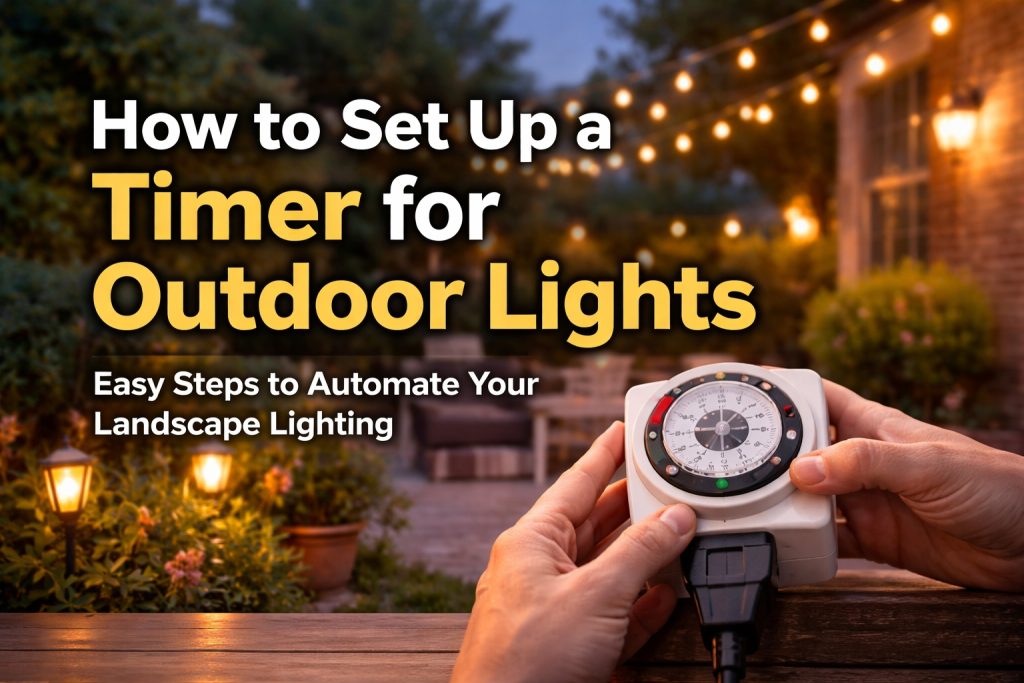
Do you need to control the porch lights in Bandung, garden lights in Jakarta, or pathway lights around your house in Jawa Barat, Indonesia, this step-by-step, all-inclusive guide will take you through the entire process, including selecting the appropriate timer and installation and programming.
Why Use a Timer for Your Outdoor Lighting
Before we look at installation, it helps to understand exactly why outdoor light timers are useful:
- Convenience – Lights automatically follow a schedule, so you don’t need to remember to switch them on or off.
- Safety – Illuminated pathways and entrances reduce risks of trips or falls after sunset.
- Energy Savings – Timers prevent lights from staying on unnecessarily, lowering electricity use.
- Security – A predictable lighting schedule makes your home look occupied, deterring trespassers.
- Longer Bulb Life – Lights last longer when they’re not running all night.
Timers aren’t just for porch lights — you can use them with garden lighting, deck lights, driveway lights, holiday decorations, and more.
Types of Timers for Outdoor Lights
Choosing the right type of timer depends on how your lights are powered and how much control you want. The three main options are:
1. Plug‑In Outdoor Timer
Best to use: String lights, LED garden lights, holiday lighting, or any other lights that require plugging into an outdoor socket.
Pros:
- No electrical wiring needed
- Easy to install and adjust
- Affordable and simple
Cons:
- Only works with plug‑in lights
- Requires a weather‑rated outlet and protection from moisture
Plug-in timers used outdoors are the best when you need to manage the lights using a GFCI protected outlet (more particularly when it is wet, humid or tropical).
2. In‑Wall Switch Timer
Best for: Porch lights, garage entry lights, floodlights, or fixtures that are hardwired to your home.
Pros:
- Clean, built‑in appearance
- Works with hardwired light circuits
- Many models include dusk‑to‑dawn or weekly scheduling
Cons:
- Requires basic wiring knowledge
- Some homes may not have the neutral wire needed for certain models
In‑wall timers replace your existing light switch and are a more permanent solution.
3. Smart Wi‑Fi Timer or Smart Switch
Best: Homeowners who desire app control, voice-activated, or sunrise/sunset schedules.
Pros:
- Control from anywhere via smartphone
- Integrates with smart assistants like Alexa or Google Home
- Advanced automation and vacation “randomize” modes
Cons:
- Requires a good Wi‑Fi signal
- Installation and setup can be more complex
The most versatile option is smart switches, which are mostly used in large residential buildings or a modernized automated house.
Tools and Safety You’ll Need
For timers that involve wiring, gather these tools before you begin:
- Flathead and Phillips screwdrivers
- Voltage tester or multimeter
- Wire strippers
- Electrical tape
- Replacement timer switch and instructions
- Flashlight
⚠️ Safety first: When working with wires, always ensure the circuit breaker is off before touching any wire. Outside electrical work may be hazardous when performed improperly. Should you not know, then seek the service of a licensed electrician.
How to Install a Plug‑In Outdoor Timer
This is the easiest method and suitable for most homeowners:
- Confirm the Outlet Is Outdoor Rated.
Ensure the outlet is a weatherproof, grounded (GFCI) one designed for outdoor use. - Choose a Weather‑Resistant Timer.
Outdoor timers should be built to withstand rain, dust, and humidity. - Plug the Timer In.
Insert the timer securely into the outlet. - Plug Your Lights Into the Timer.
Connect your lights to the timer’s controlled outlet. - Set the On/Off Schedule.
- For mechanical timers: Push down pins or tabs for times you want lights on.
- For digital timers: Use buttons on the display to choose exact start and end times.
- Test the Timer.
Many have a manual override to test the schedule. Ensure lights turn on/off at set times.
This setup takes just minutes and offers reliable automation without rewiring.
Installing an In‑Wall Timer Switch (Hardwired)
If you want a permanent solution for core outdoor lights:
- Turn Off Power at the Breaker.
Use a voltage tester to confirm power is off. - Remove the Old Switch.
Unscrew the faceplate and gently pull out the existing switch. - Identify the Wiring.
You should see:- Line (hot, from power source)
- Load (to the lights)
- Ground (bare copper or green)
- Neutral (white wires, if present)
- Connect the Timer Wires.
Match:- Line to line
- Load to load
- Neutral to neutral (if needed)
- Ground to ground
Secure wires with wire nuts.
- Mount the Timer and Replace the Plate.
Carefully tuck wires back and screw the timer into the box. - Restore Power and Program the Timer.
Follow manufacturer instructions for scheduling. - Test Operation.
Verify your outdoor lights turn on and off as scheduled.
This method provides a clean, permanent result for hardwired fixtures.
Programming Digital or Smart Timers
The specifics vary by model, but most digital or Wi‑Fi timers follow similar steps:
- Display the date and time.
- Enter program mode.
- Choose your desired on/off times for each day.
- Turn on Auto mode (this is particularly when your unit has this feature).
- With smart switches, it is necessary to pair the switch with an app as per the instructions of the manufacturer to connect to Wi-Fi.
Smart timers may also offer sunset/sunrise tracking, which automatically adjusts for changing daylight hours.
Common Mistakes to Avoid
- Outdoor use with an indoor-only timer is not recommended, and will ruin the timer.
- Exceeding the number of lights to be loaded on the timer.
- Disregarding the neutral wiring on some switches.
- Disorganized wiring in switch boxes.
When to Call a Licensed Electrician
Consider professional help if:
- The switch box does not have a neutral wire.
- Your outdoor lights are on a multi‑way switch setup.
- You plan to add new circuits or need safety code compliance.
Conclusion
The use of a timer to regulate your outdoor lighting will help make your home safer, more efficient, and friendly. No matter the type of plug-in timer you prefer, or a smart Wi-Fi switch, the appropriate installation can conserve energy and provide you with an easy control over your exterior lights.
The best solution to enhancing outdoor lighting with minimal effort and maximum payoff is by implementing this upgrade in Indonesia or any other country.


- 10 Meters Lamp Post
- 10 Meters Pole
- 1000w Led Projector
- 100W LED Tunnel Light
- 12 Meters Lamp Post
- 12 Meters Pole
- 1200w Led Projector
- 15 Light Pole
- 1500w Led Projector
- 150W LED Tunnel Light
- 1800w Led Projector
- 2 In 1 Solar Flood Light
- 200w Led Tunnel Light
- 50w Led Tunnel Light
- 6 Meters Lamp Post
- 6 Meters Pole
- 8 Meters Lamp Post
- 8 Meters Pole
- 800w Led Projector
- 80w Led Tunnel Light
- Colourful Decorative Light
- Conical post
- Courtyard Lamp
- courtyard light
- courtyard lighting fixture
- Decorative Landscape Light
- Decorative road Light
- Flood Light For Courtyard
- Flood Light for Garden
- Flood Light For Outdoor
- Foot Led High Bay Lights
- high bay led lights 100w
- industrial lampshade
- industrial LED shed lights
- industrial magnifying glass with light
- Integrated Solar Flood Light
- led courtyard lamp
- led courtyard light
- led high bay light 100w
- LED Projector For Stadium
- Led UFO High Bay 150W 5000k
- Lighting Plants Mining Price
- Maintenance Free LED Street Light
- Pic Controlling Tunnel Light
- PLC controlling tunnel light
- Post Top Garden Light
- RGB Landscape Light
- Rgbw Decorative Light
- Smart Tunnel Light
- solar courtyard lamp
- solar courtyard light
- Solar LED Road Light
- Solar Street Light For 10 Meter Pole
- Solar Street Light For 12 Meter Pole
- Solar Street Light For 6 Meter Pole
- Solar Street Light For 8 Meter Pole
- Split Type Solar Flood Light
- Sporting Projector
- Stadium Led Projector
- Street Lighting Post
