
 Request A Quote

What Makes An Integrated Solar Street Light “Integrated”?
 FACEBOOK
 TWITTER
 LINKEDIN
Integrated Solar Street Light buyers often assume “integrated” simply means a tidier housing on top of a pole, but the real advantage is performance you can predict—because the solar panel, controller, battery, optics, and LEDs are designed to operate as one coordinated system.
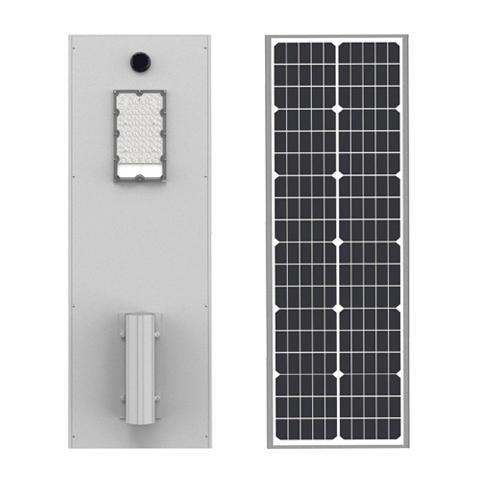
1) Start With a Clear Definition: Integration Is a System Choice
An integrated Integrated Solar Street Light is an all-in-one luminaire where the key power and lighting components are built into one compact unit. That sounds like a design detail, but it changes how projects behave in real life.
With traditional split systems, buyers often source parts separately: a solar panel from one supplier, a controller from another, and a lamp body from a third. On paper, every component looks “compatible.” On site, mismatches show up quickly—charging curves that do not fit the battery, optics that do not match the roadway, connectors that loosen after weather cycles, and settings that vary from pole to pole.
At Dawn Lighting, we build integrated solar solutions because public lighting is judged by uptime, not by perfect test conditions. Integration reduces the number of variables you need to manage. Instead of assembling a system, you deploy a system. The result is fewer installation steps, fewer points where moisture or wiring errors can cause problems, and more consistent night-to-night light output.
If you are a new buyer, here is the simplest way to understand it: integration is not “more features.” It is fewer unknowns.
2) Why Integration Matters on Real Streets: Three Benefits That Protect Your Project
When evaluating an Integrated Solar Street Light described as “integrated,” look past the product photos and focus on outcomes that affect cost, schedule, and long-term performance.
✓Faster Deployment With Less Rework
All-in-one designs typically reduce separate brackets, external boxes, and cable routing. That saves labor time and lowers the chance of small errors that create big delays—miswired polarity, loose terminals, or uneven configuration across a batch.
✓Better Weather Tolerance Through Fewer Exposure Points
Outdoor lighting failures are often caused by the “in-between places”: connections, junction boxes, and cable interfaces. A well-designed integrated unit reduces those exposure points. In the field, resilience means the light keeps operating after rain, dust, heat, and repeated temperature swings—not just on day one.
✓Lower Maintenance Load Over The Pole’s Lifetime
A simple structure is easier to inspect. With fewer external parts, you reduce corrosion opportunities, accidental damage during maintenance, and the need for frequent troubleshooting. For municipalities and contractors, lower maintenance is not a marketing phrase—it is fewer callouts, fewer spare parts, and fewer complaints from residents.
A practical way to evaluate integration is to ask: Does this design reduce total risk per pole? If the answer is yes, “integrated” is doing its job.
3) Solar Panel Integration: Why Mono Efficiency Changes Night Reliability
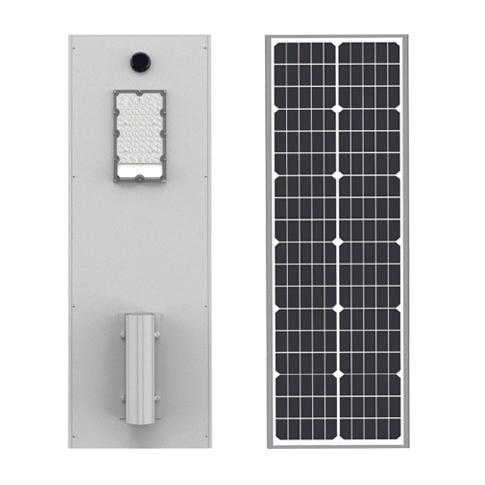
In an integrated solar Integrated Solar Street Light, the solar panel is not an accessory. It is the system’s energy engine. That is why panel type and charging efficiency matter even if you are not an electrical engineer.
Dawn Lighting uses a high-efficiency mono solar panel design with charging efficiency up to 23.95%. In straightforward terms, higher conversion efficiency means the system can capture more usable energy from the same daylight. This matters when pole top space is limited, when winter days are shorter, or when cloud cover reduces charging time.
For public lighting, one of the most common performance problems is not “bad LEDs.” It is undercharging. When a system cannot harvest enough energy, it compensates by dimming early, shortening runtime, or cycling inconsistently across the week. Higher charging efficiency helps create an energy buffer so the light can perform more steadily across changing conditions.
When comparing products, avoid judging the system only by a large nominal watt label. Ask a more useful question:
Does the panel design and housing layout help keep charging stable when sunlight is weak or inconsistent?
That question leads you to real reliability, not just attractive specs.
4) MPPT Control: The Smart “Traffic Officer“ for Solar Power
Many first-time buyers see “MPPT” and assume it is a premium add-on. In reality, MPPT is a core reason an integrated solar Integrated Solar Street Light can remain reliable over long operating cycles.
A built-in MPPT solar controller adjusts charging behavior throughout the day to keep the system operating near its best efficiency point. Sunlight intensity changes from morning to noon to evening. Temperature affects panel output. Battery voltage evolves during charging. MPPT responds to maximize solar capture and shorten time to full charge.
For a project owner, the benefits are practical and measurable in daily operation:
✓More Usable Energy Captured Each Day
✓Smarter Battery Utilization Over Time
✓More Stable Light Output Across The Night
Integration adds a second advantage here: the controller can be tuned for that specific panel, battery, and LED load. This reduces the “it should work” uncertainty that can happen when a controller is selected separately and configured differently across installers or regions.
If your goal is consistent public lighting, MPPT is not a buzzword. It is part of how a solar system stays dependable as conditions change.
5) LED Output: Why “Useful Light“ Matters More Than Big Numbers
Public lighting is not a contest for the highest lumen number. It is a safety and comfort job: deliver enough light, in the right places, with a stable pattern that supports drivers and pedestrians.
Our integrated solar Integrated Solar Street Light platform can deliver around 5400 lm with luminous efficacy over 190 lm/W. This combination matters because it links brightness to efficiency. When lm/W is high, the light produces strong illumination while consuming less electrical power from the battery. That directly improves overnight endurance and reduces the pressure on the charging system during difficult weather periods.
Color temperature flexibility is also more important than many new buyers realize. Different areas require different visual comfort levels. A configurable CCT range of 3000–6500K helps planners choose warmer light for residential streets and parks, while allowing cooler light where higher contrast and perceived brightness may be preferred for traffic zones.
Instead of asking, “How many lumens is it?”, a better buyer question is:
Will this Integrated Solar Street Light deliver uniform, comfortable visibility on the road surface without harsh glare?
Optics and stability are what turn output into real-world usability.
6) A Buyer-Friendly Integrated Checklist and a Practical CTA
If you are sourcing an Integrated Solar Street Light for a municipal road, a pathway network, or an urban renovation, use a short checklist that reflects how solar lighting succeeds in the field.
✓System Match: Are the panel, controller, battery, optics, and LEDs engineered as one platform rather than assembled from unrelated parts?
✓Charging Strength: What is the panel efficiency, and does the design support consistent charging? (Up to 23.95% is a meaningful benchmark for compact integrated units.)
✓Control Strategy: Is MPPT included, and does the system manage power intelligently across the night to protect battery life while maintaining safe lighting?
✓Efficiency Over Brute Output: Does the luminaire offer high efficacy (for example 190+ lm/W) so the battery works less for the same usable brightness?
✓Planning Flexibility: Can you choose CCT for different zones (such as 3000–6500K) instead of forcing one color tone across the entire project?
At Dawn Lighting, we support new buyers who want a clear path from “spec sheet” to “street performance.” If you share your project type (road, park, pathway), installation region, and target lighting goals, we can recommend an integrated solar configuration that matches your application—not just your procurement checklist.
CTA: Contact Dawn Lighting with your pole height, site layout, and lighting scenario. We will propose an integrated Integrated Solar Street Light solution and a practical deployment plan—so you achieve stable night lighting, smoother installation, and fewer maintenance callbacks after handover.

- 10 Meters Lamp Post
- 10 Meters Pole
- 1000w Led Projector
- 100W LED Tunnel Light
- 12 Meters Lamp Post
- 12 Meters Pole
- 1200w Led Projector
- 15 Light Pole
- 1500w Led Projector
- 150W LED Tunnel Light
- 1800w Led Projector
- 2 In 1 Solar Flood Light
- 200w Led Tunnel Light
- 50w Led Tunnel Light
- 6 Meters Lamp Post
- 6 Meters Pole
- 8 Meters Lamp Post
- 8 Meters Pole
- 800w Led Projector
- 80w Led Tunnel Light
- Colourful Decorative Light
- Conical post
- Courtyard Lamp
- courtyard light
- courtyard lighting fixture
- Decorative Landscape Light
- Decorative road Light
- Flood Light For Courtyard
- Flood Light for Garden
- Flood Light For Outdoor
- Foot Led High Bay Lights
- high bay led lights 100w
- industrial lampshade
- industrial LED shed lights
- industrial magnifying glass with light
- Integrated Solar Flood Light
- led courtyard lamp
- led courtyard light
- led high bay light 100w
- LED Projector For Stadium
- Led UFO High Bay 150W 5000k
- Lighting Plants Mining Price
- Maintenance Free LED Street Light
- Pic Controlling Tunnel Light
- PLC controlling tunnel light
- Post Top Garden Light
- RGB Landscape Light
- Rgbw Decorative Light
- Smart Tunnel Light
- solar courtyard lamp
- solar courtyard light
- Solar LED Road Light
- Solar Street Light For 10 Meter Pole
- Solar Street Light For 12 Meter Pole
- Solar Street Light For 6 Meter Pole
- Solar Street Light For 8 Meter Pole
- Split Type Solar Flood Light
- Sporting Projector
- Stadium Led Projector
- Street Lighting Post
