
 Request A Quote

LED Sports Lighting Fixtures
 FACEBOOK
 TWITTER
 LINKEDIN
LED sports lighting fixtures are revolutionizing the way stadiums, arenas, gymnasiums and recreational courts are lit. LED lighting technology has become the preferred solution for modern sports facilities all over the world and has many benefits, such as greater visibility, better energy efficiency, reduced maintenance costs and more.
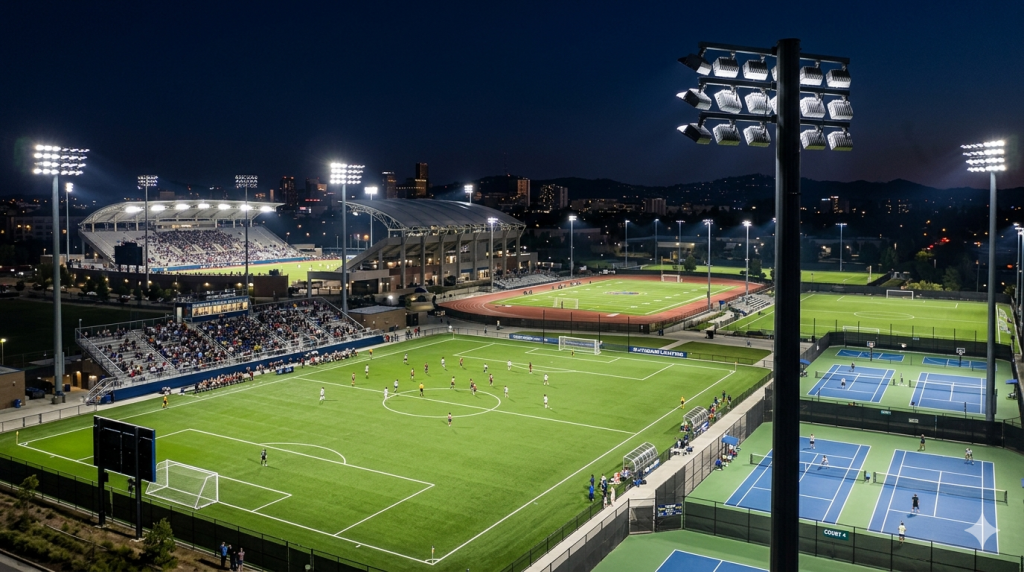
For any sports facility from a football stadium, baseball field, tennis court, or indoor arena, the right LED sports lighting fixture can be the difference for optimal performance of the athletes, comfort for the crowd, and cost savings over time.
Why LED Sports Lighting Fixtures Matter
Sports lighting is about more than brightness. Proper illumination directly affects:
- Player safety
- Game visibility
- Broadcast quality
- Spectator experience
- Energy consumption
- Maintenance expenses
In traditional lighting systems, light output declines over time, metal halide lamps come with high initial investment and long warm-up times, and these systems consume a lot of electricity. With LED sports light fixture, many of these problems are solved—led sports lighting fixtures provide instant illumination, better light uniformity, and much longer life.
New LED fixtures help cut energy costs up to 50% over traditional fixtures, and can last from 50,000 to 100,000 hours.
Key Benefits of LED Sports Lighting Fixtures
1. High Energy Efficiency
Compared to previous lighting options, LED sports lights offer more lumens per watt. Today, some high-end fixtures boast 120-170 lumens per watt to help facilities get to professional light quality while reducing energy costs.
This efficiency is particularly crucial for big sports complexes that run for a number of hours each day.
2. Better Visibility and Uniformity
The uniform lighting minimizes shadows and dark spots around the playing area. Ball tracking, team tracking, and opponent tracking is more efficient for athletes, and there is increased visibility for observers.
High definition broadcasting and slow motion replay systems are also demanded in consistent lighting for professional venues.
3. Instant-On Technology
Metal-halide systems can take several minutes to start up, but LED fixtures come on instantly. This feature is useful when:
- Live broadcasts
- Tournament events
- Power interruptions
- Training sessions
4. Reduced Maintenance Costs
LED fixtures are engineered to last for a long time. Facility managers can save on labor and equipment costs in the long run due to the fact that they have to replace them less often and they require less maintenance.
5. Improved Glare Control
Advanced optics direct light towards its exact location where required. Good glare control will help to keep players comfortable and reduce spill lights into nearby residential areas.
Types of LED Sports Lighting Fixtures
The lighting requirements for various sports will vary. Choosing the right fixture type means that the fixture will perform best and meet the competition requirements.
LED Stadium Lighting Fixtures
LED stadium lights are designed for large outdoor venues hosting collegiate and professional events.
Typical applications include:
- Football stadiums
- Soccer fields
- Baseball parks
- Track and field complexes
These fixtures usually feature:
- Wattage: 600W–1500W
- High lumen output
- Advanced beam control
- Long throw distances
- Pole heights up to 200 feet
Professional stadium lighting should be able to deliver the highest brightness, color rendering and uniformity to satisfy broadcasting demand.
LED Sports Field Lighting Fixtures
Sports field lighting is commonly used for:
- High school athletics
- Recreational leagues
- Community parks
- Training facilities
These are also generally lower wattage than professional stadium lighting systems, yet provide good visibility and efficiency.
Common specifications include:
- Wattage: 400W–900W
- Pole heights: 40–60 feet
- Moderate beam spread
- Reduced operating costs
LED Sports Court Lighting Fixtures
Sports court fixtures are ideal for:
- Tennis courts
- Pickleball courts
- Basketball courts
- Multi-purpose courts
These systems focus on uniformity and minimising glare as players tend to look upwards when playing.
Some facilities are now being fitted with asymmetric floodlighting to illuminate the court with a more focused beam, whilst reducing spill light.
Indoor Arena and Gymnasium LED Fixtures
The sport facilities for use inside should be equipped with special fixtures that can produce high brightness without glare.
Common applications include:
- Basketball arenas
- Volleyball courts
- Ice hockey arenas
- School gymnasiums
Popular fixture types include:
- UFO high bay lights
- Linear LED fixtures
- Ceiling-mounted floodlights
Indoor LEDs also eliminate flickering, which improves video recording quality and athlete comfort.
Important Factors When Choosing LED Sports Lighting Fixtures
Lighting Level Requirements
Different sports and competition levels require different lux levels.
For example:
- Recreational fields: 120–200 lux
- High school competitions: 200–500 lux
- Professional broadcasts: 1000+ lux
Lighting standards often depend on league regulations and television broadcasting requirements.
Beam Angle and Optics
The beam angle determines how light spreads across the field.
Narrow beams are ideal for:
- Tall poles
- Long throw distances
- Stadium applications
Wide beams work better for:
- Smaller courts
- Lower mounting heights
- Indoor facilities
Proper optics are critical because lighting quality depends on beam distribution, not just wattage.
Color Temperature (CCT)
The range of sports facilities is 4000K to 5700K.
The higher the color temperatures, the more visible and broadcast clear the images will be, and the lower the color temperatures, the less the glare and light pollution will be.
Several municipalities are now willing to promote the use of 3000K fixtures in compliance with dark-sky requirements.
CRI (Color Rendering Index)
CRI measures how accurately colors appear under lighting.
For sports applications:
- Recreational use: CRI 70+
- Professional broadcasting: CRI 80–90+
Higher CRI improves camera performance and spectator viewing experience.
Durability and Weather Resistance
Outdoor sports lighting fixtures must withstand:
- Rain
- Wind
- Dust
- Temperature fluctuations
- UV exposure
Look for fixtures with high IP ratings and corrosion-resistant housings for long-term reliability.
LED vs Traditional Sports Lighting
| Feature | LED Sports Lighting | Metal Halide Lighting |
|---|---|---|
| Energy Efficiency | High | Moderate |
| Lifespan | 50,000–100,000 hours | 10,000–15,000 hours |
| Warm-Up Time | Instant | Several minutes |
| Maintenance | Low | High |
| Light Uniformity | Excellent | Moderate |
| Flicker | Minimal | Common |
| Glare Control | Advanced optics | Limited |
LED technology clearly offers better long-term value for most sports facilities.
Best Practices for Sports Lighting Installation
Use Professional Lighting Design
Every facility has unique requirements based on:
- Pole height
- Field dimensions
- Sport type
- Competition level
- Local regulations
Professional lighting simulations help optimize fixture placement and reduce glare.
Focus on Uniformity, Not Just Brightness
The more watts the more light does not necessarily mean the better light. fixtures may cause imbalance in light output and glare.
Consider Future Expansion
Many facilities start off with recreational lighting and then progress to competitive events. Choosing scalable LED systems can make future expansion projects easier.
Reduce Light Spill
Modern optics and screening reduce light pollution and increase the compatibility of neighbourhoods. Dark Sky Friendly designs are becoming more and more significant in the city.
Final Thoughts
The LED sports lighting fixtures are widely used in modern sports facilities to meet the requirements of energy conservation, good visibility, long lifespan and low maintenance.
Whether they’re installed in professional stadiums or community courts, LED systems deliver consistent lighting that boosts athletic performance and improves the enjoyment of stadium goers while reducing operating expenses.
When choosing sports lighting fixtures, facility managers should consider:
- Proper lighting design
- Fixture efficiency
- Beam control
- Uniformity
- Durability
- Compliance with sport-specific standards
Today, there is no reason why any sports venue can’t realize years of increased performance and operational savings with a high-quality sports LED light.
- 10 Meters Lamp Post
- 10 Meters Pole
- 1000w Led Projector
- 100W LED Tunnel Light
- 12 Meters Lamp Post
- 12 Meters Pole
- 1200w Led Projector
- 15 Light Pole
- 1500w Led Projector
- 150W LED Tunnel Light
- 1800w Led Projector
- 2 In 1 Solar Flood Light
- 200w Led Tunnel Light
- 50w Led Tunnel Light
- 6 Meters Lamp Post
- 6 Meters Pole
- 8 Meters Lamp Post
- 8 Meters Pole
- 800w Led Projector
- 80w Led Tunnel Light
- Colourful Decorative Light
- Conical post
- Courtyard Lamp
- courtyard light
- courtyard lighting fixture
- Decorative Landscape Light
- Decorative road Light
- Flood Light For Courtyard
- Flood Light for Garden
- Flood Light For Outdoor
- Foot Led High Bay Lights
- high bay led lights 100w
- industrial lampshade
- industrial LED shed lights
- industrial magnifying glass with light
- Integrated Solar Flood Light
- led courtyard lamp
- led courtyard light
- led high bay light 100w
- LED Projector For Stadium
- Led UFO High Bay 150W 5000k
- Lighting Plants Mining Price
- Maintenance Free LED Street Light
- Pic Controlling Tunnel Light
- PLC controlling tunnel light
- Post Top Garden Light
- RGB Landscape Light
- Rgbw Decorative Light
- Smart Tunnel Light
- solar courtyard lamp
- solar courtyard light
- Solar LED Road Light
- Solar Street Light For 10 Meter Pole
- Solar Street Light For 12 Meter Pole
- Solar Street Light For 6 Meter Pole
- Solar Street Light For 8 Meter Pole
- Split Type Solar Flood Light
- Sporting Projector
- Stadium Led Projector
- Street Lighting Post
