
 Request A Quote

led sports lighting
 FACEBOOK
 TWITTER
 LINKEDIN
To match the growing demands of modern sports facilities, bright lights are no longer the only thing required. The stadiums, school fields, tennis courts, and recreational complexes that are necessary for everyone today need to be illuminated to increase visibility, decrease energy costs, improve player safety, and enhance the spectator experience. The use of LED has become the standard solution due to its impressive combination of performance, reduced operating costs and extended life cycle compared to conventional lighting.
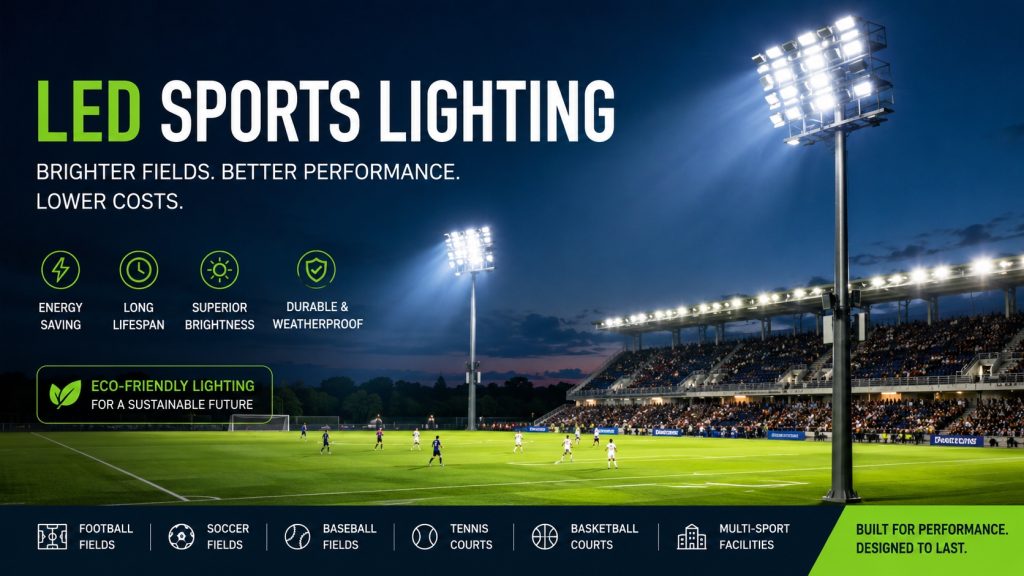
Whether in professional stadiums or community parks, the future of sports lighting is LED.
What Is LED Sports Lighting?
LED sports lighting refers to high-output lighting systems specifically engineered for athletic environments such as:
- Football stadiums
- Soccer fields
- Baseball diamonds
- Tennis courts
- Basketball courts
- Multi-sport complexes
- Indoor arenas
Sports lights are designed to deliver uniform lighting on a large playing area, they are not the same as a conventional outdoor floodlight.
LED fixtures can provide high output without wasting energy and electricity, and modern technology allows them to be installed on tall poles or stadium structures to achieve high levels of light output.
Why Sports Facilities Are Switching to LED Lighting
Older metal halide and HID lamps are high in energy consumption and maintenance requirements, and are not always bright enough. LED technology can address many of these problems.
1. Significant Energy Savings
Energy efficiency is one of the greatest benefits of LED sports lighting. Many LED products can save up to 50% to 75% energy compared to HID, with equal or greater amounts of light output.
Over time, it can help significantly reduce electricity costs for facilities that turn on lights for practices, games and events.
2. Longer Lifespan
Typical lifespan of LED sports lights ranges from 50,000 to 100,000 hours, a significantly longer lifespan than metal halides. This results in less frequent replacements and less maintenance cost.
Higher poles and hard-to-reach fixtures can result in significant labor savings as the number of maintenance cycles is reduced.
3. Instant On and Off
Unlike traditional lighting options that take time to warm up, LED sports lights can reach their full brightness immediately.
This feature works well in particular for:
- Emergency restarts
- Weather delays
- Training sessions
- Multi-use sports facilities
4. Improved Visibility and Uniformity
LED fixtures provide accurate beam control to minimize dark spots and non-uniform lighting in the field. Improved visibility for athletes to see fast moving objects and also enhance spectator’s experience.
The need for uniform illumination in competitive sports and televised events is important.
5. Better Color Rendering
In general, LED sports lighting has a higher Color Rendering Index (CRI) than traditional lighting systems. This allows for more clear and natural colors for athletes, referees, cameras and fans.
Higher CRI also enhances video recording and broadcasting quality.
Key Features of High-Quality LED Sports Lights
When selecting LED sports lighting fixtures, several factors should be considered.
Beam Angle Control
Sports facilities require specialized optics that direct light exactly where needed. Different beam angles are used depending on:
- Pole height
- Field dimensions
- Sport type
- Viewing requirements
Proper beam control minimizes glare and light spill into surrounding areas.
Wattage and Lumen Output
There are numerous wattages of sports lighting systems such as 400W, 800W and even higher output systems for larger stadiums. Compared to traditional HID systems, LED systems can provide similar levels of light consumption, but with far less energy use.
For large professional venues this might be required:
- 800W–1200W fixtures
- High mast mounting
- Precision aiming systems
Smaller recreational fields may use lower wattage configurations.
Weather Resistance
Outdoor sports lights must withstand harsh environmental conditions including:
- Rain
- Wind
- Dust
- Extreme temperatures
Most commercial-grade LED sports fixtures include IP65 or higher weatherproof ratings for reliable long-term performance.
Thermal Management
Efficient heat dissipation is essential for extending LED lifespan. Premium fixtures use advanced cooling systems and aluminum housings to maintain stable operating temperatures.
Applications for LED Sports Lighting
Football and Soccer Fields
Large outdoor fields require high-powered fixtures with excellent uniformity and glare control. LED systems improve visibility for players while enhancing fan experience during night games.
Baseball and Softball Fields
Baseball lighting requires careful optical design because different areas of the field need different illumination levels. Infield and outfield lighting often use separate beam configurations.
Tennis and Basketball Courts
Court lighting must eliminate shadows and maintain consistent brightness to support fast player movement and ball tracking.
Indoor Sports Arenas
Indoor facilities benefit from flicker-free LED lighting that enhances visibility while supporting high-quality video production and streaming.
Important Considerations Before Installation
Lighting Design Matters
An effective LED upgrade is not all about the switch. Improper lighting design may produce glare, uneven lighting and poor visibility. A well-planned lighting system will be appropriate for the size of the field and the configuration of the poles.
Pole Height and Placement
The lighting performance is greatly affected by pole positioning. Improper spacing and/or height can decrease uniformity and glare.
Compliance and Safety Standards
The sports lighting systems should meet local electrical codes and sports lighting standards. It is strongly recommended that it is professionally installed by licensed electricians.
LED Sports Lighting vs Traditional HID Lighting
| Feature | LED Sports Lighting | Traditional HID Lighting |
|---|---|---|
| Energy Efficiency | High | Lower |
| Warm-Up Time | Instant | Several minutes |
| Lifespan | 50,000–100,000 hours | 10,000–15,000 hours |
| Maintenance | Minimal | Frequent lamp replacement |
| Light Quality | Excellent uniformity | Uneven over time |
| Flicker | Minimal | Common |
| Operating Cost | Lower | Higher |
LED systems consistently outperform traditional lighting in efficiency, reliability, and visibility.
The Future of Sports Facility Lighting
The industry is moving towards increasingly modern sports venues, and LED technology is topping the list. Smart controls, dimming systems, remote monitoring and advanced optics enable facilities to enhance the quality of their lighting while simultaneously cutting costs.
LED sports lighting provides for stadiums and other sports facilities, including:
- Better performance
- Lower maintenance
- Reduced energy consumption
- Enhanced player safety
- Improved spectator experience
LED investments for facilities today put them in position to save money over the long run and to achieve lighting performance advantages.
Final Thoughts
LED sports lighting has revolutionized the field, court, and stadium lighting in sporting venues. LEDs are more efficient, last longer, offer better visibility and maintenance reductions over traditional lighting systems.
Whether it’s in a football stadium or at a local recreation park, today’s LED sports lighting systems help create safer, brighter and more energy-efficient environments for athletes and their fans. LED technology is pushing the boundaries of what is expected for sports facility lighting, thanks to the blending of technological advancements in optical, construction and intelligent lighting designs.
- 10 Meters Lamp Post
- 10 Meters Pole
- 1000w Led Projector
- 100W LED Tunnel Light
- 12 Meters Lamp Post
- 12 Meters Pole
- 1200w Led Projector
- 15 Light Pole
- 1500w Led Projector
- 150W LED Tunnel Light
- 1800w Led Projector
- 2 In 1 Solar Flood Light
- 200w Led Tunnel Light
- 50w Led Tunnel Light
- 6 Meters Lamp Post
- 6 Meters Pole
- 8 Meters Lamp Post
- 8 Meters Pole
- 800w Led Projector
- 80w Led Tunnel Light
- Colourful Decorative Light
- Conical post
- Courtyard Lamp
- courtyard light
- courtyard lighting fixture
- Decorative Landscape Light
- Decorative road Light
- Flood Light For Courtyard
- Flood Light for Garden
- Flood Light For Outdoor
- Foot Led High Bay Lights
- high bay led lights 100w
- industrial lampshade
- industrial LED shed lights
- industrial magnifying glass with light
- Integrated Solar Flood Light
- led courtyard lamp
- led courtyard light
- led high bay light 100w
- LED Projector For Stadium
- Led UFO High Bay 150W 5000k
- Lighting Plants Mining Price
- Maintenance Free LED Street Light
- Pic Controlling Tunnel Light
- PLC controlling tunnel light
- Post Top Garden Light
- RGB Landscape Light
- Rgbw Decorative Light
- Smart Tunnel Light
- solar courtyard lamp
- solar courtyard light
- Solar LED Road Light
- Solar Street Light For 10 Meter Pole
- Solar Street Light For 12 Meter Pole
- Solar Street Light For 6 Meter Pole
- Solar Street Light For 8 Meter Pole
- Split Type Solar Flood Light
- Sporting Projector
- Stadium Led Projector
- Street Lighting Post
