
 Request A Quote

landscape lighting system
 FACEBOOK
 TWITTER
 LINKEDIN
When it comes to outdoor lighting, the uses go far beyond just lighting up your yard at night. A well-designed landscape lighting system can boost curb appeal, make paths and patios safer, make them more secure, and enhance any garden, walkway or architectural element into an inviting night time environment. Selecting the right landscape lighting system can be a complex task, depending on whether it’s an upgrade or a fresh outdoor lighting design, it requires careful thought and selecting the right lighting techniques, power sources, and fixtures.
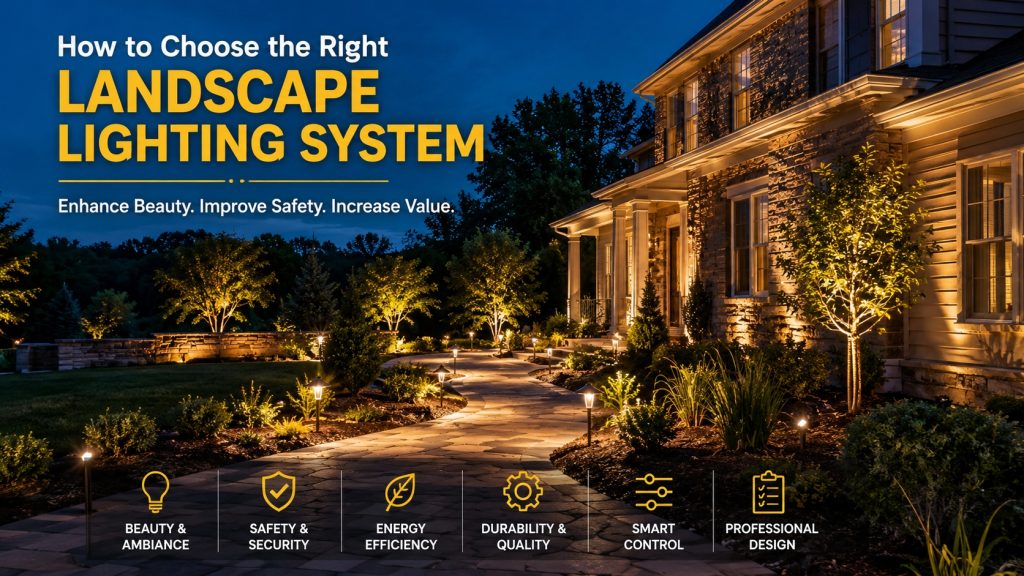
Modern homeowners are not content with standard floodlights or even to buy a lower priced solar stake from a retail outlet. The emphasis of today’s landscape lighting design systems is on multi-layered lighting, energy conservation, intelligent controls, and lifespan. Knowing some of the basics can help you to design a lighting scheme that looks professional and is also practical and affordable.
Why Landscape Lighting Matters
A good landscape lighting system has several purposes. Aside from its looks, it also makes it easier to maneuver around the house and provides a valuable security measure at night. Lighting can be used to create a focal point for trees, gardens, pathways, water features, walls, patios, and other architectural features, and can also help to reduce the amount of dark space around the house.
Landscape lighting offers many advantages such as:
- Improved curb appeal and home value
- Safer walkways, stairs, and outdoor living spaces
- Extended use of patios and backyards after dark
- Enhanced security and visibility
- Greater visual depth and dimension in the landscape
- Increased comfort for entertaining outdoors
A lot of expert lighting designers are suggesting that lighting should be done in “layers” across the property instead of providing light in every area. Sometimes, strategic lighting can create a more sophisticated and inviting look than over-lighting.
Start with Your Lighting Goals
When installing fixtures or transformers, determine the function of the lighting system. Each property will have their own priorities. Some homeowners prefer to achieve a more secure home environment at night, while others want to entertain, emphasize their landscaping, or have a luxury environment.
Some of the common lighting goals are:
- Illuminating pathways and entryways
- Accenting trees and architectural elements
- Lighting patios, decks, and outdoor kitchens
- Enhancing garden beds and water features
- Creating ambiance for evening entertaining
- Improving visibility around driveways and stairs
Having a clear plan helps decide on the correct types of fixture, the angle of the beam, how bright the fixture should be, and how the fixture will be placed. Lighting designers always stress that the lighting system should be designed based on the use of the space, rather than the fixtures.
Understand the Main Types of Landscape Lighting
The right fixtures are key to providing balance and function. There are several different types of lighting techniques that are needed throughout your home.
Path Lights
Path lights are one of the most prevalent types of landscaping lights. They offer low-level lighting for walkways, garden borders and driveways, as well as safety and navigation. These fixtures are usually low to the ground and spaced evenly to avoid glare.
Spotlights and Uplights
Spotlights focus a strong beam of light on a particular area, like a tree, a statue, a stone wall, or an architectural feature. Uplighting produces dramatic shadows and depth by lighting from the bottom up.
Floodlights
Generally, floodlights cast a wider light ray over a larger area. They are frequently employed in landscape lightings, driveways and wide area coverage.
Deck and Step Lights
These fixtures enhance safety and provide low level ambient lighting at the edge of stairs, patios and decks.
Wall Wash Lights
The beams are used for wall washing, which provides a soft light on walls, fences or textured surfaces, without a strong glare.
Well Lights
Well lights are set into the ground level and offer subtle lighting for trees, walls and architectural emphasis.
Multiple types of fixtures together provide a more professional and balanced lighting design.
Solar vs Low Voltage Landscape Lighting
It is one of the most critical choices which one has to make between solar light and the lighting systems based on low voltage.
Solar Landscape Lighting
One of the advantages of solar lighting is that it is cheap and simple to install. The fixtures use sunlight to charge, which means they don’t need to be electrically wired in and don’t use home power.
Advantages:
- Easy DIY installation
- No trenching or wiring
- Energy-efficient
- Budget-friendly
Disadvantages:
- Reduced brightness
- Limited runtime during cloudy weather
- Performance depends on sun exposure
- Lower overall reliability
Solar lights work best for small decorative applications and are often not able to provide reliable light levels over the night period.
Low Voltage Landscape Lighting
Low voltage systems can be considered the industry standard for professional landscape lighting. These systems usually take 12 volts power from a transformer which transforms household power.
Advantages:
- Brighter and more reliable lighting
- Greater design flexibility
- Better durability and performance
- Easier integration with timers and smart controls
- Ideal for larger properties
Disadvantages:
- Higher upfront cost
- Requires wiring and transformer installation
This is because most professional installations are based on low voltage LED systems, which have the optimal combination of efficiency, lighting quality and durability.
Why LED Lighting Is the Best Choice
LED landscape lighting is the best choice for contemporary outdoor lighting. Traditionally, the choice of light sources was between halogen and incandescent bulbs, but the LED is now replacing them due to its efficiency and long life.
Some of the advantages of LED landscape lighting are:
- Lower energy consumption
- Longer bulb lifespan
- Reduced maintenance
- Cooler operating temperatures
- Better brightness control
- Available in multiple color temperatures
Previous generations of LEDs emitted white light that was too cool, but today LED technology has been developed to provide warm color temperatures that closely match traditional incandescent lighting. For a more natural look, homeowners can select warm white colors with a temperature of 2700K.
LED fixtures also do not strain transformers and wiring, making them ideal to use in larger installations.
Choosing the Right Transformer
The low voltage landscape lighting system is based on the transformer. It is a 12V power transformer that converts the 120V power consumed by the house into the 12V power consumed by the outdoor lights.
It is essential that the right size transformer is selected. If the transformer is too small, lights may be dim or flicker or fixtures may burn out. Reserve capacity in a transformer is available for future expansion.
The important points to consider when sizing a transformer:
- Add the wattage of all fixtures
- Include a 10–20% buffer for future growth
- Divide the system into zones if necessary
- Consider voltage drop over long wire runs
Multi-zone transformers are used in professional systems to individually manage pathways, accent lights, patios and security lights.
Focus on Lighting Effects, Not Just Fixtures
A lot of people make the error of selecting fixtures just for looks. Good fixture design is important, but the fixture lighting effect is much more important.
Professional landscapers specialize in:
- Beam spread
- Brightness levels
- Shadow placement
- Glare reduction
- Layered lighting composition
The aim here is not to get the brightest settings. Balance, depth and visual comfort are the qualities of successful outdoor lighting, however, rather than those of what is not. Overlighting can cause a property to look unnatural and unflattering. Generally it is light that is the most understated that gives the most beautiful look.
Smart Landscape Lighting Trends
Smart technology is becoming commonplace in modern landscape lighting systems. With smart outdoor lights, homeowners can program lights, brightness, and zones on their smartphones or home automation systems.
Popular smart features include:
- App-based controls
- Motion activation
- Dimming capabilities
- Automated timers
- Scene presets
- Voice assistant integration
Some advanced systems even use sensors to illuminate pathways dynamically as people move through the yard.
Professional Installation vs DIY
While DIY landscape lighting kits may be suitable for smaller projects, larger systems might require professional planning and installation. Know the working of beam angles, sizing of transformers, wiring arrangements, voltage management etc.
A good system design will provide:
- Better lighting balance
- Cleaner installation
- Reduced maintenance issues
- Longer system lifespan
- Improved nighttime aesthetics
Some landscape lighting companies will even give a night demonstration for homeowners that want to see the fixtures in place before they decide to install.
Final Thoughts
There’s more to picking the right landscape lighting system than picking out pretty fixtures. Smart design, low voltage compatibility, effective LED fixtures, and strategic placement all contribute to a safe, welcoming, and beautiful outdoor lighting experience.
You should first determine your objectives, pick the correct types of fixtures, and avoid getting cheap cuts in favor of high-quality fixtures. A well-designed landscape lighting plan can enhance the beauty and functionality of your outdoor area, whether you’re looking for security, ambiance, entertainment or curb appeal.
With a few simple tricks in lighting techniques, transformer sizing, and LED technology, your property can be beautiful, functional, and inviting long after it’s dark.
- 10 Meters Lamp Post
- 10 Meters Pole
- 1000w Led Projector
- 100W LED Tunnel Light
- 12 Meters Lamp Post
- 12 Meters Pole
- 1200w Led Projector
- 15 Light Pole
- 1500w Led Projector
- 150W LED Tunnel Light
- 1800w Led Projector
- 2 In 1 Solar Flood Light
- 200w Led Tunnel Light
- 50w Led Tunnel Light
- 6 Meters Lamp Post
- 6 Meters Pole
- 8 Meters Lamp Post
- 8 Meters Pole
- 800w Led Projector
- 80w Led Tunnel Light
- Colourful Decorative Light
- Conical post
- Courtyard Lamp
- courtyard light
- courtyard lighting fixture
- Decorative Landscape Light
- Decorative road Light
- Flood Light For Courtyard
- Flood Light for Garden
- Flood Light For Outdoor
- Foot Led High Bay Lights
- high bay led lights 100w
- industrial lampshade
- industrial LED shed lights
- industrial magnifying glass with light
- Integrated Solar Flood Light
- led courtyard lamp
- led courtyard light
- led high bay light 100w
- LED Projector For Stadium
- Led UFO High Bay 150W 5000k
- Lighting Plants Mining Price
- Maintenance Free LED Street Light
- Pic Controlling Tunnel Light
- PLC controlling tunnel light
- Post Top Garden Light
- RGB Landscape Light
- Rgbw Decorative Light
- Smart Tunnel Light
- solar courtyard lamp
- solar courtyard light
- Solar LED Road Light
- Solar Street Light For 10 Meter Pole
- Solar Street Light For 12 Meter Pole
- Solar Street Light For 6 Meter Pole
- Solar Street Light For 8 Meter Pole
- Split Type Solar Flood Light
- Sporting Projector
- Stadium Led Projector
- Street Lighting Post
