
 Request A Quote

Different Types of light street lamp
 FACEBOOK
 TWITTER
 LINKEDIN
Lighting in the streets is very important in infrastructure. It enhances the safety of those who use the roads, provides visibility during nights, assists in city development, and contributes to the city having efficient means of transport. Street lighting has transformed immensely since the use of the traditional sodium lamps up to the current state of using LED smart systems.
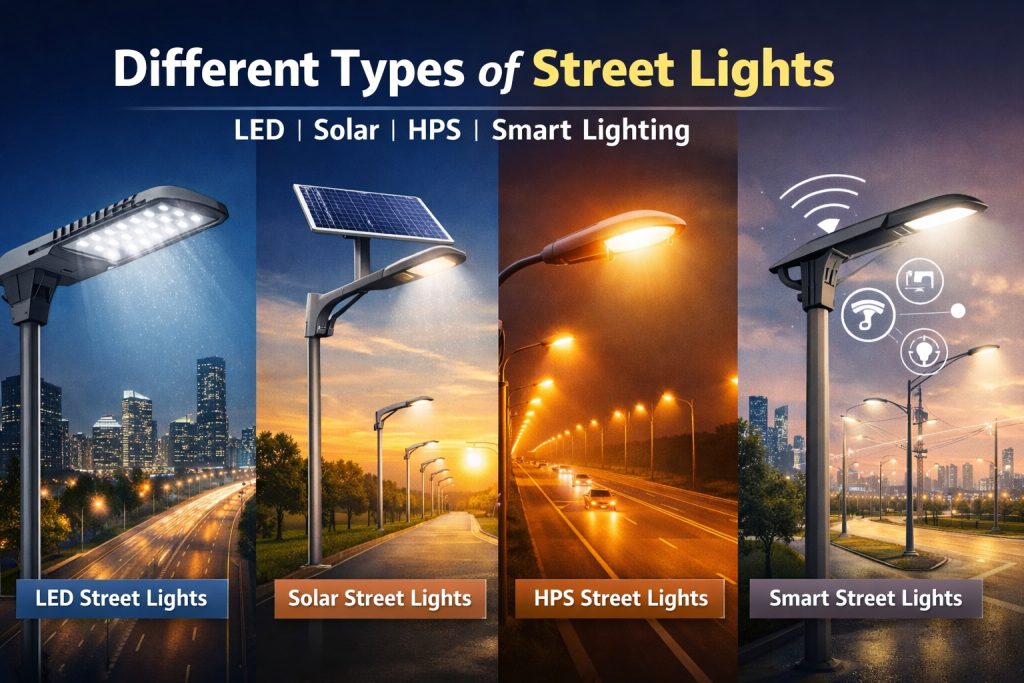
In this guide, we discuss the various categories of the street lights, their pros and cons, and their common uses. The knowledge of the lighting technologies can assist the municipalities, engineers and businesses in determining the most suitable lighting system to use in roads, highways, parks and city areas.
1.LED Street Lights
The most popular form of lighting in the road is the LED (Light Emitting Diode) street lights. Several cities in the world are slowly eliminating the old lighting systems to adopt LEDs in their lighting systems because of its efficiency in energy as well as its longevity.
The LED street lights change directly electricity into light, with the application of semiconductor technology, thus consuming significantly less energy than the conventional lamps. They have a life span of 50,000- 100,000 hours that save on maintenance and replacement.
Benefits of LED Street Lights.
- Extremely energy-efficient
- Long lifespan
- No warm up time, instant start.
- Lower maintenance costs
- Improved visibility and light.
Disadvantages
- Greater initial installation price.
- Poor design may cause glare
Common Applications
- Urban roads
- Highways
- Residential areas
- Parking lots
- Smart city lighting systems
Due to their effectiveness and flexibility, the LED lighting has become the standard technology of the contemporary street lighting projects.
2.High-Pressure Sodium (HPS) Street Lights.
One of the most widespread technologies of street lighting over decades was High-Pressure sodium lights. These lamps emit yellow-orange light and are characterized by reasonably good energy efficiency in comparison with the more ancient lighting technologies.
The principle of HPS lights is to conduct electricity in a vaporized sodium contained in a sealed tube thereby producing light.
The benefits of HPS Street Lights.
- Good energy efficiency
- Long lifespan (about 24,000 hours)
- Dependable visibility in foggy weather.
- Lower upfront cost
Disadvantages
- Poor color rendering
- When seen through yellow light, objects are distorted.
- Warm-up time required
- Increased long term servicing.
Typical Uses
- Highways
- Industrial roads
- Large outdoor areas
Albeit not completely abandoned in certain areas, the use of HPS lighting is slowly being overtaken by LED systems due to the fact that it is more energy-efficient and more visible.
3.Metal Halide Street Lights
Metal Halide (MH) lamps are a different lighting that is a high intensity discharge (HID) which is used in outdoor lighting. They give a white light that is bright and has good color rendering hence they can be used in places where it is essential to have color visibility.
Metal halide lights produce light by subjecting a mixture of metal halide and mercury vapor to an electric arc.
Benefits of the Metal Halide Lighting.
- Bright white illumination
- Good color accuracy
- It fits well in large outdoor areas.
Disadvantages
- Shorter lifespan (15,000–20,000 hours)
- Increased maintenance demands.
- Longer warm-up time
Applications
- Commercial districts
- Stadiums and sports fields
- Parking areas
- Urban streets
Despite the fact that metal halide lights are a great source of brightness, they are more energy consuming and need to be replaced often as opposed to LED lighting.
4.Solar Street Lights
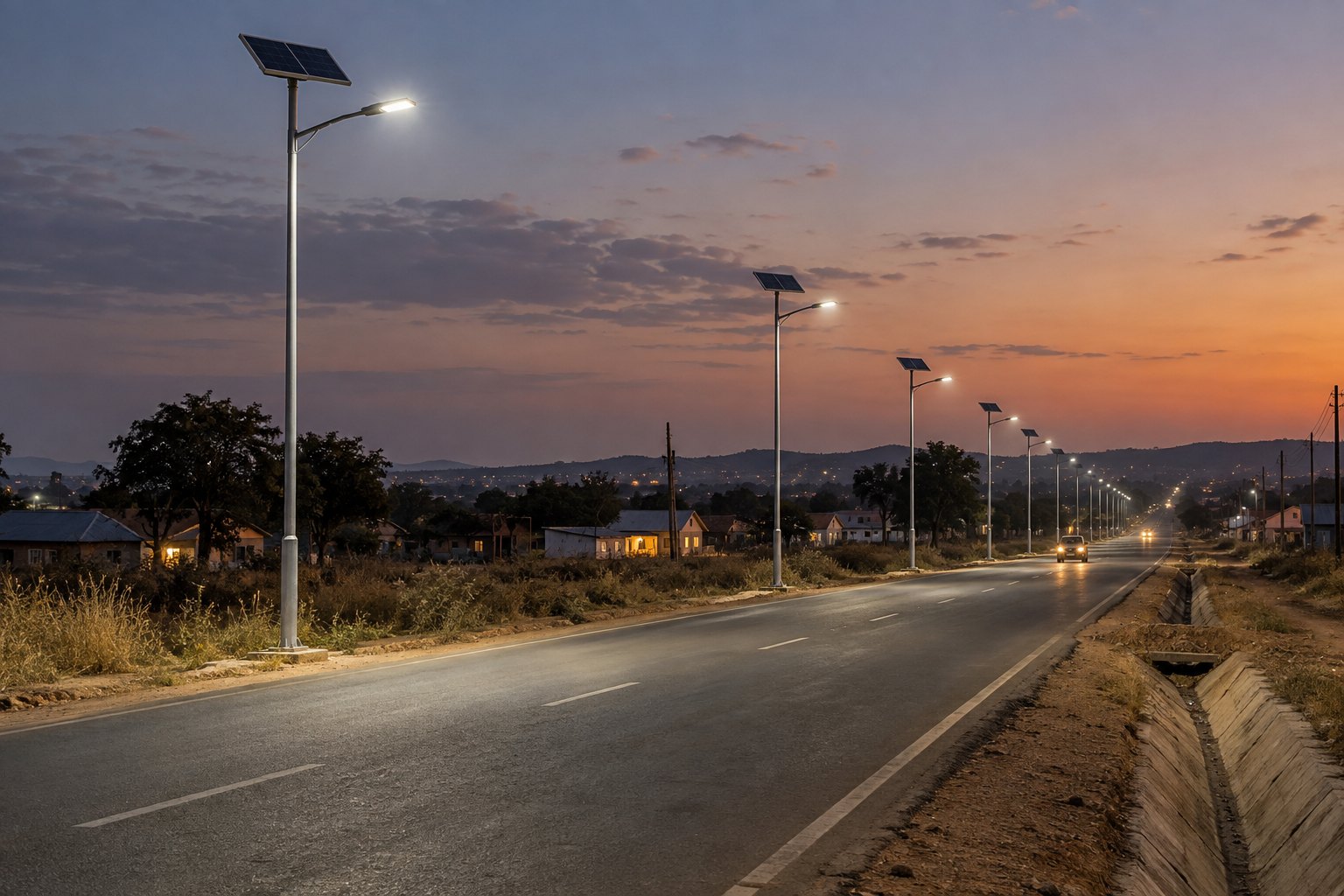
A trend that is gaining momentum is the introduction of solar street lights as cities are shifting to sustainable energy options. These systems use the solar panels to collect sunlight in the daytime and store it in batteries which supply the lights in the night.
Photovoltaic panels and battery storage are generally used with LED lamps to create solar lighting.
The benefits of Solar Street Lights.
- No electricity costs
- Environmentally friendly
- Simple plug-in installation.
- The appropriate remote locations.
Disadvantages
- Higher initial investment
- Weather conditions are dependent on performance.
- It might need a replacement of the battery.
Applications
- Rural roads
- Parks and pathways
- Off-grid communities
- Developing regions
Solar street lamps are particularly useful in locations where the power infrastructure is not very reliable.
5.Fluorescent Street Lights
Fluorescent lighting used to be employed in walkways and in residential streets. These lamps generate light by electric discharge of mercury vapor that makes a phosphor coating release visible light.
However, street lights with fluorescence are less efficient than the current technology of LED and they are slowly being replaced by street lights using LED.
Advantages
- Lower initial cost
- Low-key lighting that can fit small spaces.
Disadvantages
- Lower efficiency
- Shorter lifespan
- It contains mercury that must be disposed with care.
Typical Applications
- The elderly residential areas.
- Pedestrian pathways
- Minor lighting arrangements in the outdoors.
They are replacing the street lights with LED-based fluorescent lights that are available today in almost all municipalities.
6.Smart Street Lights
The evolution of urban lighting is the smart street lighting. These systems are a combination of LED fixtures, sensors, communication networks, and remote management software.
Intelligent street lights have a capability of automatically regulating the brightness according to the traffic, weather patterns or time of the day. They also have the opportunity to link to other larger smart city systems, such as traffic cameras and environmental observators.
Advantages
- Smart grid technology.
- Remotely monitored and maintained.
- IoT network integration.
- Enhanced public safety
Applications
- Smart cities
- The urban transport systems.
- Infrastructure development projects are high-tech.
Smart lighting systems will dominate the way urban development and sustainable city planning will take shape in the future.
A Guide to Selecting the Right Street Light.
The choice of the most suitable street lighting system is determined by a number of factors:
- Energy Efficiency
The most energy-saving feature is the LED and solar street lights.
- Installation Cost
The conventional HPS lamps are cheaper to install but more expensive to maintain.
- Lighting Quality
LED lights and metal halide have superior color rendering as compared to sodium lamps.
- Maintenance Requirements
LED systems have major lifespan hence become very less maintained.
- Environmental Impact
The most environment-friendly ones are solar and LED lighting.
The Future of Street Lighting.
In the new development in lighting technology, the use of LED and smart street lights is fast replacing the traditional lighting systems in the world. These technologies will offer enhanced efficiency, increased life-span and enhanced integration in digital infrastructure.
It is expected that street lighting will be included in bigger smart cities in the future to provide control over energy efficiency, road traffic, and urban safety.
✅ Conclusion
The use of street lights has developed to include the use of the conventional sodium lamps, and the use of the LED and smart lighting. Street lights can be of the most popular LED, high-pressure sodium, metal halide, solar, fluorescent and smart lighting solutions.
The possibilities between these options include LED street lights and solar-powered systems, which are becoming the favorites of such solutions because of their energy efficiency and sustainability, as well as their high durability.
The ultimate decision on the selection of street lighting solution is based on the requirements of the particular location, such as energy use, quality of lighting and the requirements of the infrastructure.

- 10 Meters Lamp Post
- 10 Meters Pole
- 1000w Led Projector
- 100W LED Tunnel Light
- 12 Meters Lamp Post
- 12 Meters Pole
- 1200w Led Projector
- 15 Light Pole
- 1500w Led Projector
- 150W LED Tunnel Light
- 1800w Led Projector
- 2 In 1 Solar Flood Light
- 200w Led Tunnel Light
- 50w Led Tunnel Light
- 6 Meters Lamp Post
- 6 Meters Pole
- 8 Meters Lamp Post
- 8 Meters Pole
- 800w Led Projector
- 80w Led Tunnel Light
- Colourful Decorative Light
- Conical post
- Courtyard Lamp
- courtyard light
- courtyard lighting fixture
- Decorative Landscape Light
- Decorative road Light
- Flood Light For Courtyard
- Flood Light for Garden
- Flood Light For Outdoor
- Foot Led High Bay Lights
- high bay led lights 100w
- industrial lampshade
- industrial LED shed lights
- industrial magnifying glass with light
- Integrated Solar Flood Light
- led courtyard lamp
- led courtyard light
- led high bay light 100w
- LED Projector For Stadium
- Led UFO High Bay 150W 5000k
- Lighting Plants Mining Price
- Maintenance Free LED Street Light
- Pic Controlling Tunnel Light
- PLC controlling tunnel light
- Post Top Garden Light
- RGB Landscape Light
- Rgbw Decorative Light
- Smart Tunnel Light
- solar courtyard lamp
- solar courtyard light
- Solar LED Road Light
- Solar Street Light For 10 Meter Pole
- Solar Street Light For 12 Meter Pole
- Solar Street Light For 6 Meter Pole
- Solar Street Light For 8 Meter Pole
- Split Type Solar Flood Light
- Sporting Projector
- Stadium Led Projector
- Street Lighting Post
