
 Request A Quote

Beyond Brightness: The Core Design Standards and Safety Codes for Parking Lot Lighting
 FACEBOOK
 TWITTER
 LINKEDIN
Parking lot lighting is often misunderstood under the old adage: “more light means better safety.” In actuality, professional parking lot lighting is the design science of safety standards, metrics, and knowing people. Inefficient parking lot lighting is more than a value loss; it causes liability, unused energy, and even safety code issues.
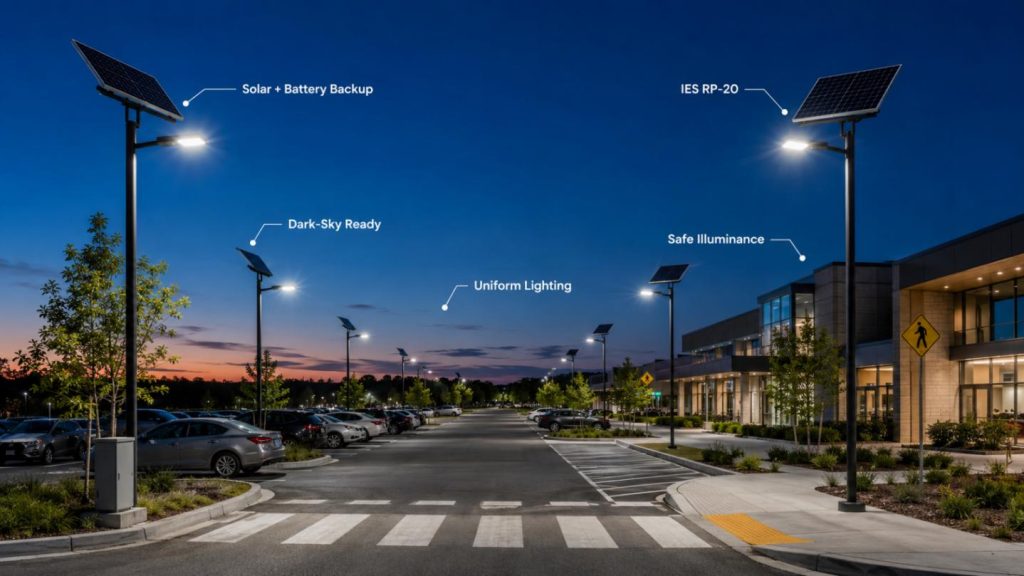
We discuss the modern safety codes that define parking lot lighting design and the benefits of solar LED light solutions. Dawn Lighting, for example, provides a new advanced option for solar parking lot lighting.
The Foundation: IES RP-20 – The Industry Gold Standard
Of the available parking lot lighting design resources in North America, the Illuminating Engineering Society’s RP-20 (Recommended Practice: Lighting for Parking Facilities) is the most comprehensive. From illuminance and vertical illuminance to lighting uniformity and even the emergency lighting design, this safety standard covers it all.
Professional parking lot lighting designers must understand RP-20 as it is the basis for most safety and liability codes.
Illuminance: How Much Light Is Actually Enough?
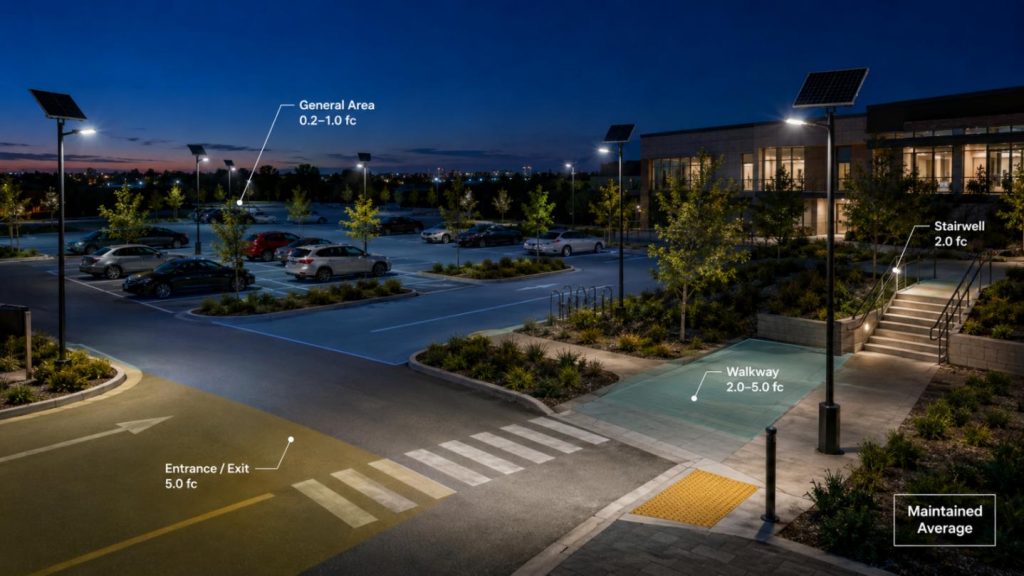
Illuminance—the amount of light falling on a surface—is measured in footcandles (fc) in the United States (1 fc ≈ 10 lux). RP-20 establishes different illuminance targets based on area type and activity level:
•General parking areas: 0.2–1.0 maintained footcandles minimum, with 1.0 fc recommended for higher-security facilities
•Entrance and exit lanes: 5.0 fc recommended to ease the transition from exterior street lighting
•Pedestrian walkways and crosswalks: 2.0 fc minimum, with 5.0 fc recommended as average for enhanced pedestrian safety
•Stairwells: 2.0 fc minimum horizontal illuminance
Critical design note: These are maintained averages—meaning the system must be designed at higher initial levels to account for light depreciation over the fixture’s lifespan. A system designed at exactly 1.0 fc will fall below standard before the first maintenance cycle.
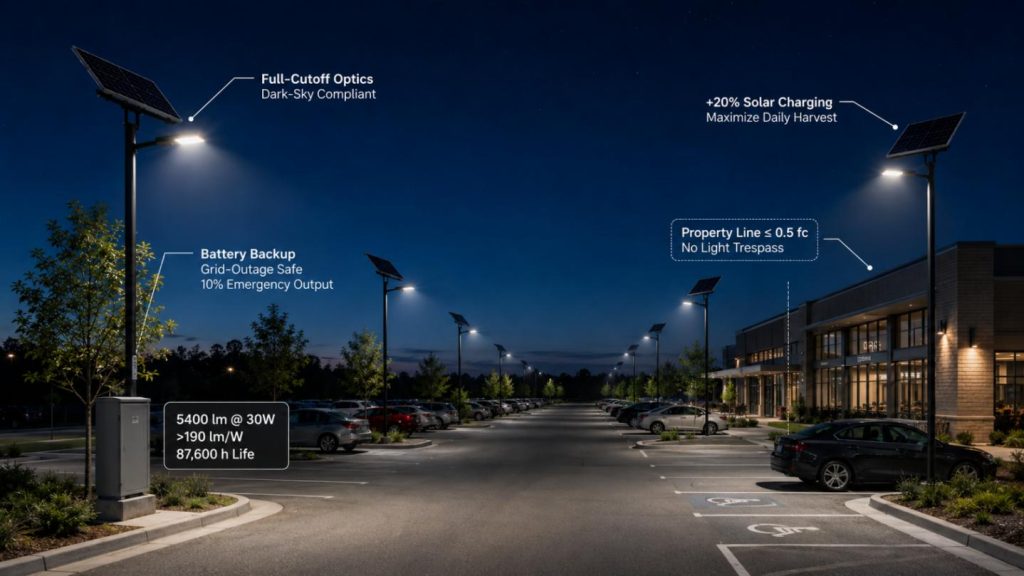
5400 lumens at 30W mean a nominal luminous efficacy of >190 lm/W for our solar parking lot lights. This results in fewer lights needed to reach a target level of illuminance with lowers costs and decreases light pollution.
Uniformity: Eliminating “Dark Spot“ Danger
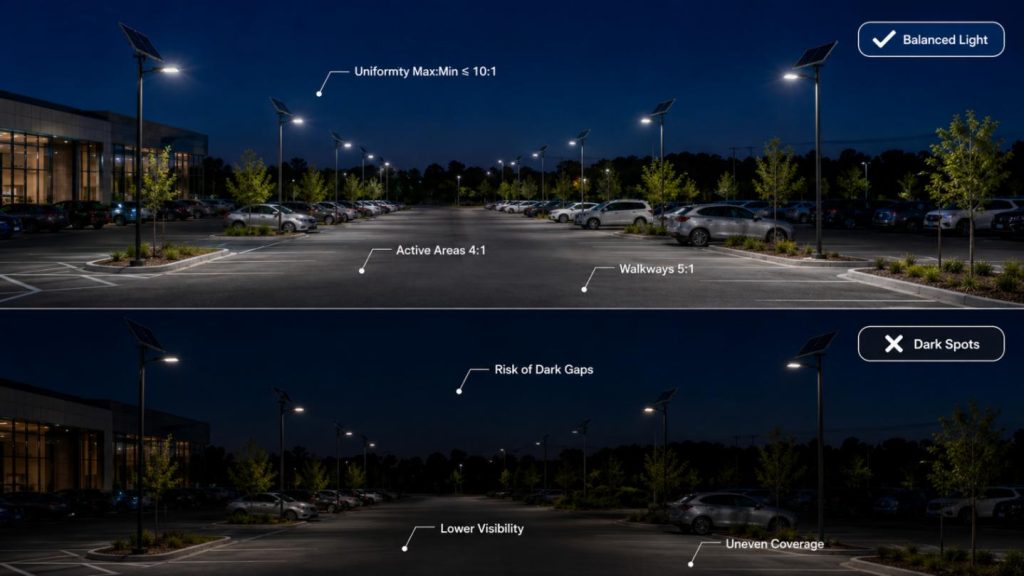
Actually, average illuminance is a bit of a misnomer. The illuminance uniformity ratio, which describes the relationship between maximum to minimum illuminance, is just as important. Dark zones of poor uniformity are created where pedestrians and vehicles are hard to see, even if average illuminance is considered sufficient.
IES standards and suggestions:
•For parking lot illuminance: 10:1 maximum to minimum uniformity ratio.
•For highly active areas: 4:1 maximum to average uniformity ratio.
•For walkways: 5:1 uniformity ratio is recommended.
Safety concern with uniformity: Dark zones in between fixture locations can look average to be safe, but are in fact quite the opposite. Security footage from under-lit, non-uniform lots is often considered too inadequate to be seen as evidence.
Vertical illuminance: The Ability to See Pedestrians
When we illuminate horizontal surfaces (the ground), we are only addressing part of the solution. To detect pedestrians and even recognize their faces, illuminance that strikes more than just horizontal surfaces is a must.
According to RP-20 guidelines:
•For general areas, a vertical to horizontal illuminance ratio of 1:2 shall be used
•For LED installations, a 1:3 to 1:2 ratio is preferred since LED’s have different optical properties which can affect perceived glare.
Why is this important? Heightened vertical illumination helps drivers to see and recognize pedestrians on their path. It allows security cameras to capture clear and identifiable images, which plays an important role in investigating incidents and mitigating liability.
Light Quality: CCT and CRI
The quality of light is as important as its quantity. In parking lot design, the quality of light can be described using two metrics:
•Correlated Color Temperature (CCT) – CCT, expressed in Kelvin (K) is defined as the color of light:
•The preferred color of light in parking structures is 3000K–4000K
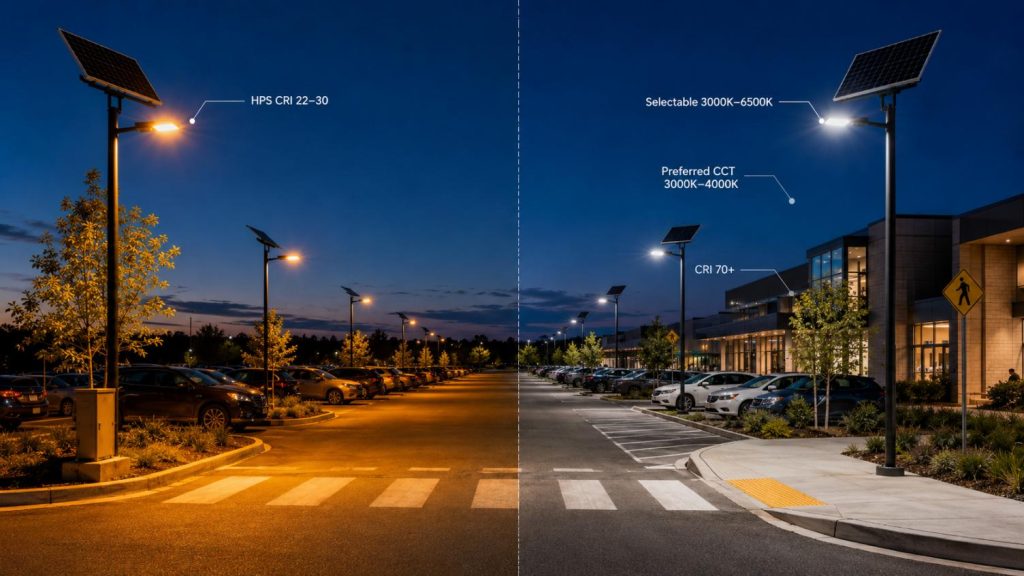
Dawn Lighting’s solar parking lot lights provide designers the flexibility to select a CCT for the lights of 3000K to 6500K. Warmer lighting tones can be designed for residential focused lighting. Commercial and security lighting applications can benefit from lighting of a higher CCT and color tone of a lighting design that is as visible as possible.
•Color Rendering Index (CRI) – CRI is the measurement of color accuracy of a light source. The scale for CRI is from 0 to 100.
•The minimum requirement for parking lot lighting is a CRI of 70
Dawn Lighting’s fixtures, with a CRI of 70+, provide parking lot lighting designs that portray a high level of color accuracy and assist comments and cues on security and perceived lighting quality of a parking lot.
Comparative insight: The lighting of older style parking lots still using high pressure sodium lighting has a CRI of 22 to 30 and a poor yellow/orange color of lighting that impairs visual acuity.
Dark Sky Compliance and Light Trespass
Today’s design considerations for parking lot lighting must take into account the impact of lighting on the environment. The International Dark-Sky Association (IDA) and more local ordinances are demanding:
•Full-cutoff luminaires that direct light only downwards.
•Property line restrictions, with many setting an illuminance limit of 0.5 fc at the property line.
•Situational restrictions on maximum pole heights and maximum luminaire wattage.
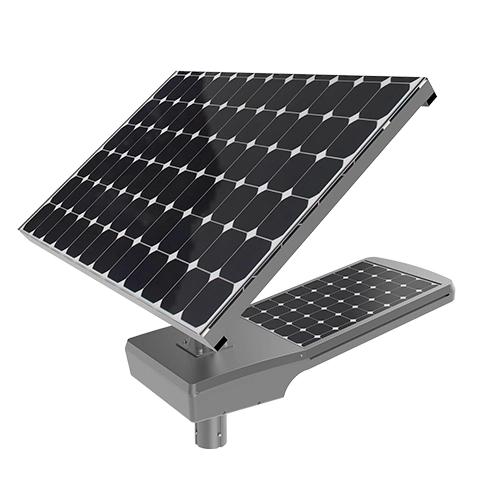
With their innovative optics and dual-sided solar panels, Dawn Lighting solar parking lot lights are built with dark sky compliance in mind. By avoiding the upward light spill caused by traditional area lighting, they do so by offering light only where it is needed and by utilizing on-site generated power.
Emergency Lighting: Grid Down Safety Solutions
RP-20 includes provisions for power disruption incidents. In the case of power interruption:
•Emergency lighting will provide 10% of the standard lighting output for that system
•Along means of egress, the emergency lighting will provide no less than 10 lux (approximately 1 fc)
•The system will be in compliance with NFPA 101 Life Safety Code and NFPA 70 National Electrical Code
As for solar-powered parking lot lighting, they are not dependent on the grid, which means they have one built in advantage. Thanks to the built in battery storage, during a grid power outage, Dawn Lighting’s solar solutions would continue to light the surroundings, which turns a potential liability into a safety asset.
How Modern Solar LED Technology Meets These Standards
Solar LED Technology has changed how parking lot lighting design can be constructed. An example of this would be in our solar parking lot lights. These lights demonstrate the principles discussed herein:
•5400 lm luminous flux while only using 30W nominal—Bright and energy conscious design
•>190 lm/W luminous efficacy—Exceeds traditional lighting technologies
•87600-hour service life—Reduces the burden and cost of frequent servicing
•Bilateral solar panel design increases charging efficiency by 20% guaranteed dusk-to-dawn lighting under inclement weather
•Built-in self-PV sweeper automatically cleans the solar panels
•Rain sensor activation further enhances cleaning efficiency and minimizes maintenance needs
Closing Words
Lighting design involves the considerations of various standards such as IES RP-20 while keeping the customer and user in mind. Safety and efficiency are two of the driving forces for the evolution and design, while the balance of dark-sky concerns and emergency preparedness has become a greater focal point of design in recent years.
Dawn Lighting shows that modern solar LED solutions are achievable and cost-effective. With advanced luminous efficacy, and self-cleaning, grid-free systems, these solutions show just how smart, safe, and sustainable future parking lot lighting can be.
Frequently Asked Questions (FAQ)
Q1. What do the IES RP-20 guidelines say about illuminance in General Parking Areas?
General Parking Areas may be illuminated to 0.2 – 1.0 maintained footcandles. For a higher – security facility, 1.0 ft. candle is advised.
Q2. What is the implication of Uniformity Ratio in Parking Lot Lighting?
It is important to lighting safety, as it reduces the chance of a dark area. An industry wide standard is a maximum-to-minimum ratio of 10:1.
Q3. What is CRI and how important it is to the lighting of parking lots?
CRI is Color Rendering Index, which is a measure of color accuracy. A rating of CRI which is greater than 70, will help a driver as well as a security camera to better distinguish objects, vehicles and people.
Q4. How is CCT (Color Correlated Temperature) considered in the design of Parking Lot Lighting?
CCT ranges from warm (3000K) to cool (6500K) – lighting of a parking lot is better when it is of the cooler range. Warmer tones may be appropriate for lighting of a more residential or mixed-use area.
Q5. What is Vertical Illuminance and how is it considered in the design?
Vertical Illuminance illuminates the side of the vehicles and the walls of a parking lot. It improves the detection of a pedestrian and improves the quality of security images.

- 10 Meters Lamp Post
- 10 Meters Pole
- 1000w Led Projector
- 100W LED Tunnel Light
- 12 Meters Lamp Post
- 12 Meters Pole
- 1200w Led Projector
- 15 Light Pole
- 1500w Led Projector
- 150W LED Tunnel Light
- 1800w Led Projector
- 2 In 1 Solar Flood Light
- 200w Led Tunnel Light
- 50w Led Tunnel Light
- 6 Meters Lamp Post
- 6 Meters Pole
- 8 Meters Lamp Post
- 8 Meters Pole
- 800w Led Projector
- 80w Led Tunnel Light
- Colourful Decorative Light
- Conical post
- Courtyard Lamp
- courtyard light
- courtyard lighting fixture
- Decorative Landscape Light
- Decorative road Light
- Flood Light For Courtyard
- Flood Light for Garden
- Flood Light For Outdoor
- Foot Led High Bay Lights
- high bay led lights 100w
- industrial lampshade
- industrial LED shed lights
- industrial magnifying glass with light
- Integrated Solar Flood Light
- led courtyard lamp
- led courtyard light
- led high bay light 100w
- LED Projector For Stadium
- Led UFO High Bay 150W 5000k
- Lighting Plants Mining Price
- Maintenance Free LED Street Light
- Pic Controlling Tunnel Light
- PLC controlling tunnel light
- Post Top Garden Light
- RGB Landscape Light
- Rgbw Decorative Light
- Smart Tunnel Light
- solar courtyard lamp
- solar courtyard light
- Solar LED Road Light
- Solar Street Light For 10 Meter Pole
- Solar Street Light For 12 Meter Pole
- Solar Street Light For 6 Meter Pole
- Solar Street Light For 8 Meter Pole
- Split Type Solar Flood Light
- Sporting Projector
- Stadium Led Projector
- Street Lighting Post
