
 Request A Quote

2026 Outdoor Landscape Spotlights: AI-Driven Control, Circadian Lighting, and “Invisible” Design
 FACEBOOK
 TWITTER
 LINKEDIN
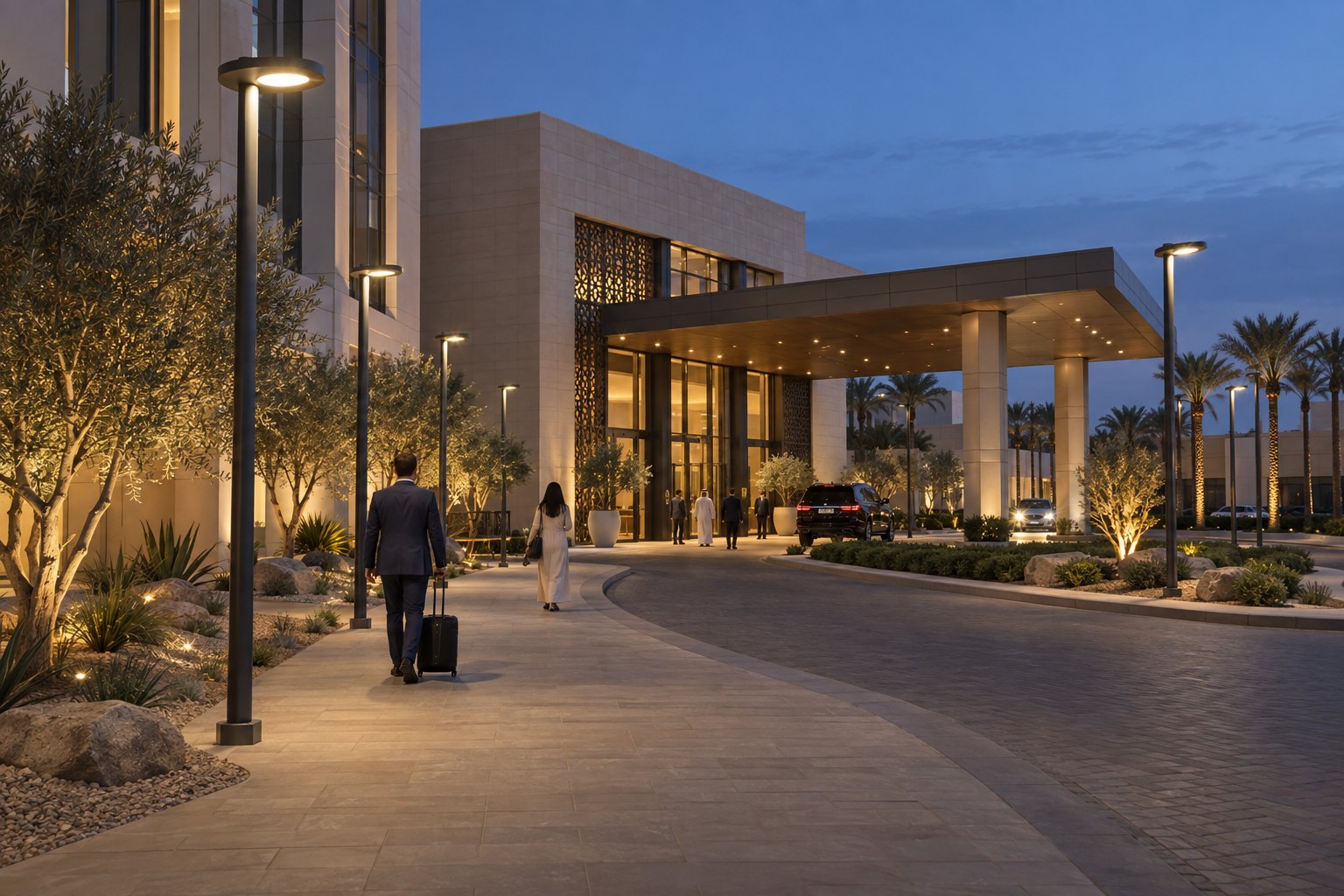
2026 will mark a huge development year for the outdoor landscape lighting industry. Landscape lighting has been traditionally used for safety or visibility. However, it will soon be viewed as a design element. Innovations of AI, health promoting design, and minimalist design will be appreciated. Technology will continue to develop as the consumer market demands more energy efficient, personalized, and environmentally sustainable products.
Trend 1: Integrated Systems and AI
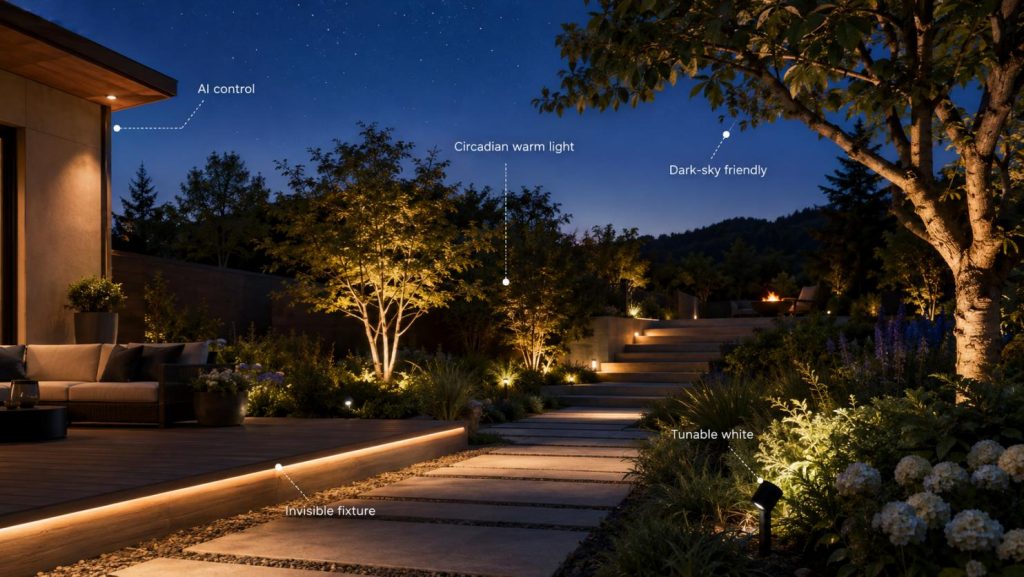
Fully integrated, AI-based systems will replace the disjointed, timers-based outdoor landscape lighting of the past. Property managers and homeowners prefer integrated systems to control lighting in landscape beds, hardscape walls, steps, decks, and other areas and features of the outdoor living space.
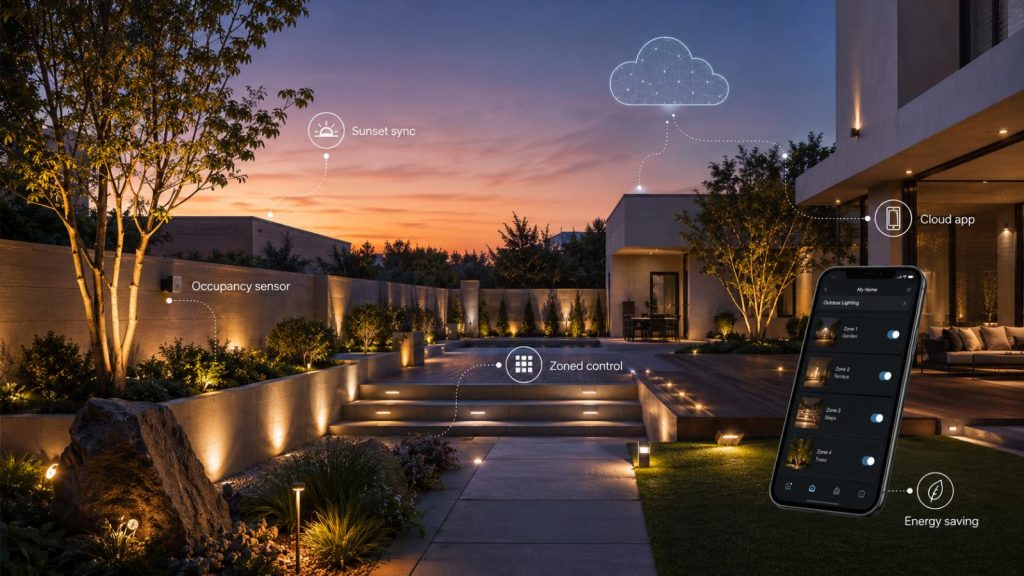
•AI-driven landscape spotlights operate and adjust to the timing of the sunrise and sunset: Timers will become obsolete as systems shift to real time data to set and adjust lighting.
•AI Lighting will adjust based on the time and anticipated behavior: The system will identify and adjust to the environmental factors and the expected time of arrival for the users.
•Zoned design and system control will become the standard: Outdoor features will be controlled through one device.
Spaces with no occupants will be lit only when warranted: Safety and aesthetics will be considered in the application of automation.
•Connectivity of IoT and sensors will make environments smart. The combination of artificial intelligence with IoT and smart sensors will lead to advanced lighting solutions that will adjust to the presence of people and the surroundings.
•Cloud management will lead to control from a distance. Property managers and owners will have the capability to see and edit their lighting system from almost anywhere.
Trend 2: Lighting for Health and Circadian Aiding Design
The designs of lighting for health and wellbeing are in their infancy. Lighting that assists the body’s natural circadian rhythm will adjust the color and intensity of the light throughout the evening to reflect the natural changes of the environment in order to help people to unwind.
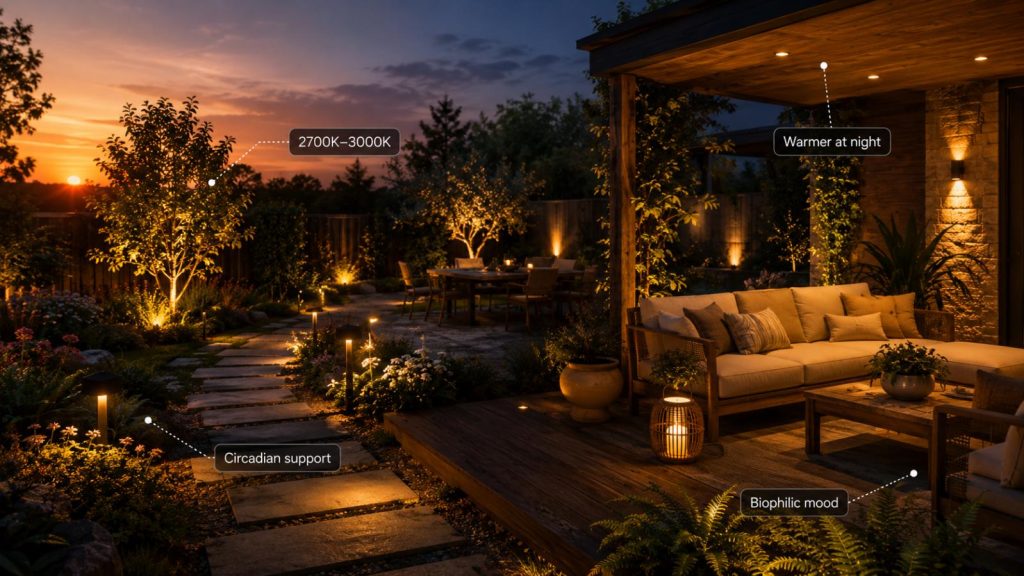
•The 2026 design portfolio will have warmer color temperatures 2700K–3000K. The design cycle will end the use of outdoor lighting that has cold, bluish-white color temperatures. Warm incandescent lighting will be used.
•Lighting that helps people unwind in the evening will align with the natural circadian rhythm. Lighting that is cool-white and of the illuminating spectrum will disrupt the natural sleep cycle. To create an atmosphere that encourages people to unwind in the evening, warm lighting will be used.
•By 2026, the lighting systems that are designed to help people and be centered around people will be worth $4.52 billion. The lighting systems will be advanced and wellness-centered and will be used to design spaces that promote health and productivity.
•Biophilic design focuses lighting on the beauty of nature: Fixtures with designs that incorporate leaves, rocks, and other natural shapes create a calming effect and a balance with nature.
•Light that changes in intensity and color is the design focus for the day: Designers are increasingly inspired by circadian rhythms in the design focus for the day from light in the golden hour until after the sun sets.
Trend 3: “Tunable White“ and Dynamic Color Lighting
The standard for “warm white” lighting is being replaced by tunable white technology. This “warm white” standard” now allows consumers to choose between warm amber (2700K) and cool (4000K) white based on personal preference or changes in activity.
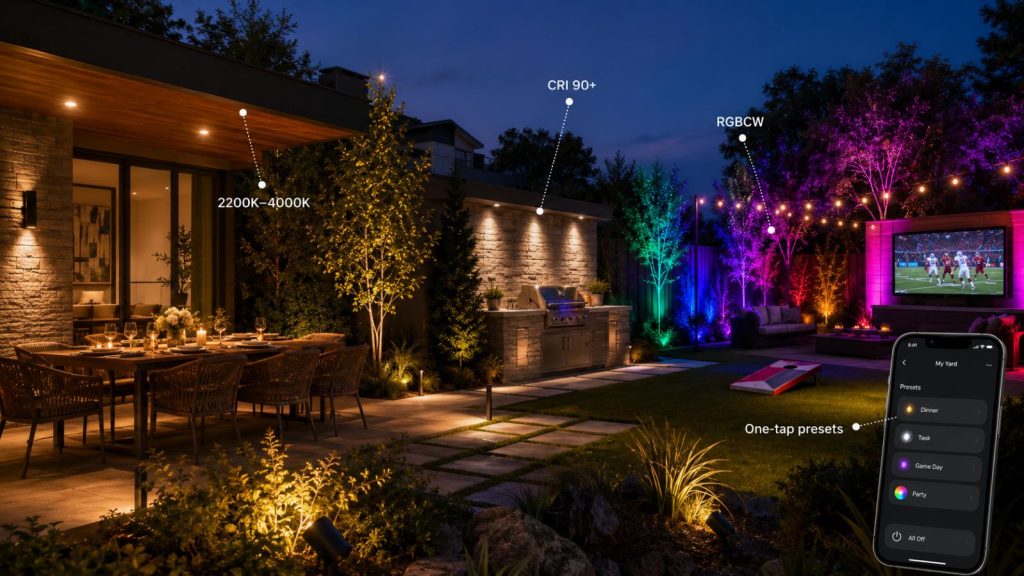
•RGBCW-enabled landscape spotlights combine ease of use with serious functionality: RGBCW technology blends tunable white and full CW with some products offering full control over the range of 2200K-4000K.
•Gone are the days of boring one-tone lighting: With a tap of a button on the app, homeowners can now switch lighting from the warm white during family dinners to whatever color lighting they prefer during parties or game-day.
•High CRI (Color Rendering Index) means no more guesswork when it comes to color: Tunable white products now in the market are hitting a CRI of 90+ allowing everything from plants to the stonework to the arch and everything in between to be seen in their natural color.
•No need to update your lighting for the seasons anymore with all the presets: Consumers can now choose the lighting they want for all their summer parties and winter holidays and everything in between and set it on their phones to pull up whenever they want.
•By the year 2032, the global outdoor LED lighting market is expected to hit $47.80 billion: This growth, with a CAGR of 7.35%, is a direct result of the use of more advanced and customizable lighting technology.
Trend 4: The “Invisible“ Lighting Movement
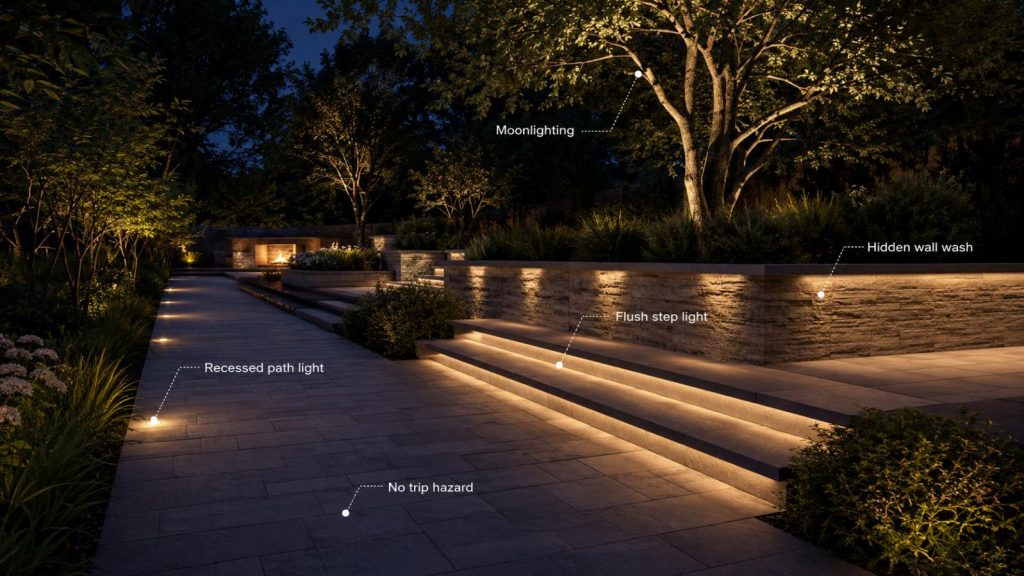
2026 may be the year where most lighting design concepts become “Invisible”. There will be a transition away from using bulky path lights or spotlight units, to designs that recess and conceal lights so they vanish in daylight.
•Pitting lights against fixtures is the general design philosophy behind most commercial landscape lighting. Low profile walk line lighting and slim integrated lighting remains trickiest to design against.
•Designs where lighting is integrated within path walk and driveways recess lighting completely into the fixtures and eliminates protrusion above ground.
•Step edges and space dividers remain illuminated from integrated lighting fixtures flush against the material.
•Light fixtures strategically placed within tree boughs to imitate a full moon create organic shadow patterns in a lighting design concept called “moonlightin”.
•While hidden lighting elevates the aesthetic design of a space, it can also eliminates protruding objects which may cause a tripping hazard.
Trend 5: Ecological Integration and Dark Sky Compliance
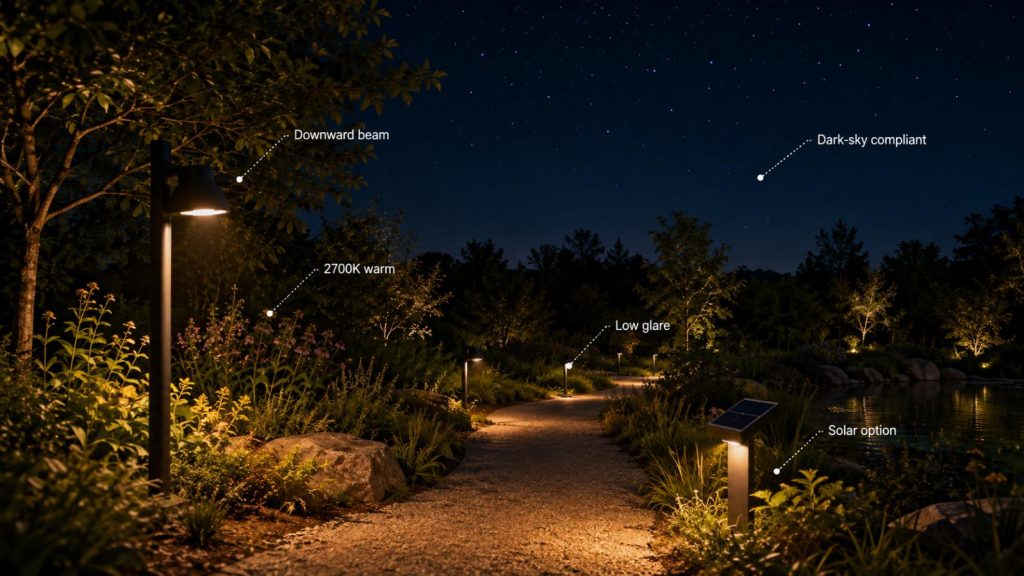
Sustainability is rapidly becoming an expectation of modern lighting design and less of a consideration. An emerging focus of design is on respecting natural ecosystems and the impact lighting may have.
•”See the light, not the fixture” is also about seeing the light, not the lamp. This design philosophy embraces the notion of respecting natural rhythms and creating design solutions that minimally impact the environment.
•Cool, blue-rich whites and cool whites are being eliminated in favor of lighting with warmer color temperatures that are less disturbing to nocturnal wildlife and insects.
•AI and edge computing in urban safety applications are driving the demand for lighting that balances protection of the human and natural environments.
•Innovative solar and kinetic energy technologies combined with hybrid solar energy systems are encouraging landscape lighting to become self-powered in more remote and sensitive locations.
Why Choose Dawn Lighting
Since 2011, Dawn Lighting has provided municipal, commercial, and residential customers with quality outdoor lighting. With more than 35,000 sqm of manufacturing on site, we control the quality and the supply of our poles, solar components, and fixtures.
We provide engineering support in the form of IES/Dialux, structural calculations, and installation drawings. Our products are tested for UV, salt spray, and vibration. Our solutions help the customer and the market with innovation and sustainability in mind.
FAQs
Q1: What are AI-driven outdoor landscape spotlights?
They modify their schedules, brightness, and color based on the current weather, the number of people in the vicinity, and even the user’s habits to use energy more efficiently and improve comfort.
Q2: What is circadian lighting for outdoor spaces?
It changes color to simulate warmer or cooler lighting to match the time of day, promoting a more natural sleep cycle.
Q3: Why choose tunable white technology?
Tunable white fixtures let you adjust the color temperature to match your mood or the season.
Q4: What does “invisible” lighting design mean?
It refers to design elements that are flush to the surface or otherwise concealed. The lighting effect is visible, but the fixture is not.
Q5: How do I select the right IP rating for outdoor spotlights?
IP65 is sufficient for fixtures that will only experience rain and dust; IP67 or IP68 is required for lighting that will be completely submerged.
- 10 Meters Lamp Post
- 10 Meters Pole
- 1000w Led Projector
- 100W LED Tunnel Light
- 12 Meters Lamp Post
- 12 Meters Pole
- 1200w Led Projector
- 15 Light Pole
- 1500w Led Projector
- 150W LED Tunnel Light
- 1800w Led Projector
- 2 In 1 Solar Flood Light
- 200w Led Tunnel Light
- 50w Led Tunnel Light
- 6 Meters Lamp Post
- 6 Meters Pole
- 8 Meters Lamp Post
- 8 Meters Pole
- 800w Led Projector
- 80w Led Tunnel Light
- Colourful Decorative Light
- Conical post
- Courtyard Lamp
- courtyard light
- courtyard lighting fixture
- Decorative Landscape Light
- Decorative road Light
- Flood Light For Courtyard
- Flood Light for Garden
- Flood Light For Outdoor
- Foot Led High Bay Lights
- high bay led lights 100w
- industrial lampshade
- industrial LED shed lights
- industrial magnifying glass with light
- Integrated Solar Flood Light
- led courtyard lamp
- led courtyard light
- led high bay light 100w
- LED Projector For Stadium
- Led UFO High Bay 150W 5000k
- Lighting Plants Mining Price
- Maintenance Free LED Street Light
- Pic Controlling Tunnel Light
- PLC controlling tunnel light
- Post Top Garden Light
- RGB Landscape Light
- Rgbw Decorative Light
- Smart Tunnel Light
- solar courtyard lamp
- solar courtyard light
- Solar LED Road Light
- Solar Street Light For 10 Meter Pole
- Solar Street Light For 12 Meter Pole
- Solar Street Light For 6 Meter Pole
- Solar Street Light For 8 Meter Pole
- Split Type Solar Flood Light
- Sporting Projector
- Stadium Led Projector
- Street Lighting Post
