
 Request A Quote

Self-Cleaning Solar Street Lights for Palm Oil Plantations
 FACEBOOK
 TWITTER
 LINKEDIN
The lighting infrastructure is very important in palm oil plantations. The roads, the areas where the workers live, the plants and the security areas all demand coherent lighting so as to ensure that the operations are safe even in the dark. Nonetheless, conventional lighting systems are not very applicable in plantation settings because of dust, humidity, oil fog and poor accessibility to maintenance.
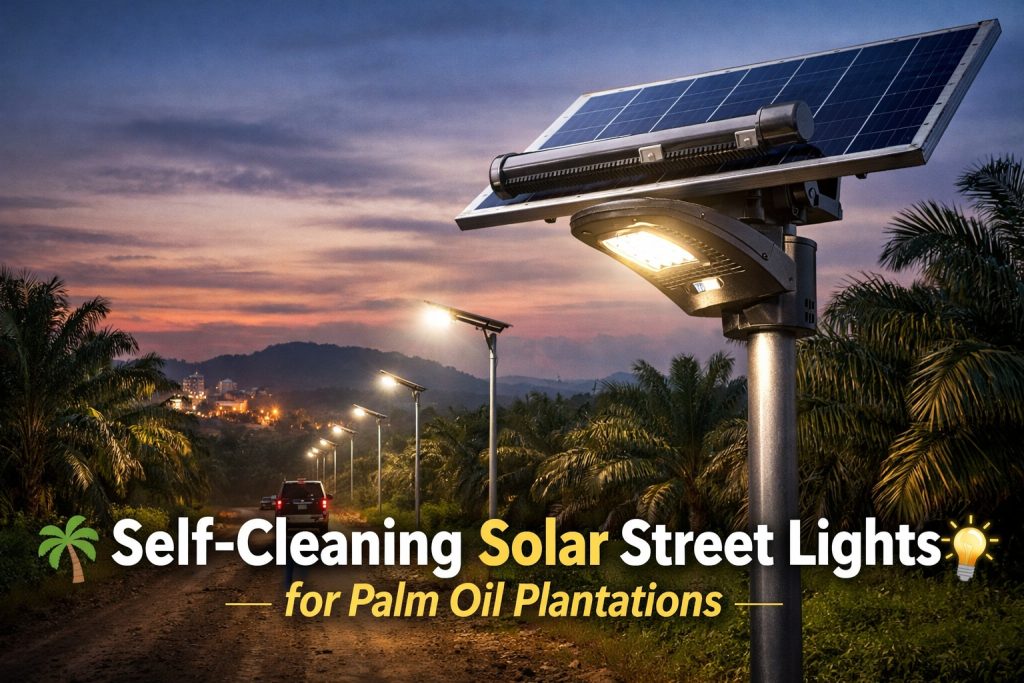
Self cleaning street lights in palm oil plantations offer a viable and sustainable solution in this area. These systems can minimize the need to maintain lighting performance as they can achieve this by combining solar power with automated cleaning technology.
This article discusses the operation of self-cleaning street lights, why they are especially important in palm-oil areas, and how they can be installed successfully by the owners of a plantation.
What Is a Self Cleaning Street Light?
A self-cleaning solar street light is a lighting system that comes with automatic mechanisms that automatically clean the solar panel surface of dust and debris as well as contaminants. That is primarily aimed at preserving a high level of energy generation without a manual cleaning every now and then.
Conventional solar lights come with the need of having workers wipe the panels after some intervals. In big plantations when lights are spaced over kilometers of road this activity is costly, time consuming and even unsafe.
To address this issue, self-cleaning street lights are used that involve the following automated technologies:
- Wipers or mechanical brushes.
- Hydrophobic/nano-coatings.
- Smart cleaning programs in response to a sensor.
- Combined solar lighting systems.
These technologies keep the solar panels clean to enable them to keep capturing sunlight effectively.
The reason Palm Oil Plantations should have Self-cleaning Street Lamps.
The plantations of palm oils provide special environment that influences development of outdoor infrastructures.
Common challenges include:
- Dust and Plantation Debris
Large quantities of dust are produced by unpaved roads, harvesting operations and vehicles involved in transportation. With time, this dust gets deposited on solar panels and slows power generation.
- Oil Mist and Organic Residue
The factories emit small oil particles into the atmosphere. These particles are capable of accumulating on equipment surfaces and creating sticky layers, which are hard to remove.
- High Humidity and Rainfall
Southeast Asia and some parts of Africa are where palm oils are grown where the humidity is high and seasonal rain is experienced. These are conditions that hasten corrosions and degradation of materials.
- Remote Infrastructure
Plantations are usually situated well away from the urban centers. All they do is to cover a long distance to clean or repair lights equipment by maintenance teams.
These challenges are resolved by self-cleaning lighting systems to ensure that the solar output in the lights is kept at an automatic level and that the systems require minimal manual maintenance. Research creates a possibility of introducing automated cleaning systems that can cut down on maintenance by up to 65-70 per cent in agricultural set ups.
The Science behind Self-Cleaning Technology.
There are a number of various technologies employed by self-cleaning street lights to ensure that there is no contamination on solar panels and lamp surfaces.
Automated Cleaning Systems.
There is even some systems that have motorized brushes or wipers running over the surface of the solar panel at regular intervals. This will physically get rid of dust, pollen and oil residue before they build up.
Depending on the environment washing can be done once or twice in a day.
Hydrophobic Coatings on Surfaces.
Repelling water and decreasing particle-surface contact, the hydrophobic coating helps the panelherd to adhere to the surface. During rainfall, the dirt is washed away by the droplets as they roll on the panel.
Such coating forms a micro-textured surface that cannot allow contaminants to stick easily.
Smart Automation
Controllers and sensors used in the lighting systems of modern world watch over the power production. In case the solar efficiency is lowered by the dust, it automatically causes a cleaning cycle.
This is to synchronize performance and reduce energy consumption.
Advantages of Palm oil plantations operations.
Self cleaning street lights have a number of operational benefits to the plantation owners and the planners in the infrastructure.
Reduced Maintenance Costs
The process of cleaning up the panels manually involves workforce, machinery, and transportation. Most of this work can be removed by automated cleaning systems, which reduces the operational costs in the long run.
Night lighting should be regular.
The level of energy production is higher in clean solar panels, which makes lights to be reliable during the night.
Good lighting enhances safety of workers, road navigation, and logistics of a plantation.
Improved Sustainability
The solar street lights do not require any facility to the electric grid. They also contribute to the reduction of carbon emissions by using renewable energy and preventing travels with maintenance.
This facilitates sustainability programs and ESG undertakings in the palm oil sector.
Longer Equipment Lifespan
Since the cleanups are done periodically, there is a reduction in the rate of degradation experienced by the solar panels and LED fixtures. This increases life span of systems and lowers cost of replacement.
Important Elements of a Self Cleaning Street light System.
The design and components of the lighting systems should be considered when picking the one to use in palm oil plantations.
Superior Energy-Saving Solar Panels.
Majority of the systems adopt monocrystalline photovoltaic panels due to the fact that they generate higher power under scarce sunlight.
To minimize the accumulation of contamination, anti-dust or hydrophobic coating is frequently placed.
Lithium Battery Storage
A reputable energy storage would also mean that the lights would be on during the night even in cloudy seasons.
The common type of battery is Lithium iron phosphate (LiFePO4) batteries which have a long life and it is highly stable.
Smart Solar Controllers
The Maximum Power Point Tracking (MPPT) controllers are used to optimize energy production and hence the electrical load is varied in relation to sunlight.
Cleaning cycles and energy consumption are also controlled in these controllers.
LED Lighting Fixtures
LEDs are high efficiency, which means that they emit bright light using little power. The use of modern fixtures is able to provide more than 160 lumens per watt, which enhances the efficiency of the entire system.
The palm oil plantations deployment considerations.
The installation of self cleaning street lights needs proper planning so that the performance will last long.
Conduct a Site Assessment
Plantation managers are to estimate:
- Solar irradiance levels
- Dust concentration
- Rainfall frequency
- Oil mist exposure
- Road and facility layout
This knowledge is used to identify the correct system set up.
Plan Lighting Layout
The height of the poles, their spacing, and light coverage must be arranged in such a way that dark areas are not created in plantation roads and operational areas.
It improves the safety of workers and vehicle navigation through proper planning.
Setting up Maintenance Monitoring.
The self cleaning systems do not need much maintenance, but there is need to have periodic inspections.
The problems that may be revealed by quarterly inspections include:
- Mechanical wear
- Battery degradation
- Structural corrosion
Other systems also have IoT monitoring platforms that enable the managers to monitor performance remotely.
Practical Application in the Oil Palm Areas.
The self-cleaning street lights have proven to be effective in plantations, as shown by several pilot projects in Southeast Asia.
As an example, a pilot project in 2024 in Indonesia installed more than 200 self-cleaning solar street lights on the plantation roads. The results showed:
- Maintenance visits decreased by 65% in number.
- Better visibility at night.
- Greater dependability of monsoons.
These findings indicate that self-cleaning systems would help a lot to enhance the lighting reliability of remote agricultural operations.
The Problems and Reflections.
Even though they have the benefits, there are also limitations associated with self-cleaning street lights.
Higher Initial Cost
The Self-cleaning models are usually more expensive than the conventional solar lights because they have extra mechanisms and sensors.
The high initial cost is however compensated by the lower maintenance costs over the long run.
Mechanical Wear
Moving parts in the system as in brushes, or wipers can need replacement after a while.
Unexpected failures can be avoided by conducting routine inspections.
Energy Management
It takes energy to clean the cycles. The right size of the system should be taken in order to make sure that the batteries are able to provide the lighting and cleaning features.
Plantation Lighting of the Future.
With the development of palm oil plantations, the use of automatized solar light systems gains more significance as the infrastructure becomes more intelligent.
The cleaning of street lights on their own is a step towards more robust and sustainable plantation processes. These systems are practical in remote agricultural settings by lowering the cost of maintenance, enhancing safety and facilitating the use of renewable energy.
Self-cleaning solar street lights are one long-term investment that enhances efficiency and sustainability of operation to plantation owners who want to enjoy the benefits of reliable lighting with minimal maintenance.


- 10 Meters Lamp Post
- 10 Meters Pole
- 1000w Led Projector
- 100W LED Tunnel Light
- 12 Meters Lamp Post
- 12 Meters Pole
- 1200w Led Projector
- 15 Light Pole
- 1500w Led Projector
- 150W LED Tunnel Light
- 1800w Led Projector
- 2 In 1 Solar Flood Light
- 200w Led Tunnel Light
- 50w Led Tunnel Light
- 6 Meters Lamp Post
- 6 Meters Pole
- 8 Meters Lamp Post
- 8 Meters Pole
- 800w Led Projector
- 80w Led Tunnel Light
- Colourful Decorative Light
- Conical post
- Courtyard Lamp
- courtyard light
- courtyard lighting fixture
- Decorative Landscape Light
- Decorative road Light
- Flood Light For Courtyard
- Flood Light for Garden
- Flood Light For Outdoor
- Foot Led High Bay Lights
- high bay led lights 100w
- industrial lampshade
- industrial LED shed lights
- industrial magnifying glass with light
- Integrated Solar Flood Light
- led courtyard lamp
- led courtyard light
- led high bay light 100w
- LED Projector For Stadium
- Led UFO High Bay 150W 5000k
- Lighting Plants Mining Price
- Maintenance Free LED Street Light
- Pic Controlling Tunnel Light
- PLC controlling tunnel light
- Post Top Garden Light
- RGB Landscape Light
- Rgbw Decorative Light
- Smart Tunnel Light
- solar courtyard lamp
- solar courtyard light
- Solar LED Road Light
- Solar Street Light For 10 Meter Pole
- Solar Street Light For 12 Meter Pole
- Solar Street Light For 6 Meter Pole
- Solar Street Light For 8 Meter Pole
- Split Type Solar Flood Light
- Sporting Projector
- Stadium Led Projector
- Street Lighting Post
