
 Request A Quote


Solar LED Street Lights: Evaluate Road Illumination Beyond Wattage
 FACEBOOK
 TWITTER
 LINKEDIN
You might have a great solar street light in a catalogue and it may still fail on the road. There is no relationship between high wattage and whether the beam gets to the other side of the kerb and whether it is problematic for pedestrians; or whether there will be adequate cover on the night setting.
The LED specification of solar LED street lights is a starting point, not a verdict that contractors and project buyers can use for comparing solar LED street lights. The more robust proposal relates the actual performance of the luminaire to a practical layout and a well-defined operating mode.
Use a separate LED Power from Panel Power.
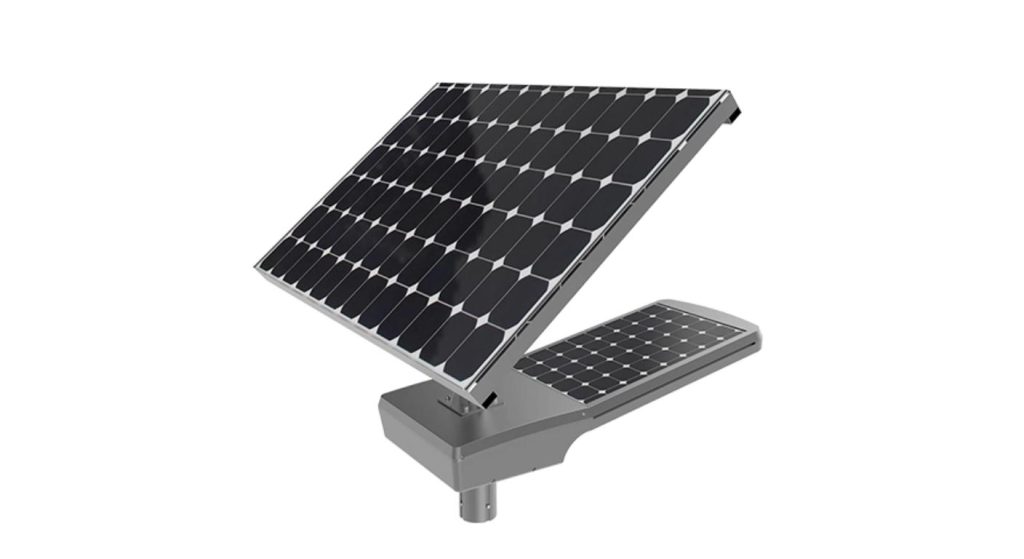
There are a number of electrical ratings that are relevant to solar lighting products and are combined in one product description. LED Input power is consumption at stated operating setting. The wattage of a solar panel is the amount of generation capacity under certain test conditions. The battery watt-hours are used to describe nominal stored energy. These values address various questions.
Always check with the supplier to label each rating and determine the operating mode before comparing models. Products that have a high wattage in the headline may not use that amount of energy during the nighttime. Similarly, a larger panel doesn’t automatically guarantee that the road will light up more brightly.
Dawn Lighting’s LED solar street light series comes with various system configurations. Use a model specific data sheets, which includes the lighting specification and charging and storage components separately, so competing proposals can be evaluated on equal bases.
To read out Efficacy at the Complete-Luminaire Level.
Luminous efficacy is a measure of efficiency that relates the amount of light produced for a given amount of electrical energy consumed (in units of lumens per watt). The efficiency of an LED package is different however from the measured efficacy of an assembled luminaire. The finished product is affected by drivers, optics and operating condition.
For example, a fully rated 30W, 4800lm luminaire has an efficacy of 160lm/W. When the lumen is rated for bare LEDs, the wattage is rated for another system component, the same wattage calculation cannot be reliably used.
Ask what is behind the quoted number – test basis, input power, output and product configuration. An equivalent chip brand or a great ‘max’ rating is not a replacement for an equivalent luminaire report. When comparing values, compare measurements made in the same conditions, not mixing component and finished product claims.
Follow the Beam Beyond the Brightest Patch
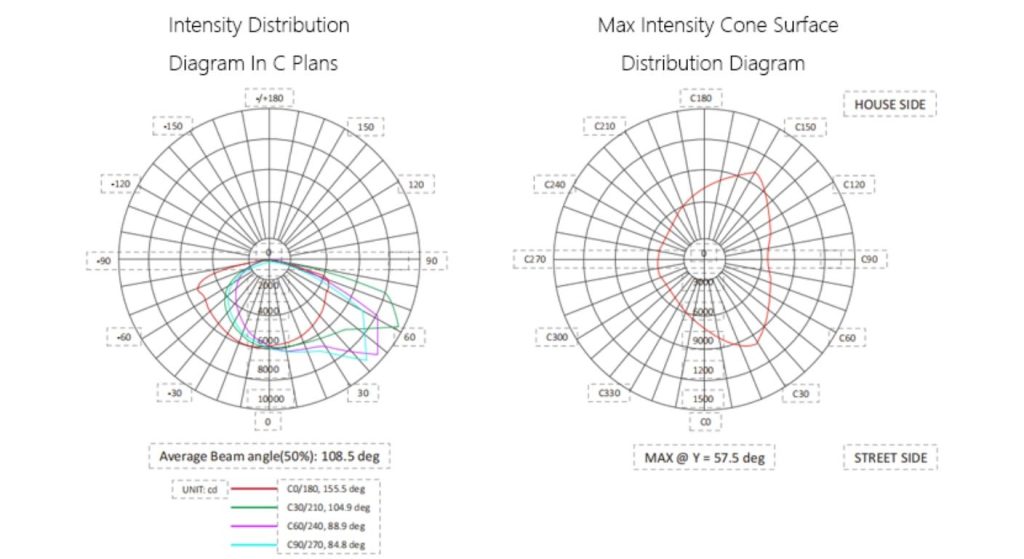
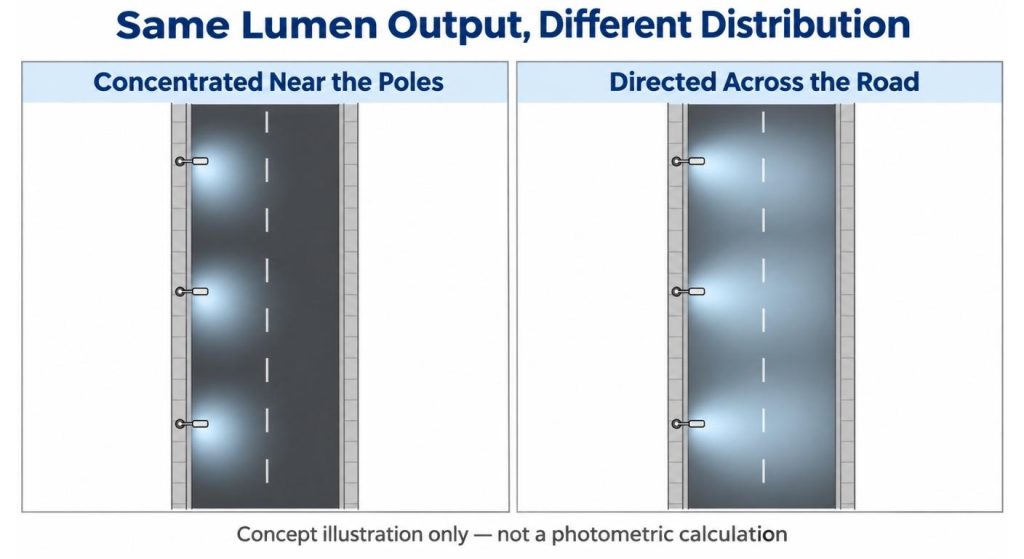
The units of lumens refer to the amount of light emitted, and illuminance refers to the amount of light that is striking a surface. A high lumen total or a high patch under the pole is not a good indication of a whole road receiving the correct coverage. Distribution relates to the amount of output that is delivered to useful places.
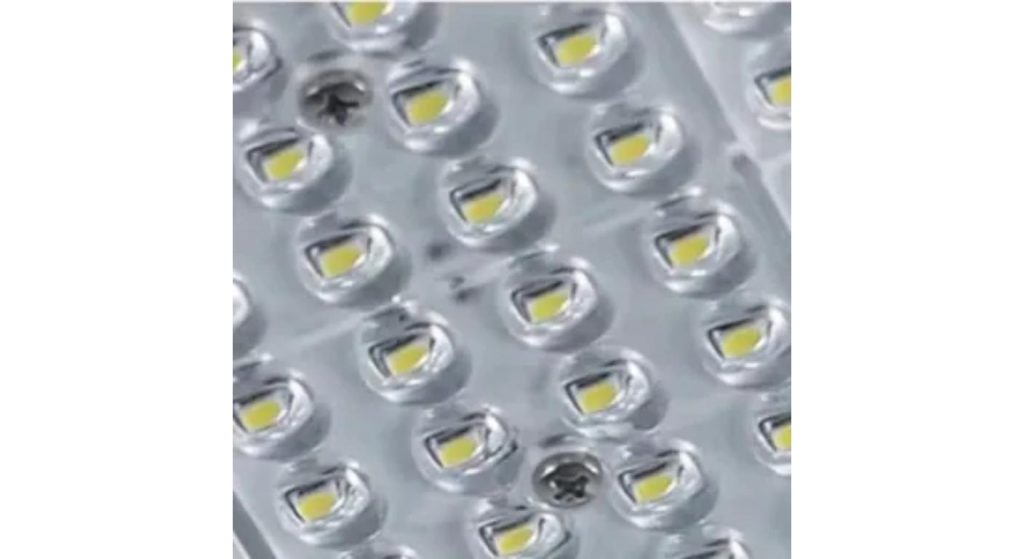
Solar street light – Optical lenses that are designed to control distribution and glare – Semi integrated (Dawn Lighting). Consider the selected optic with its photometric file, don’t assume the general description of the product is a performance statement for all roads.
Look on the opposite side of the street, between poles and other walkways. Beam direction is also important – when a directional fixture is turned, it can direct light outside of the intended area. Verify on the approved drawing the installation angle and the optical orientation.
Comparing the Layouts under the same circumstances.
A meaningful comparison only includes the same road width, mounting height and pole positions, as well as the same calculation assumptions. Otherwise, one proposal might look good simply because more poles are used or the area being evaluated is smaller. Set project criteria prior to judging the results.
Request the average, minimum values, the uniformity method used and how the glare and boundary spill is treated, if applicable. Averages can disguise areas that are weak. When light requirements are different for review crossings, junctions and entrances, consider lighting these separately.
Dawn Lighting is a stand-alone component of the solar street light solution that it offers, describing IES files and Lighting Simulation support. Inquire about the files that match the mentioned model, optic and output. A report from a related product should not be considered a substitute for evidence.
Choose Colour for the Application
Correlated colour temperature relates to the colour appearance of the light, colour rendering to the appearance of objects under the light. These are various characteristics. A cooler lamp does not necessarily provide more efficiency or less glare or is more appropriate for a home situation.
The colour-temperature and colour-rendering options are listed on the semi-integrated model by Dawn Lighting. Verify selection of combination and measured output. The lighting assessment is based on the product specification, which may be subject to change depending on the LED options used, so the final specification to be used in the lighting assessment should be stated.
When choosing colour characteristics, take into account local needs, nearby houses and pedestrian traffic. When a sample is subjected to a visual assessment, it is compared under controlled conditions. An automatic white balance and exposure photo taken on a cell phone is not reliable for comparison.
See the What Happens When the Light Dims check.
A lighting calculation for maximum output only applies to the one operating condition. Should the controller cut back power after a specified period, then the project must be evaluated at the desired overnight level as well. Even if there is sufficient early evening coverage, this does not constitute performance before dawn.
Inquire about the means of output control and which dimming percentage the quote is for (power, light output or other control value). Don’t always take those percentages to be the same. There are also certain boost modes that are sensor driven, which require a set background level and response time.
The automatic lighting adjustment is a feature of Dawn Lighting’s all-in-one solar LED street light. Check with the ordered version what the actual control functions are and keep the approved setting. A lighting schedule should be developed to meet the site needs and be compatible with the energy available from the solar system.
Make sure that Construction and Verification is part of the Decision.
More than just an LED specification is required for optical performance. How the product works is influenced by the housing design, thermal design, light transmitting surfaces and condition of the optics. Dawn Lighting’s semi-integrated model refers to an aluminium die-cast body and tempered glass detailing that can be viewed by the buyer.
Inquire about evidence of the entire configuration, not just the materials. This LED component lifetime statement does not apply to the battery, controller, seals or system. Double check warranty coverage and replacement procedures separately.
Record the mounting geometry, operating mode, weather and measurement locations for sample evaluation. Use appropriate equipment to take illuminance measurements and compare to agreed design. While conditions can be identified with a visual impression, a documented condition makes investigation of technical differences easier.
| Record Field | What to Enter | Why Retain It |
| Sample identity | Model and serial number | Trace the tested unit |
| Test setup | Height, tilt, and orientation | Reproduce the arrangement |
| Operating condition | Controller mode and battery status | Explain output differences |
| Measurement record | Meter, locations, and readings | Support a fair comparison |
| Final decision | Accepted version and date | Prevent unapproved substitutions |
Conclusion
The most similar solar street lights like LEDs are traced to the road from the electrical input. Review the complete-luminaire efficacy, distribution, selection of colour characteristics and the actual dimming schedule. Match up reports and site measurements to give an even stronger purchasing base than a headline wattage.
FAQs
Q1. Do more watts always mean brighter roads?
No. The amount of electrical power that becomes useful road lighting depends on the number of luminaires, its efficacy and the geometry of the mounting.
Q2. Is LED chip efficacy equal to the luminaire efficacy?
Complete-luminaire performance takes into account the impact of the assembled fixture, as well as the electrical and optical elements.
Q3.Can I choose pole spacing from the lumen figure?
Not reliably. Use actual photometric file and project geometry to evaluate coverage and uniformity and pertinent lighting criteria.
Q4. Is cool white light the best?
No. Choose colour properties near to the application, neighbouring properties and local needs, and verify the performance of the selected version.
Q5. What information do I need to submit for approval?
Ask for a matching data sheet, photometric file, layout calculation and control schedule. If available, keep sample measurements and configuration information.
- 10 Meters Lamp Post
- 10 Meters Pole
- 1000w Led Projector
- 100W LED Tunnel Light
- 12 Meters Lamp Post
- 12 Meters Pole
- 1200w Led Projector
- 15 Light Pole
- 1500w Led Projector
- 150W LED Tunnel Light
- 1800w Led Projector
- 2 In 1 Solar Flood Light
- 200w Led Tunnel Light
- 50w Led Tunnel Light
- 6 Meters Lamp Post
- 6 Meters Pole
- 8 Meters Lamp Post
- 8 Meters Pole
- 800w Led Projector
- 80w Led Tunnel Light
- Colourful Decorative Light
- Conical post
- Courtyard Lamp
- courtyard light
- courtyard lighting fixture
- Decorative Landscape Light
- Decorative road Light
- Flood Light For Courtyard
- Flood Light for Garden
- Flood Light For Outdoor
- Foot Led High Bay Lights
- high bay led lights 100w
- industrial lampshade
- industrial LED shed lights
- industrial magnifying glass with light
- Integrated Solar Flood Light
- led courtyard lamp
- led courtyard light
- led high bay light 100w
- LED Projector For Stadium
- Led UFO High Bay 150W 5000k
- Lighting Plants Mining Price
- Maintenance Free LED Street Light
- Pic Controlling Tunnel Light
- PLC controlling tunnel light
- Post Top Garden Light
- RGB Landscape Light
- Rgbw Decorative Light
- Smart Tunnel Light
- solar courtyard lamp
- solar courtyard light
- Solar LED Road Light
- Solar Street Light For 10 Meter Pole
- Solar Street Light For 12 Meter Pole
- Solar Street Light For 6 Meter Pole
- Solar Street Light For 8 Meter Pole
- Split Type Solar Flood Light
- Sporting Projector
- Stadium Led Projector
- Street Lighting Post
