
 Request A Quote

LED Streetlights and the Blue Light Problem
 FACEBOOK
 TWITTER
 LINKEDIN
The world cities have been changing their standard streetlights with LEDs at a very high pace. The transition will guarantee radical energy conservation, extended life expectancies, and less upkeep expenses. However, as many communities have found, with the switch to LED-street lighting, there has been a side effect of very strong bluish light that has impacted human health, wildlife, and the sky at night.
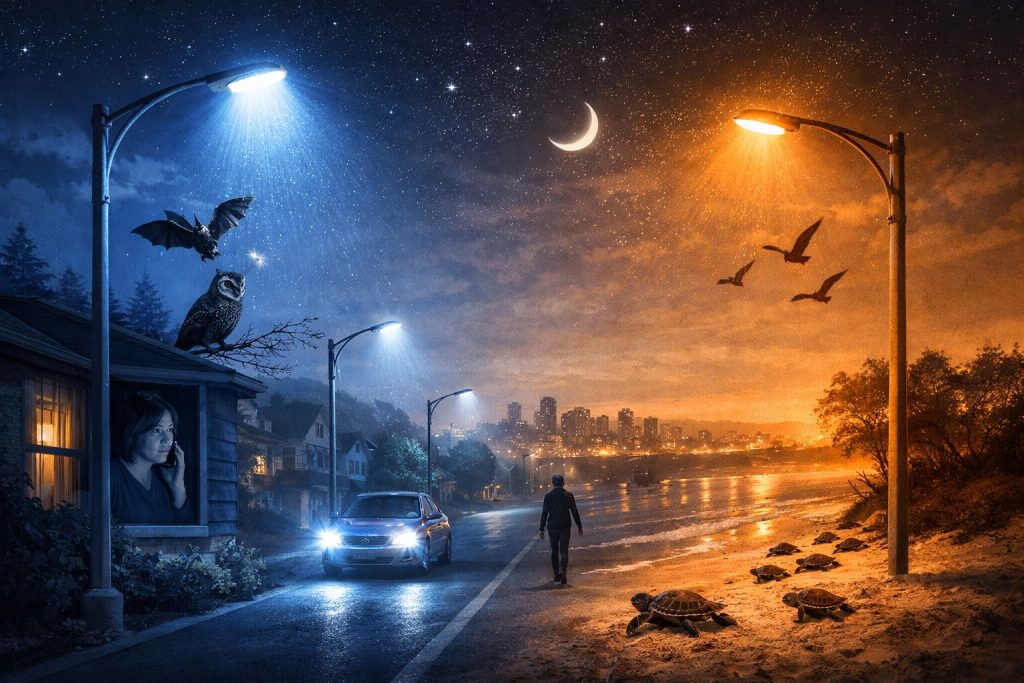
The controversy about LED Streetlights brings to the fore one of the most important questions to city planners and environmental scientists: in what ways can urban cities reconcile energy efficiency and quality of life?
The Reason Cities are Replacing Streetlights With LED.
In the last ten years, the local governments across the world have been fiercely moving towards the use of LED streetlights. This is due to the fact that LED lighting is much more efficient when compared to old technologies.
The lamps that were normally used in traditional streetlights are sodium or mercury vapor with high pressure. Although they were efficient, these lights used big quantities of electricity and had to be replaced regularly.
The LED technology has a number of benefits:
- Higher energy efficiency
- Longer lifespan
- Lower maintenance costs
- Better specification of light direction.
In the United States, the lighting outdoors takes up a huge percentage of the electric power used in lighting. Estimates by analysts indicate that the switching of all of the outdoor light to LEDs would result in saving of enough energy to serve millions of households annually.
These savings that could be saved made most cities upgrade in a hurry. Megacities equipped tens of thousands of LED lights on the streets anticipating economic and environmental rewards.
Nonetheless, experimental implementation of LED lighting revealed some unanticipated issues.
The Blue Light Issue
Majority of the early LED streetlights cast high amounts of blue-rich color that results in the cold bright light commonly referred to as harsh or glary.
This is due to the fact that the majority of the white LEDs are developed as a result of combining:
- A blue LED emitter
- A yellow phosphor coating
The combination of the blue and yellow light is perceived as white by the human eye, although the spectrum usually contains a strong blue color.
Color temperature is a measurement of color of lighting that is measured using a measure of Kelvin (K). Early LED streetlights tended to be 4,000 K to 6,500 K, which is bluer in the eye than the traditional sodium lamps.
For comparison:
- Sodium streetlights: ~ 2,100-2,300 K (sweet orange)
- Typical indoor lighting: ~2,700–3,000 K
- Early LED streetlights: 4,000–6,500 K
The difference might seem technical but in real life this difference can really be dramatic in terms of the looks and feel of the night time settings.
Impact on Human Health
Among the gravest implications of blue-rich lighting is the issue with circadian rhythms the biological clock that controls the sleep and wake rhythms.
The eyes of human beings have special receptors of blue light. These receptors aid in giving an indication to the brain that it is daytime. However, exposing the brain to blue light during the night may give the brain a false impression that it is daytime.
It has been found that exposure to blue light at night can:
- It inhibits the synthesis of melatonin, a sleep hormone.
- Alter natural sleeping habits.
- Alters general circadian rhythms.
According to the estimates, blue-rich outdoor lighting can affect sleep patterns 5 times more intensely than conventional street lighting, according to scientists.
This can be compared to the famous effect with the process of using smartphones or screens at night, which also releases blue light.
In certain cities, it has been reported that bright LED streetlights are disturbing sleep patterns expressed by people living in such places.
More Glare and Light Pollution.
Discomfort glare is another criticism of the early LED streetlights.
In the atmosphere the blue wavelengths are easily scattered as compared to the warmer colors. Consequently, blue-rich lighting may play a role in skyglow, which is the lightening of the dark sky in urban areas.
Research has proposed that certain white LED street lights can cause up to four times night sky glow as compared to sodium lamps of the same brightness.
This has brought close criticism by the astronomers and environmental groups with the concern of light pollution.
Although LEDs may be brighter, overindulgence in glare can also lower the level of visual comfort among the drivers and pedestrians despite the technology.
Impact on Wild life and Ecosystems.
Artificial lighting has already disrupted most natural ecosystems, which might be aggravated by blue-rich lighting.
Natural cycles of light influence the behavior of many animals. The lighting patterns at night may disrupt the feeding, migration and the reproduction.
Examples include:
Insects and Bats
Blue light traps heavy populations of insects that are active at night like the moth. These insects further increase the predators such as bats, which distort the feeding habits in nature.
Sea Turtles
Newly hatched sea turtles automatically head towards moonlight that is reflected on the sea. Artificial light that is blue-rich that is prevalent around the beaches may mislead them and they may be moving inland other than heading to the water.
Due to this fact there are now more areas of the coast that need outdoor lights in close proximity to nesting areas which emit the longer wavelengths such as amber or red.
Birds
Migration routes of birds which depend on celestial manipulation can also be interfered with by artificial lighting.
Why Early LEDs Were So Blue
With these disadvantages, a lot of individuals would want to know why these cities put these blue-rich lights to begin with.
The solution to this question is highly dependent on efficiency.
When the first LEDs were designed, the most energy efficient ones were those that generated even more color temperatures, that is, bluer light. Engineers worked towards the maximization of lumens per watt which is a measurement of the lighting efficiency.
Consequently, the early municipal lighting projects aimed to save energy at the expense of the environment or health.
New Solutions: Warm LED Lighting.
Fortunately, the technology of LED is developing rapidly.
Manufacturers of lighting are now providing warmer LED streetlights, usually with the range of 3,000 K or less, that greatly cut down blue light emissions.
These newer designs provide:
- Improved visual comfort
- Less effect in circadian rhythms.
- Lower skyglow
- Greater congruence with dark-sky programs.
There are also smart lighting systems being put in place in some cities that turn off the lighting in the streets during the times when no one is on the road.
Adaptive lighting systems can be used to regulate the lighting level depending on the real time conditions and this will achieve the reduction of energy usage and also light pollution.
Thinking Again about Urban Night Lighting.
The switch to LED streetlights is a good example of a key lesson about introducing technology.
Even the well-intentioned innovations could create unintentional effects when introduced too fast.
The need to fight climate change still necessitates energy efficiency. But the lighting design should also take into account:
- Human health
- Environmental impact
- Night sky preservation
- Community comfort
The positive thing is that the LED technology is highly adjustable. Cities can develop structures of efficient and environmentally conscious lighting by using the color temperature, brightness, and smart controls.
Street Lighting of the Future.
The LED streetlights will probably continue to be the leading light technology in urban areas all over the globe. Their productivity and longevity ensure that they are hard to substitute.
Nevertheless, the new generation of lighting systems will probably not be concerned with the raw brightness but rather with the balanced lighting, the lighting that helps to avoid accidents and at the same time, respects individuals and nature.
The future of nighttime illuminance can be greener and easier on the eye because of improved design standards and more intelligent infrastructure.
- 10 Meters Lamp Post
- 10 Meters Pole
- 1000w Led Projector
- 100W LED Tunnel Light
- 12 Meters Lamp Post
- 12 Meters Pole
- 1200w Led Projector
- 15 Light Pole
- 1500w Led Projector
- 150W LED Tunnel Light
- 1800w Led Projector
- 2 In 1 Solar Flood Light
- 200w Led Tunnel Light
- 50w Led Tunnel Light
- 6 Meters Lamp Post
- 6 Meters Pole
- 8 Meters Lamp Post
- 8 Meters Pole
- 800w Led Projector
- 80w Led Tunnel Light
- Colourful Decorative Light
- Conical post
- Courtyard Lamp
- courtyard light
- courtyard lighting fixture
- Decorative Landscape Light
- Decorative road Light
- Flood Light For Courtyard
- Flood Light for Garden
- Flood Light For Outdoor
- Foot Led High Bay Lights
- high bay led lights 100w
- industrial lampshade
- industrial LED shed lights
- industrial magnifying glass with light
- Integrated Solar Flood Light
- led courtyard lamp
- led courtyard light
- led high bay light 100w
- LED Projector For Stadium
- Led UFO High Bay 150W 5000k
- Lighting Plants Mining Price
- Maintenance Free LED Street Light
- Pic Controlling Tunnel Light
- PLC controlling tunnel light
- Post Top Garden Light
- RGB Landscape Light
- Rgbw Decorative Light
- Smart Tunnel Light
- solar courtyard lamp
- solar courtyard light
- Solar LED Road Light
- Solar Street Light For 10 Meter Pole
- Solar Street Light For 12 Meter Pole
- Solar Street Light For 6 Meter Pole
- Solar Street Light For 8 Meter Pole
- Split Type Solar Flood Light
- Sporting Projector
- Stadium Led Projector
- Street Lighting Post
