
 Request A Quote

solar energy street light price
 FACEBOOK
 TWITTER
 LINKEDIN
One of the most used outdoor lighting systems in terms of popularity in cities, communities, highways, parking lots, and rural roads is solar street lights. With the shift of governments and businesses in favor of renewable energy, street lights powered by the grid are being abolished in favor of the solar-powered versions.
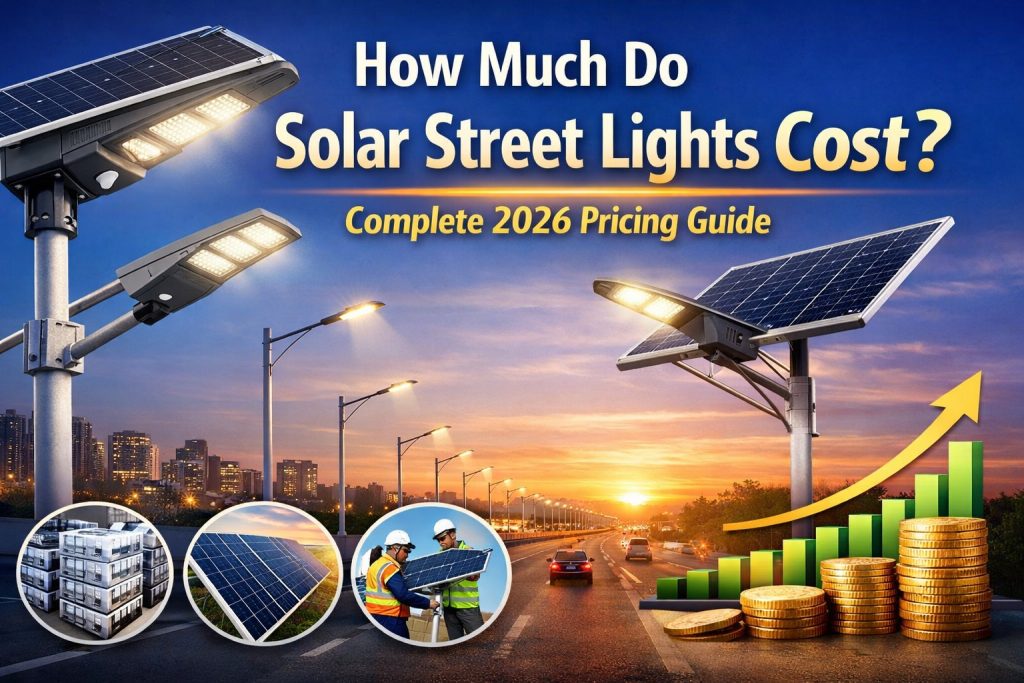
Nevertheless, the question that is most commonly asked by buyers is How much do solar street lights cost?
The solution will be based on a number of factors such as the type of light, the level of wattage, the ability of the battery, the efficiency of solar panels, and the installation needs. Here we are going to dissect the average cost of the solar street lights, what dictates the cost and how much you will save in the long run.
Mean Price of Solar Street Lights.
Solar street lights come in a wide range of prices that are dependent on its design and performance level. A typical unit would cost an average of 100-1000 or more, depending on specifications and features.
For example:
- Model of Solar Street Light Average Price Range.
- All-in-one solar street light $100 – $500
- Split-type solar street light $300 -1,000.
- High-end commercial systems $1,500 – $3,000+
The integrated system is normally cheaper as the solar panel, battery, and LED light are combined in a single unit, hence making the systems easy to install. Split-type systems are more versatile and powerful and therefore may be more expensive because of different components and bigger solar panels.
In big municipal projects, the overall expenses may exceed millions of dollars should it install hundreds or thousands of lights.
Solar Street Lights and their prices.
It is possible to know the various categories of solar street lights, in order to be able to estimate costs more reasonably.
- All-in-One Solar Lighting Street Lamps.
All-in-one solar street lights are a combination of the LED lamp, solar panel, battery, and controller in one small portable unit.
Key Advantages
- Easy installation
- Lower installation cost
- Minimal wiring required
- Compact design
Typical Price Range
$100 – $500 per unit
These lights are normally applicable in:
- Residential roads
- Pathways
- Parking areas
- Small community projects
Maintenance is also easier because everything is integrated unlike in the traditional lighting systems.
- Solar Street Lights Split-Type.
Split-type systems divide the solar panel, battery, and the light-fixing devices into various parts.
Key Advantages
- Higher power output
- Larger solar panels
- Customizable configurations
- Large roads or highways are better.
Typical Price Range
$300 – $1,000+ per unit
Split systems are commonly fitted in:
- City roads
- Highways
- Industrial parks
- Commercial areas
They are expensive in the short-term, but are capable of providing higher lighting performance and long-term durability.
Major Existing Factors that influence the cost of Solar Street lights.
The cost of a solar street light will vary depending on various technical and material factors.
- LED Light Wattage
More wattage results in brighter lighting though at the cost.
Example price estimates:
- 20W solar street light: around $150
- 50W solar street light: $400 or more
More powerful lights are normally demanded in roads with highways, significant roads and big parking lots.
- Solar Panel Efficiency and Size.
The solar panels accumulate power during the day, which is converted to light during the night.
Factors affecting price are:
- Panel wattage
- Conversion efficiency
- Panel durability
Greater or more powerful panels raise the cost of the system as a whole and enhance the speed and reliability of the charge.
- Battery Capacity
The solar energy can be collected in the battery and it turns on the street light when the sun sets.
Standard types of batteries are:
- Lithium-ion batteries
- LiFePO4 batteries
- Lead-acid batteries
Batteries with higher capacity will give increased backup time but will increase the cost of the system by an additional amount of $100 up to 300 and even more.
- Smart Features and Sensors
Contemporary street lights powered by the sun can also be fitted with intelligent features like:
- Motion sensors
- Automatic dimming
- Remote monitoring
- Smart controllers
These characteristics enhance fuel consumption at the expense of higher cost of purchasing them.
- Material and Build Quality
Solar street lights have their life enhanced by durable materials.
Common materials include:
- Aluminum housing
- Galvanized steel poles
- Corrosion-resistant coatings
The materials used are of high quality such that the lights are resistant to extreme weather like heavy rain, wind, and extreme temperatures.
Other Expenses to take into account.
Solar lights are a project that needs to be budgeted to also take into consideration other costs such as the cost of the product itself.
- Installation Costs
Solar street lights are now simpler to install than the grid lights since they do not need underground wiring.
Ordinary costs of installations are between:
between 50-300 dollars per light, depending on conditions of the area and height of the pole.
More expensive complex installations may be tall poles or special equipment.
- Maintenance Costs
Low maintenance is one of the largest benefits of solar street lighting.
Yet periodical servicing is still necessary, including:
- Cleaning solar panels
- Replacement of battery after every 5-7 years.
- Controller inspection
Depending on the type of battery, change of battery can range between $50 and $300 per battery.
- Shipping and Transportation.
Shipping rates are different based on:
- Order quantity
- Distance
- Product weight
The bulk purchases can be associated with a lot of logistics expenses and the average cost of shipping is usually between 10 and 100 per unit.
Solar Street Lights and Traditional Street Lights.
In as much as solar street lights can be costly to install in the short term, they can save a lot in the long term.
As an illustration, a project that would install 10 solar streetlights would cost about 6,500 initial investment, whereas a similar traditional lighting system would cost about 55,000 initial investment, which covers wiring, equipment and labor.
Over a 10-year period:
- Solar lighting total cost: ~$8,500
- Conventional cost of lighting: ~80,000.
This huge saving is a result of getting rid of electricity bills and cutting down the cost of maintenance.
Solar street lights are totally dependent on renewable solar power i.e. there will be no monthly utility bills.
Solar Street Lights Justify the Investment?
Solar street lights are a very cost-effective solution to the outdoor lighting in most instances.
Key Benefits
- No Electricity Costs
The solar lights produce their energy using sunlight, and they do not require energy bills. - Easy Installation
It does not require any trenching, cabling, or grid connection. - Low Maintenance
LED lights are able to last more than 10 years and experience little maintenance. - Environmentally Friendly
Solar lighting cuts carbon emission and promotes viable infrastructure. - Trustworthy Under Power Failures.
Solar street lights do not require connection to the grid thus they keep working even during blackouts.
Conclusion
Prices of the solar street lights will vary depending on the system type, wattage, size of solar panel, the battery capacity, and the installation needs. The majority of units are between 100 and 1,000 dollars, and commercial units can be expensive several thousand dollars.
Solar street lights are associated with high initial cost than the traditional lighting, but the long term advantages are tremendous as they incur low maintenance cost, no electricity payment, and enhanced sustainability.
Solar street lighting is a smart investment to municipalities, business organizations, and developers that are planning on lowering their operational expenses and at the same time encouraging the use of green power.

- 10 Meters Lamp Post
- 10 Meters Pole
- 1000w Led Projector
- 100W LED Tunnel Light
- 12 Meters Lamp Post
- 12 Meters Pole
- 1200w Led Projector
- 15 Light Pole
- 1500w Led Projector
- 150W LED Tunnel Light
- 1800w Led Projector
- 2 In 1 Solar Flood Light
- 200w Led Tunnel Light
- 50w Led Tunnel Light
- 6 Meters Lamp Post
- 6 Meters Pole
- 8 Meters Lamp Post
- 8 Meters Pole
- 800w Led Projector
- 80w Led Tunnel Light
- Colourful Decorative Light
- Conical post
- Courtyard Lamp
- courtyard light
- courtyard lighting fixture
- Decorative Landscape Light
- Decorative road Light
- Flood Light For Courtyard
- Flood Light for Garden
- Flood Light For Outdoor
- Foot Led High Bay Lights
- high bay led lights 100w
- industrial lampshade
- industrial LED shed lights
- industrial magnifying glass with light
- Integrated Solar Flood Light
- led courtyard lamp
- led courtyard light
- led high bay light 100w
- LED Projector For Stadium
- Led UFO High Bay 150W 5000k
- Lighting Plants Mining Price
- Maintenance Free LED Street Light
- Pic Controlling Tunnel Light
- PLC controlling tunnel light
- Post Top Garden Light
- RGB Landscape Light
- Rgbw Decorative Light
- Smart Tunnel Light
- solar courtyard lamp
- solar courtyard light
- Solar LED Road Light
- Solar Street Light For 10 Meter Pole
- Solar Street Light For 12 Meter Pole
- Solar Street Light For 6 Meter Pole
- Solar Street Light For 8 Meter Pole
- Split Type Solar Flood Light
- Sporting Projector
- Stadium Led Projector
- Street Lighting Post
