
 Request A Quote

Street Lights vs Lamp Posts: Key Differences and Uses Explained
 FACEBOOK
 TWITTER
 LINKEDIN
The outdoor lighting is important in the planning of urban centers, home security, and commercial buildings. The decision to use the correct lighting fixture can be a big deal when it comes to visibility, safety, and appeal whether it is in the creation of a city street, a parking lot, or a landscaped walkway.
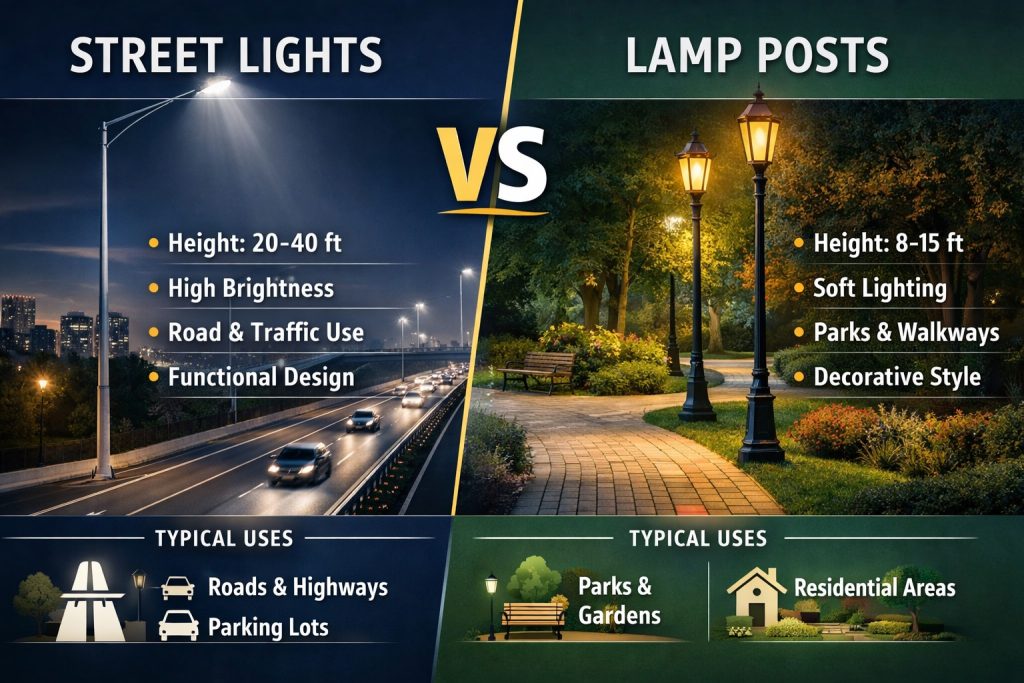
Street lights and lamp posts are the two terms that are used interchangeably. These lighting solutions may seem similar, but the situation is that they are used in different places and purposes. Learning how the lamp posts and street lights are different can assist the property developers, municipalities and the contractors in choosing the most appropriate kind of lighting system to be used in the project.
In this guide we are going to discuss the similarities, main differences, applications and the way to select between these two most used outdoor lights.
What Are Street Lights?
Street lights refer to tall outdoor lights which are mainly installed to create lights that illuminate roads, highways, parking lots and even large outdoor areas. They are primarily meant to enhance visibility and safety of vehicles and pedestrians within the night hours.
The majority of contemporary street lights are LED-powered or high-intensity discharge (HID) lamps with bright and energy efficient lighting over a large area.
Street Lights: Major Characteristics.
1.Greater Height
The usual height of street lights is between 20 and 40 feet (612 meters or above). This elevated state position enables them to scatter light to wider locations of the highway and wide streets.
2.Sufficient Brightness and Extensive Area.
These lights are aimed at giving a lot of strong and uniform light that will allow safe driving and reduce accidents at night.
3.Functional Design
Street lights are certainly not as ornamental as decorative lighting fixtures, but more utilitarian in design, paying attention to performance and durability.
4.Directional Lighting
The lights on the streets normally emit the light downwards or perpendicular to the surface of the roads to increase visibility and reduce light pollution.
Typical uses of Street Lights.
These street lights are usually fitted in:
- Highways and major roads
- Urban streets
- Parking lots
- Industrial facilities
- Airports and transports centers.
Such environments demand regular and strong lighting to maintain traffic movements and avert any form of danger to people.
What Are Lamp Posts?
Lamp posts or post lights and decorative outdoor lamps are short lighting devices that focus on the light and the beauty. They are mostly applied in places that are pedestrian-friendly and homes where daylights are more preferred.
Lamp posts contrasting with street lights are frequently ornately adorned with some sort of lantern-like lighting or ancient architectural feature, and therefore, lamp posts are aesthetically pleasing to the outdoor environment.
Key Features of Lamp Posts
1.Shorter Height
Lamp posts are normally placed at heights of between 8 to 15 feet and this produces lighting that is more comfortable to pedestrians.
2.Soft and Ambient Lighting
The intensity of the light is generally less and more scattered compared to the street lights. This is a warm environment without being too bright.
3.Decorative Design
Lamp posts are commonly decorated in classic, vintage or modern styles and added features to improve on the surrounding structure or landscape.
4.Pedestrian-Focused Lighting
Their architecture is based on illumination of sidewalks, lanes, gardens, and homes as opposed to wide roads.
Typical uses of Lamp posts.
Lamp posts can be commonly found in:
- Residential neighborhoods
- Parks and gardens
- Walkways and sidewalks
- University campuses
- Commercial plazas
- Public squares
What is good about such environments is that they have a trade-off between functional and aesthetic lighting.
The Street Lights vs. Lamp Posts: The most important differences.
Although both types of lighting find application in the outdoor lighting operation, they have variety of differences in terms of their application.
- Characteristics Lighting Posts in the Street.
- Typical Height 20–40 feet 8–15 feet
- Brightness Strong lighting in the room Weaker ambient lighting.
- Main Use Road and traffic visibility Pedestrian decoration and lighting.
- Design Functional and standardized Decorative and architectural.
- Typical Destinations Roads, highways, parking lots Parks, walkways, neighborhoods
The most significant distinction is in the intention and size. Street lights are more concerned with safety and wide coverage as compared to the lamp posts which are more concerned with the aesthetics and comfort of people.
Is it possible to use street lights along with lamp posts?
Yes. Planners in most urban settings employ both of these lighting to develop layered outdoor lighting systems.
For example:
- Main roads and traffic lanes are lit by street lights.
- Lamp posts are used to light up and illuminate the sidewalks, parks, and other surrounding pedestrian sections.
The integration of the two lighting systems will make sure that the streets will be safe to the drivers and at the same time provide a pleasant and comfortable environment to the pedestrians.
This stratified technique is usually applied in the downtown areas, mixed developments, and residential neighborhoods.
Considerations in Selecting Outdoor Lighting.
The choice between lamp posts and street lights will be made based on a number of project requirements.
- Lighting Purpose
Does the main purpose entail:
- Safety and visibility → select street lights.
- Lighting and ornamental lighting atmosphere/light sources: Select lamp posts.
- Installation heights and Area covered.
Large streets should be covered with high mount fixtures due to wide coverage but low mount fixtures are effective in small streets.
- Design and Aesthetic Goals
Lamp posts would be perfect when you desire a lighting that goes well with architectural aesthetics, landscaping or historical settings.
- Energy Efficiency
Most contemporary outdoor lighting systems are based on LED technology which has increased lifespan and low energy consumption than the older lighting systems.
- Maintenance Requirements
The height of the street lights might mandate the use of special equipments to service them, whereas the lamp posts can be easily accessed to service.
The Future of Lighting in the outdoors.
As lighting technology improves, street lights as well as the lamp posts are becoming more efficient and smart.
New developments include:
- Remote-monitored smart lighting systems.
- Adaptive brightness and motion detection.
- Lighting systems powered by the sun.
- LED fixtures that are energy efficient.
These technologies enable the cities and property developers to cut down on the costs of energy besides enhancing the safety of people and their sustainability.
Conclusion
Even though street lights and lamp posts may seem similar, they have different functions in the design of outdoor lighting.
Street lights are tall and powerful lamps and they are installed to shed light on the roads and big spaces in order to improve safety and visibility. Lamp posts on the other hand are less bright and offer ornamental lighting in walk areas like parks, walkways and residential areas.
Knowledge of the difference between these two light solutions enables the planners, contractors, and property owners to develop viable outdoor lighting systems which are functional, safe and attractive.
Selecting the correct form of lighting to be used in each setting will help in bettering the visibility, architectural design, and ensuring safer environments outside to all.
- 10 Meters Lamp Post
- 10 Meters Pole
- 1000w Led Projector
- 100W LED Tunnel Light
- 12 Meters Lamp Post
- 12 Meters Pole
- 1200w Led Projector
- 15 Light Pole
- 1500w Led Projector
- 150W LED Tunnel Light
- 1800w Led Projector
- 2 In 1 Solar Flood Light
- 200w Led Tunnel Light
- 50w Led Tunnel Light
- 6 Meters Lamp Post
- 6 Meters Pole
- 8 Meters Lamp Post
- 8 Meters Pole
- 800w Led Projector
- 80w Led Tunnel Light
- Colourful Decorative Light
- Conical post
- Courtyard Lamp
- courtyard light
- courtyard lighting fixture
- Decorative Landscape Light
- Decorative road Light
- Flood Light For Courtyard
- Flood Light for Garden
- Flood Light For Outdoor
- Foot Led High Bay Lights
- high bay led lights 100w
- industrial lampshade
- industrial LED shed lights
- industrial magnifying glass with light
- Integrated Solar Flood Light
- led courtyard lamp
- led courtyard light
- led high bay light 100w
- LED Projector For Stadium
- Led UFO High Bay 150W 5000k
- Lighting Plants Mining Price
- Maintenance Free LED Street Light
- Pic Controlling Tunnel Light
- PLC controlling tunnel light
- Post Top Garden Light
- RGB Landscape Light
- Rgbw Decorative Light
- Smart Tunnel Light
- solar courtyard lamp
- solar courtyard light
- Solar LED Road Light
- Solar Street Light For 10 Meter Pole
- Solar Street Light For 12 Meter Pole
- Solar Street Light For 6 Meter Pole
- Solar Street Light For 8 Meter Pole
- Split Type Solar Flood Light
- Sporting Projector
- Stadium Led Projector
- Street Lighting Post
