
 Request A Quote

Lamp Pole Buying Guide for Road, Parking and Public-Space Projects
 FACEBOOK
 TWITTER
 LINKEDIN
A lamp pole should be selected as a structural system, not as a decorative accessory. The correct specification connects mounting height, luminaire weight and projected area, wind speed, arm outreach, steel or aluminum grade, corrosion exposure, foundation design, cable routing, earthing, and the photometric result. For large projects, freeze the pole only after the lighting layout and structural design agree.
| DIRECT ANSWER Start with the required lux and uniformity, use DIALux to establish pole positions and mounting heights, then calculate wind load for the complete pole-arm-luminaire assembly. Confirm the material, section thickness, welds, base plate, anchor bolts, foundation, coating, access door, and earthing before approving production. |
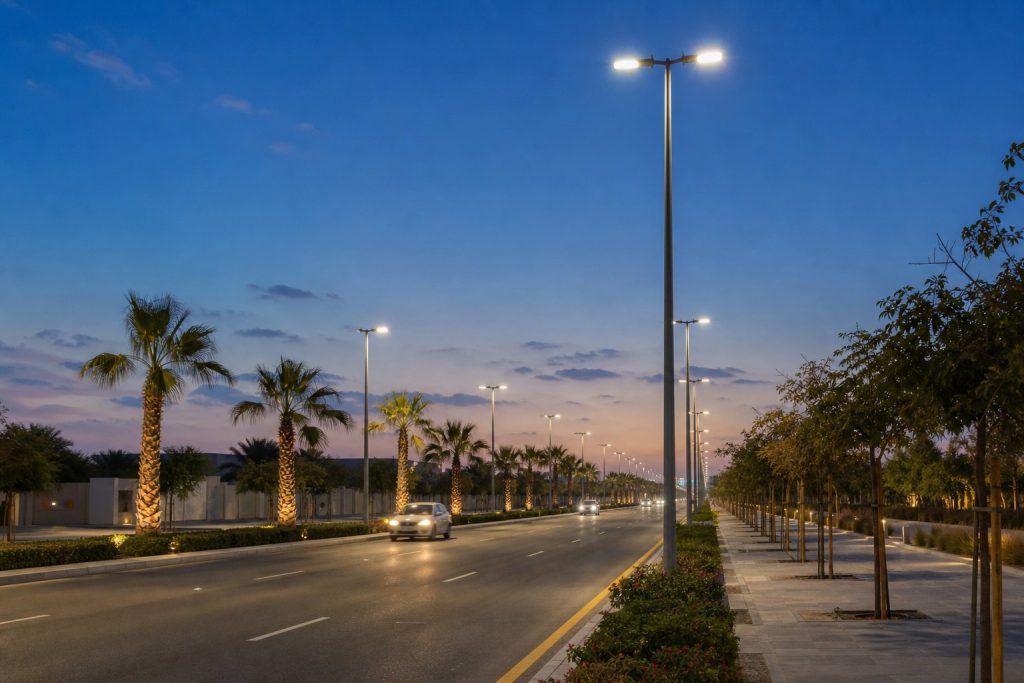
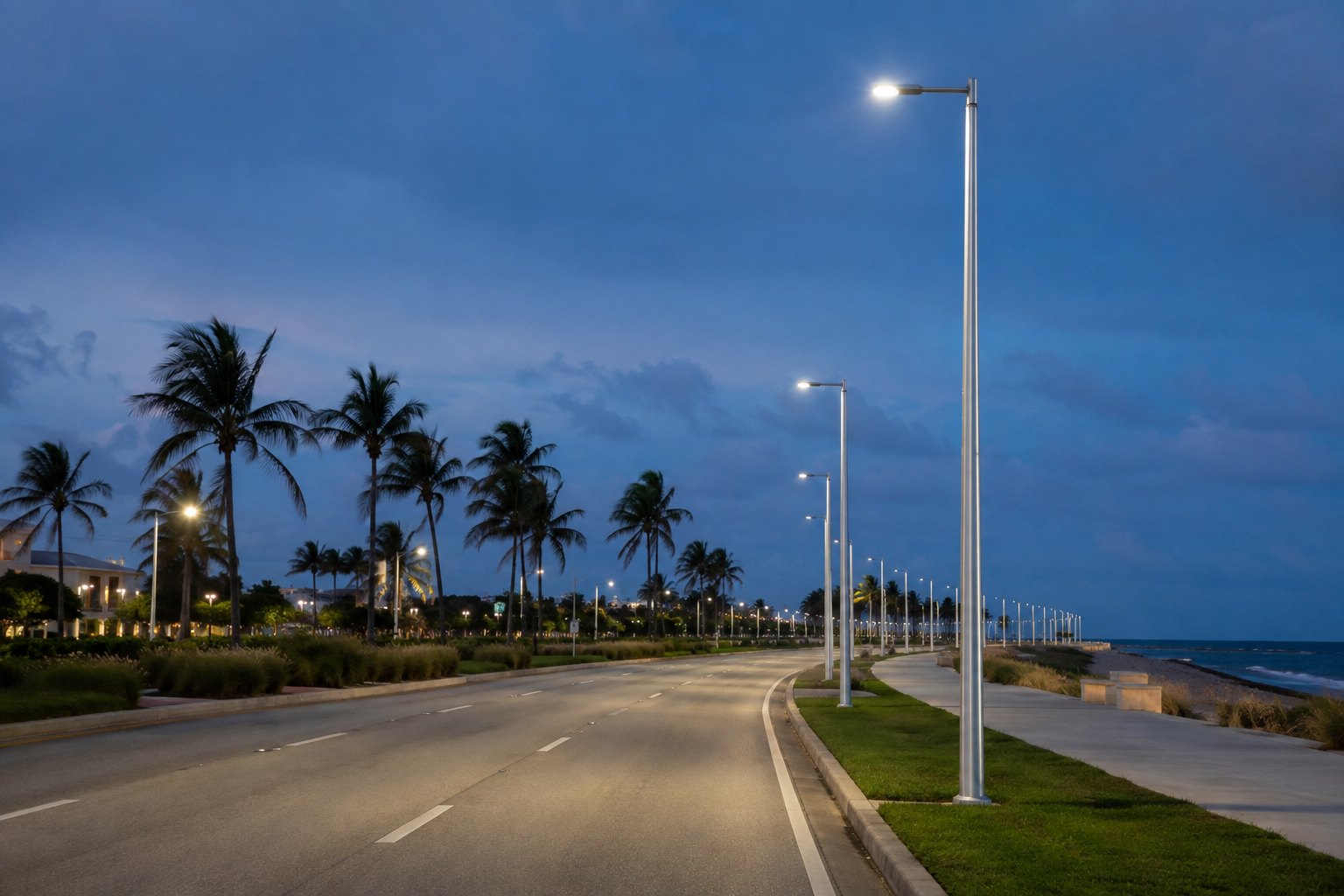
A completed boulevard shows how mounting height, spacing, arm geometry and optics operate as one system.
Why Lamp Pole Selection Starts With the Lighting Layout
When discussing road and parking projects with clients, our engineering team first asks for the site plan, road class, target maintained illuminance, minimum-to-average uniformity, setbacks, obstacles, and maintenance constraints. Pole height and spacing cannot be separated from the luminaire photometric file. A taller pole can improve coverage and reduce the number of foundations, but it increases structural demand and may place maintenance equipment beyond the client’s reach.
For preliminary planning, local streets may use poles around 6-10 m, wider roads often move toward 10-12 m, and large parking or logistics areas may need a different arrangement. These are not universal limits. The final height must follow the applicable road-lighting standard, glare limits, foundation conditions, airport or utility clearances, and the verified DIALux calculation.
Typical Lamp Pole Applications and Design Priorities
| Application | Typical design focus | Pole issue to verify | Lighting issue to verify |
| Local road | Safe visual guidance | Vehicle impact and access door | Maintained lux and uniformity |
| Arterial road | Long spacing and reliability | Wind, outreach and vibration | Road-class luminance or illuminance |
| Parking area | Pedestrian and vehicle visibility | Base protection and service access | Dark zones, glare and CCTV views |
| Promenade or plaza | Human scale and appearance | Finish and corrosion exposure | Facial recognition and spill light |
Structural Inputs the Supplier Needs
Wind speed, projected area and arm outreach
The pole is loaded by the wind acting on the shaft, bracket and luminaires. A heavy luminaire is not always the controlling case; a lighter fixture with a large effective projected area can generate more overturning moment. Supply the design wind speed, terrain or exposure category, importance factor where required, luminaire quantity, dimensions, mass, EPA, arm length, tilt and any sign, camera, solar panel or banner load. The governing structural code and a qualified engineer must determine the final section and foundation.
Base plate, anchor bolts and foundation
A robust shaft cannot compensate for a weak foundation. Check the bolt circle, bolt projection, leveling method, grout detail, base-plate thickness, weld geometry, reinforcing cage, concrete strength, soil bearing capacity and drainage. Foundation dimensions copied from another site are risky: sandy fill, expansive clay, high groundwater and reclaimed coastal land behave differently.
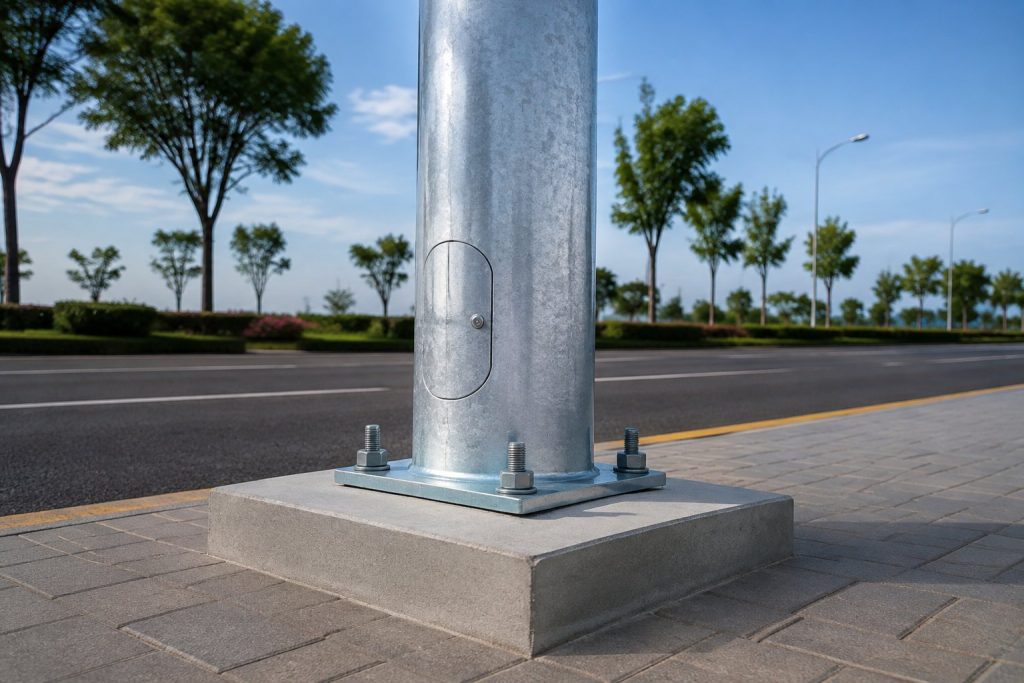
The base plate, anchor bolts, cable access and concrete pedestal must be proportioned for the actual pole system.
Steel, Aluminum and Galvanized Finishes
Steel light poles provide high stiffness and broad fabrication flexibility. Hot-dip galvanizing is widely used for outdoor corrosion protection, but the coating specification, vent and drain holes, surface repair and handling method matter. Aluminum poles reduce mass and can perform well in corrosive environments when the alloy, temper, welding, isolation from dissimilar metals and electrical bonding are properly designed. Material choice should follow the site rather than a simple price comparison.
| Option | Useful characteristics | Watch points | Common project fit |
| Hot-dip galvanized steel | Stiff, familiar fabrication, varied shapes | Coating damage, internal drainage, mass | Roads, yards, municipal networks |
| Painted galvanized steel | Added color and barrier layer | Surface preparation and repair system | Urban and architectural schemes |
| Aluminum | Lower mass, clean finish, corrosion resistance | Alloy, fatigue, isolation and bonding | Coastal roads, promenades, premium sites |
| Decorative steel pole | Custom appearance and bracket options | Complex welds, water traps and maintenance | Parks, plazas and heritage districts |
Electrical and Luminaire Coordination
Specify the access-door size and position, terminal arrangement, protective device, cable entry, gland or grommet, internal cable support and earth stud. The mounted luminaire may need IP65 or IP66 and an impact rating such as IK08, but the pole’s handhole and underground connection also need protection from water, dust, insects and accidental contact. Surge protection must be coordinated with the distribution board, protective earthing and local lightning conditions; listing a 10 kV or 20 kV SPD without a system design is incomplete.
Thermal dissipation belongs mainly to the LED luminaire, yet the pole layout influences operating life because aiming, solar exposure and maintenance access affect the complete installation. Confirm the beam angle or road optic, CRI requirement, correlated color temperature, dimming protocol and replacement access before fixing the spigot and arm dimensions.
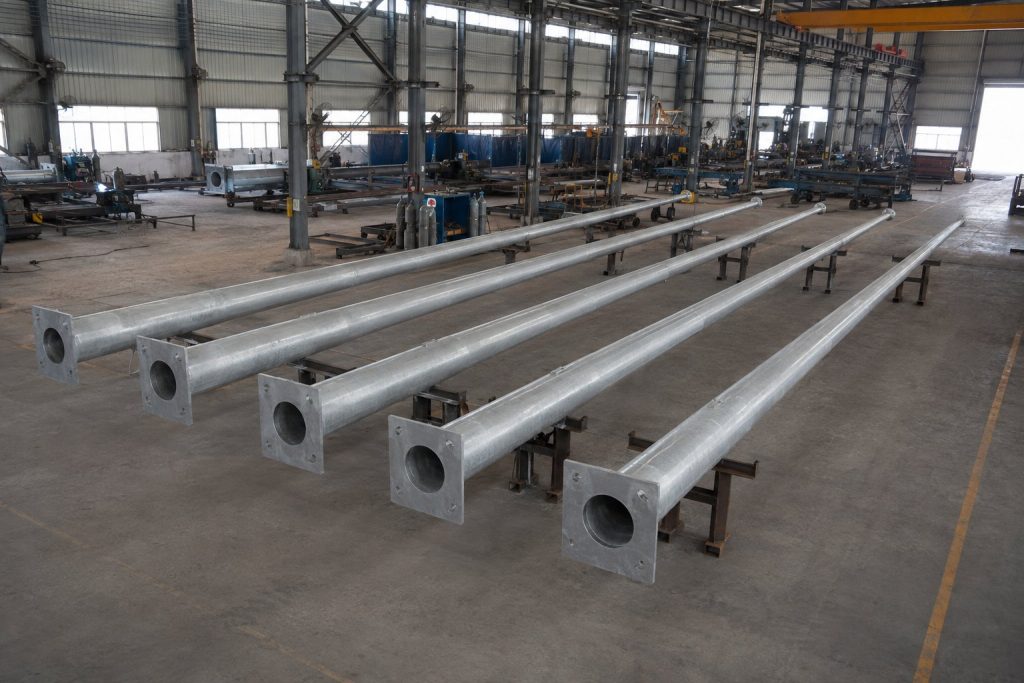
Full-length factory storage makes shaft straightness, taper, seams, flange geometry and coating condition easier to inspect.
Lamp Pole Submittal Checklist
- DIALux file and report with maintained lux or luminance, uniformity, glare metric, pole coordinates, mounting height, outreach and aiming.
- Structural calculation using the project wind data and every mounted component, plus allowable deflection and fatigue criteria where applicable.
- Dimensioned pole drawing showing shaft sections, seams, welds, base plate, anchor bolts, handhole, cable route, earth point, spigot and bracket.
- Material certificates, welding procedure and inspection plan, galvanizing or paint specification, packaging method and site repair procedure.
- Foundation design based on the local geotechnical report, electrical single-line information, surge/earthing concept, installation method and maintenance access.
Common Lamp Pole Procurement Mistakes
The most frequent error is buying by height and wall thickness alone. That ignores wind exposure, pole shape, steel grade, bracket reach, luminaire EPA and foundation behavior. Other failures come from changing the luminaire after the pole calculation, drilling unapproved holes on site, trapping water inside the shaft, leaving damaged zinc unrepaired, or tightening anchor nuts without a documented sequence.
FAQ: Questions Buyers Ask
How tall is a lamp pole?
Outdoor lamp poles commonly range from about 3 m for pedestrian spaces to 12 m or more for roads and large areas. The correct height follows the photometric layout, glare limits, wind design, clearances and maintenance method.
How far apart should light poles be?
Spacing depends on mounting height, road width, luminaire distribution, target lux or luminance, uniformity and obstructions. Use verified photometric files in DIALux instead of a fixed spacing-to-height ratio.
Is steel or aluminum better for a lamp pole?
Neither is universally better. Steel offers stiffness and fabrication flexibility; aluminum reduces mass and can suit corrosive sites. Compare structural demand, corrosion class, finish, fatigue, electrical bonding, logistics and lifecycle maintenance.
What information is needed for a lamp pole quotation?
Provide the site and lighting drawings, pole height and quantity, arms and luminaires, design wind data, soil information, material and coating requirements, foundation scope, electrical details, standards and delivery location.
Turn the Lighting Plan Into a Buildable Pole Package
| PROJECT REVIEW For a road, parking, logistics or public-space project, share the site drawing, target lighting class, DIALux basis, mounting height, luminaire data, wind criteria, soil report, corrosion environment and required standards. |
Send the site plan, target lux, mounting heights, operating schedule, environmental conditions, and electrical data through the Dawn Lighting official inquiry page. The engineering team can review the design basis and prepare a project-specific DIALux proposal and B2B quotation.
- 10 Meters Lamp Post
- 10 Meters Pole
- 1000w Led Projector
- 100W LED Tunnel Light
- 12 Meters Lamp Post
- 12 Meters Pole
- 1200w Led Projector
- 15 Light Pole
- 1500w Led Projector
- 150W LED Tunnel Light
- 1800w Led Projector
- 2 In 1 Solar Flood Light
- 200w Led Tunnel Light
- 50w Led Tunnel Light
- 6 Meters Lamp Post
- 6 Meters Pole
- 8 Meters Lamp Post
- 8 Meters Pole
- 800w Led Projector
- 80w Led Tunnel Light
- Colourful Decorative Light
- Conical post
- Courtyard Lamp
- courtyard light
- courtyard lighting fixture
- Decorative Landscape Light
- Decorative road Light
- Flood Light For Courtyard
- Flood Light for Garden
- Flood Light For Outdoor
- Foot Led High Bay Lights
- high bay led lights 100w
- industrial lampshade
- industrial LED shed lights
- industrial magnifying glass with light
- Integrated Solar Flood Light
- led courtyard lamp
- led courtyard light
- led high bay light 100w
- LED Projector For Stadium
- Led UFO High Bay 150W 5000k
- Lighting Plants Mining Price
- Maintenance Free LED Street Light
- Pic Controlling Tunnel Light
- PLC controlling tunnel light
- Post Top Garden Light
- RGB Landscape Light
- Rgbw Decorative Light
- Smart Tunnel Light
- solar courtyard lamp
- solar courtyard light
- Solar LED Road Light
- Solar Street Light For 10 Meter Pole
- Solar Street Light For 12 Meter Pole
- Solar Street Light For 6 Meter Pole
- Solar Street Light For 8 Meter Pole
- Split Type Solar Flood Light
- Sporting Projector
- Stadium Led Projector
- Street Lighting Post
