
 Request A Quote

Solar Parking Lot Lighting for Middle East Commercial Sites
 FACEBOOK
 TWITTER
 LINKEDIN
Solar parking lot lighting works when the optical layout and the energy system are designed together. For malls, logistics parks, hospitals, compounds, and staff car parks in the Middle East, the project team must define lux and uniformity, operating hours, dimming scenes, solar resource, battery autonomy, pole spacing, wind load, thermal conditions, dust exposure, and maintenance access before choosing a nominal wattage.
| DIRECT ANSWER Start with a night-time lighting brief and a site-specific solar energy budget. Use DIALux to verify the pole-and-optic layout, then size the LED load, panel, controller, and battery for the local solar resource and required autonomy. Check shading, high-temperature battery derating, IP65/IP66 sealing, IK impact risk, surge protection, pole wind load, and corrosion protection before procurement. |
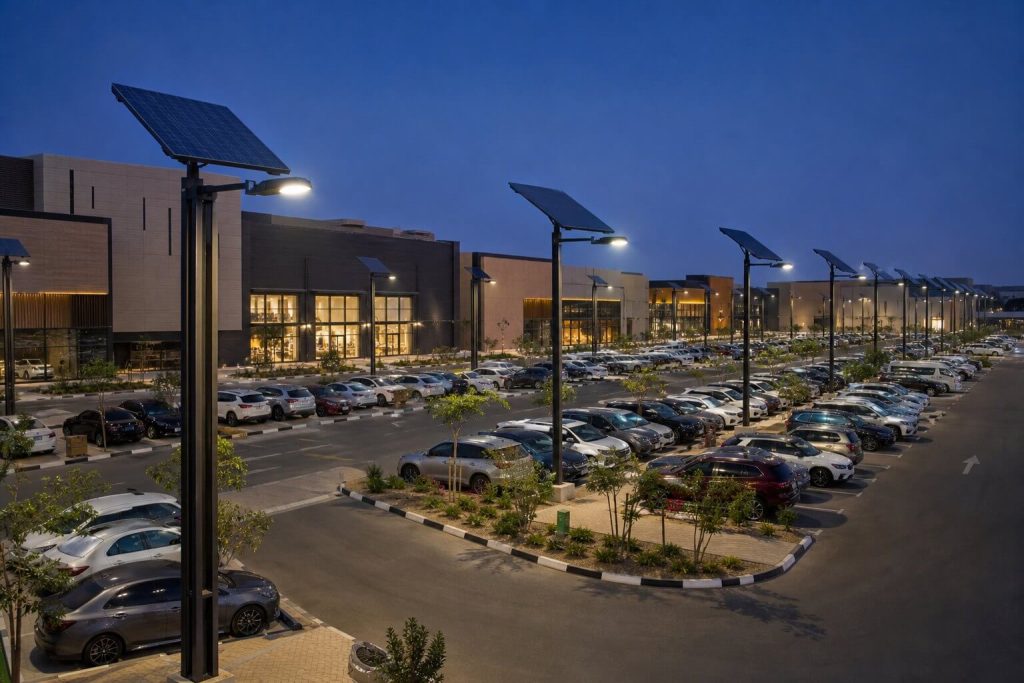
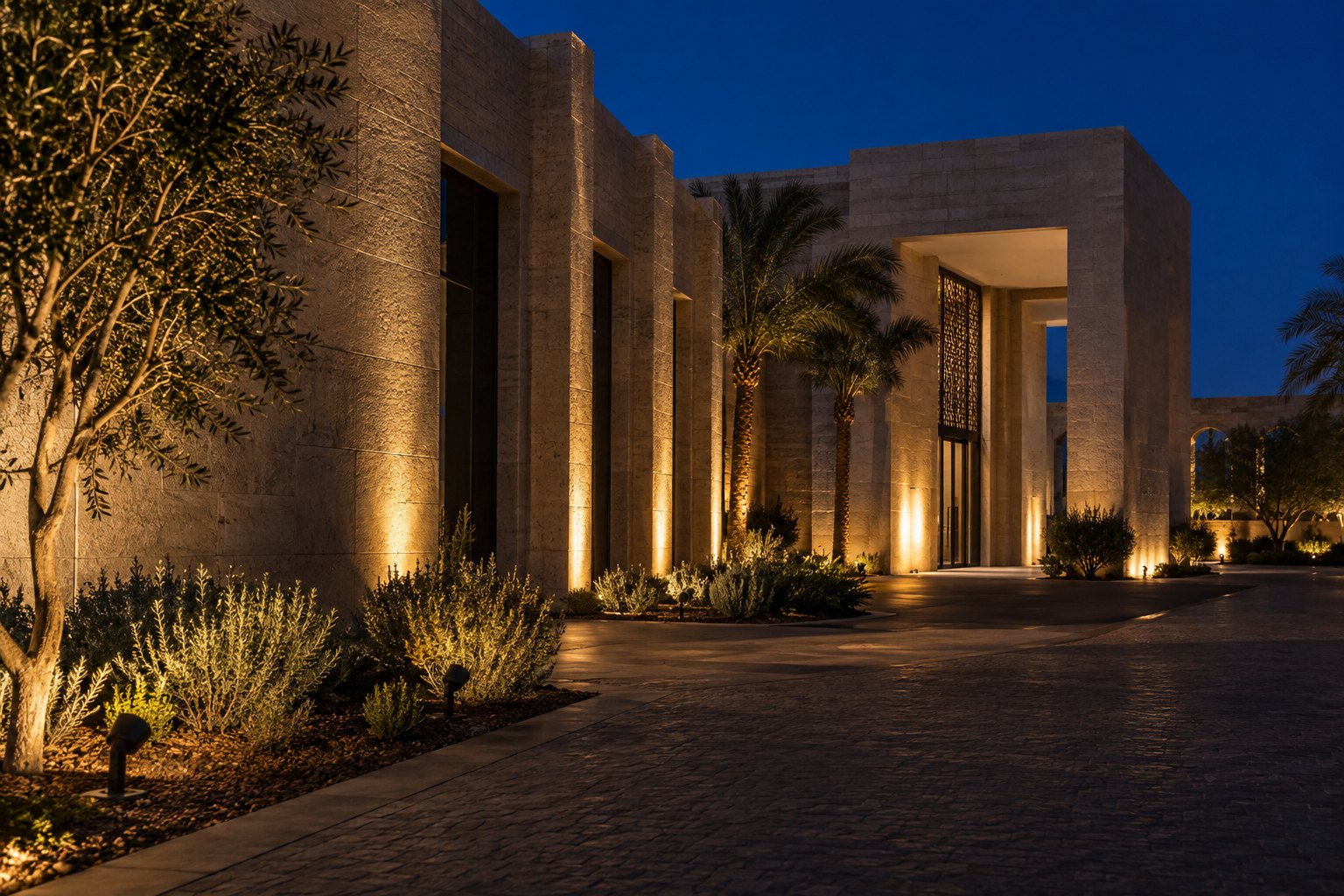
A commercial solar parking lot needs continuous visibility across bays, aisles, crossings, and entrances.
Define the Parking Tasks Before Selecting the Solar System
A parking area contains several visual tasks. Drivers need to identify aisle direction, parked vehicles, kerbs, ramps, and pedestrians. Security staff need usable facial and vehicle detail. Customers need to see crossings, trolley areas, payment points, and entrances without looking into a row of bright sources. One average lux value cannot describe all of this.
When discussing projects with clients, our engineering team asks for the parking plan, traffic flow, pedestrian routes, CCTV positions, operating schedule, nearby buildings, expected shading, pole restrictions, and local electrical or solar requirements. These inputs determine whether an all-in-one, separated, or hybrid solar configuration is practical.
Solar Parking Lot Lighting Lux Levels and Uniformity
The values below are early planning bands only. Local codes, owner requirements, CCTV needs, accessibility rules, and the project risk assessment control the final criteria. Uniformity is critical because a bright hotspot beside a dark parking bay can make people and obstacles harder to see.
| Parking zone | Indicative average lux | Uniformity focus | Additional check |
| Parking bays | 10-20 lux | Avoid dark gaps between vehicles | Vertical visibility and CCTV |
| Traffic aisles | 10-20 lux | Continuous route guidance | Glare toward drivers |
| Crossings and entrances | 20-30 lux | Clear conflict-area contrast | Pedestrian faces and kerbs |
| Loading or security points | 30-50 lux or task-specific | Minimum lux at the task | Local task lighting may be needed |
For an initial car-park model, a minimum-to-average uniformity target around 0.25 to 0.40 may be evaluated, but the specified metric and limit must come from the applicable standard. The DIALux report should show the calculation grid, pole coordinates, mounting height, beam distribution, maintenance factor, average and minimum lux, and spill light at the site boundary.
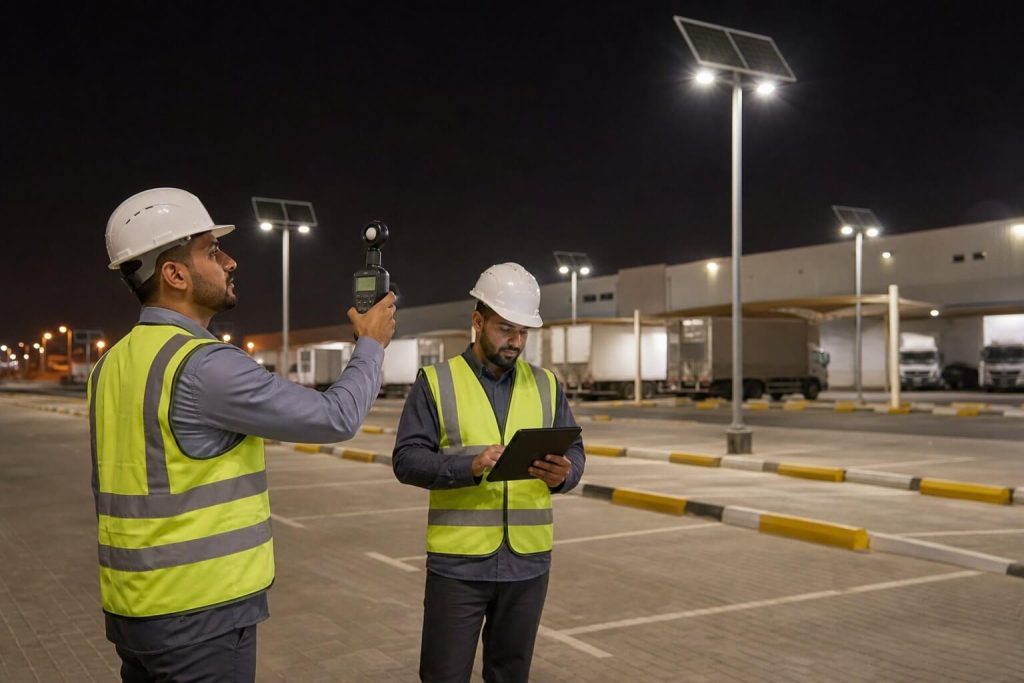
Commissioning measurements should follow the same grid and operating scene used in the approved lighting model.
Build the Night-Time Energy Budget
Solar parking lot battery sizing starts with watt-hours, not the wattage printed on the luminaire. Calculate the LED power used during each dimming period, multiply by the hours in that scene, and include controller, driver, wiring, battery, and temperature losses. A simple 60 W fixture running at full output for 12 hours would require 720 Wh before system losses. A programmed profile such as four hours at 100%, four hours at 50%, and four hours at 30% uses far less energy while preserving useful light when traffic is low.
Battery autonomy should be agreed in nights or hours. Two or three nights may be considered for many commercial projects, but cloudy-season data and the consequence of failure should decide the final value. High ambient temperature accelerates battery ageing, so capacity, enclosure ventilation, cell chemistry, charge limits, and replacement access must be reviewed together.
Size and Position the Solar Panel
Use location-specific solar irradiation, worst-month conditions, panel orientation, tilt, dirt loss, temperature loss, controller efficiency, and shading to size the array. Trees, canopies, signs, buildings, and parked trucks can remove several hours of useful charging even when the site looks sunny at noon. A shading review should cover the full year, not one site visit.
In dusty Gulf conditions, the panel angle and cleaning method affect yield. Horizontal or shallow panels collect more dirt. Provide safe access and a realistic cleaning interval. If the panel is remote from the battery or light head, include cable voltage drop and protection in the energy calculation.
Select Optics, Pole Height, and Spacing Together
Parking layouts often need asymmetric or rectangular distributions rather than a circular pool of light. The correct beam angle depends on pole setback, mounting height, aisle width, and whether the pole is single- or double-arm. More watts cannot repair a poor optic. Test several layouts in DIALux and compare minimum lux, uniformity, glare, pole count, panel shading, and civil cost.
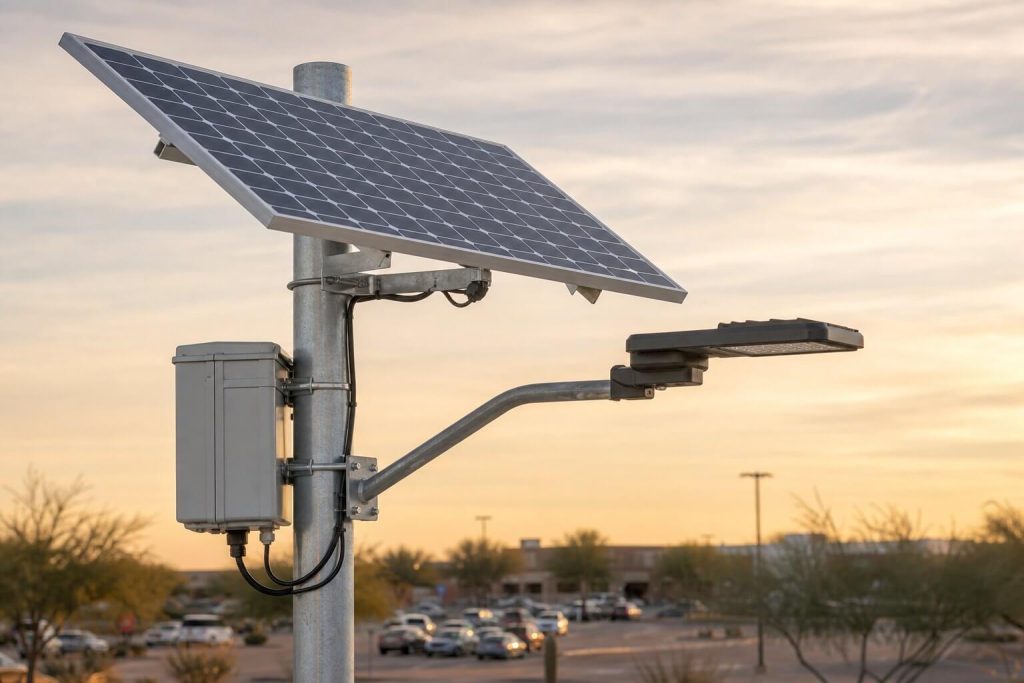
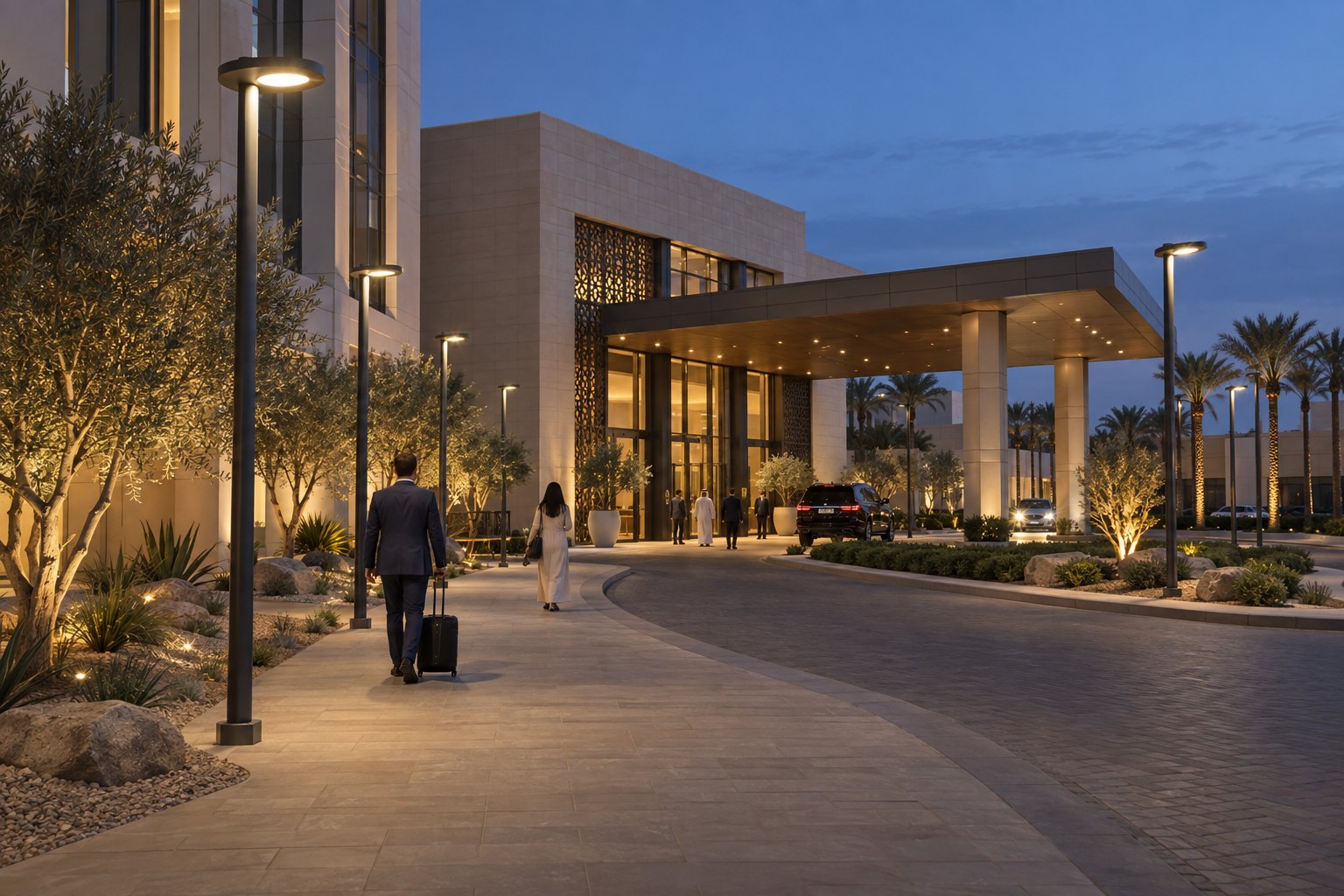
The solar panel, battery enclosure, controller, luminaire, bracket, and cable routing form one outdoor system.
Engineer for Heat, Dust, Wind, and Electrical Events
- Use IP65 or IP66 according to dust, rain, washing, and cable-entry exposure. The installed glands and access doors must preserve the intended rating.
- Review IK impact resistance where vehicles, trolleys, tools, or vandalism can reach the battery box or luminaire; IK08 may be considered where the risk justifies it.
- Check panel, luminaire, arm, and battery-box effective projected area in the pole wind-load calculation. Use project wind speed, terrain category, pole height, steel grade, and soil data.
- Coordinate surge protection and earthing for the controller, luminaire, battery, and any AC backup circuit. The required kV rating must follow the site electrical and lightning study.
- For coastal sites, specify salt-spray resistance, coating system, fasteners, and isolation between dissimilar metals across the complete assembly.
Compare Solar Parking Lot System Architectures
| System | Best fit | Strength | Main risk |
| All-in-one | Small lots and simple retrofits | Fast installation and compact package | Panel area, battery temperature, and shading limits |
| Separated panel and battery | Larger commercial projects | Flexible sizing and component placement | More cabling, joints, and installation work |
| Solar with AC backup | Critical or high-traffic areas | Higher operating resilience | Control complexity and grid connection |
| Mixed solar and grid layout | Sites with varied shading | Uses solar where it performs best | Two maintenance and control systems |
Procurement and Commissioning Checklist
1. Issue the parking plan, target lux, operating profile, CCTV and pedestrian requirements, and pole restrictions.
2. Request verified IES files and a DIALux report showing average, minimum, uniformity, glare-sensitive directions, and spill light.
3. Review the worst-month energy calculation, autonomy, battery temperature assumptions, panel losses, and dimming schedule.
4. Confirm IP/IK, wind load, foundation, corrosion protection, surge coordination, earthing, cables, and cleaning access.
5. Commission at night, record measurements and control settings, then verify charging and battery performance through representative operating cycles.
FAQ: Questions Buyers Ask
How many lux are needed for a solar parking lot?
Parking bays and traffic aisles may begin around 10-20 lux, while entrances, crossings, loading, or security points may require more. The final target and uniformity must follow the local code, owner brief, CCTV needs, and risk assessment.
How many cloudy nights should the battery support?
Two or three nights are common project discussions, but the correct autonomy depends on worst-month solar data, dimming strategy, site criticality, battery temperature, and acceptable failure risk.
Are all-in-one solar parking lights suitable for large malls?
They can suit some zones, but large sites often need more panel area, battery capacity, flexible optics, or component placement than an integrated head allows. Compare an all-in-one, separated, and hybrid design using the same performance brief.
Can solar parking lot lights work in extreme heat?
Yes, when the LED, controller, battery, enclosure, and charging limits are selected for the actual temperature. Battery placement and thermal derating are especially important because high heat can shorten service life.
Prove Both the Lighting and the Energy System
A reliable solar parking lot proposal includes a photometric model and an energy model. Buyers should be able to see where the light lands, how the battery is charged, how the system behaves after cloudy days, and how technicians will clean and service it.
| PROJECT REVIEW For a mall, hospital, logistics park, residential compound, or staff parking project, share the site plan, operating hours, solar location, required autonomy, and local environmental data for an engineering review. |
Send the site plan, target lux, mounting heights, operating schedule, environmental conditions, and electrical data through the Dawn Lighting official inquiry page. The engineering team can review the design basis and prepare a project-specific DIALux proposal and B2B quotation.
Official Dawn Lighting references
Dawn Lighting LED Solar Street Light category: https://www.dawnlighting.com/led-solar-street-light/
Dawn Lighting product categories: https://www.dawnlighting.com/products/
- 10 Meters Lamp Post
- 10 Meters Pole
- 1000w Led Projector
- 100W LED Tunnel Light
- 12 Meters Lamp Post
- 12 Meters Pole
- 1200w Led Projector
- 15 Light Pole
- 1500w Led Projector
- 150W LED Tunnel Light
- 1800w Led Projector
- 2 In 1 Solar Flood Light
- 200w Led Tunnel Light
- 50w Led Tunnel Light
- 6 Meters Lamp Post
- 6 Meters Pole
- 8 Meters Lamp Post
- 8 Meters Pole
- 800w Led Projector
- 80w Led Tunnel Light
- Colourful Decorative Light
- Conical post
- Courtyard Lamp
- courtyard light
- courtyard lighting fixture
- Decorative Landscape Light
- Decorative road Light
- Flood Light For Courtyard
- Flood Light for Garden
- Flood Light For Outdoor
- Foot Led High Bay Lights
- high bay led lights 100w
- industrial lampshade
- industrial LED shed lights
- industrial magnifying glass with light
- Integrated Solar Flood Light
- led courtyard lamp
- led courtyard light
- led high bay light 100w
- LED Projector For Stadium
- Led UFO High Bay 150W 5000k
- Lighting Plants Mining Price
- Maintenance Free LED Street Light
- Pic Controlling Tunnel Light
- PLC controlling tunnel light
- Post Top Garden Light
- RGB Landscape Light
- Rgbw Decorative Light
- Smart Tunnel Light
- solar courtyard lamp
- solar courtyard light
- Solar LED Road Light
- Solar Street Light For 10 Meter Pole
- Solar Street Light For 12 Meter Pole
- Solar Street Light For 6 Meter Pole
- Solar Street Light For 8 Meter Pole
- Split Type Solar Flood Light
- Sporting Projector
- Stadium Led Projector
- Street Lighting Post
