
 Request A Quote

LED Landscape Lighting for Hotels, Resorts, Parks, and Public Spaces
 FACEBOOK
 TWITTER
 LINKEDIN
LED landscape lighting should make a site safer and more attractive without turning every tree, path, and facade into a bright spot. A good design separates pedestrian guidance, architectural accents, planting features, water edges, service roads, and neighbour-sensitive boundaries. In Middle Eastern, African, and Asian projects, heat, dust, humidity, salt, irrigation, and maintenance access should be part of the lighting brief from the first drawing.
| DIRECT ANSWER Choose LED landscape lighting by defining the visual purpose of each zone, then select the fixture type, mounting height, beam angle, colour temperature, IP rating, and control scene. Verify path lux, glare, spill light, power loading, and maintenance access in a project layout or DIALux design before ordering in quantity. |
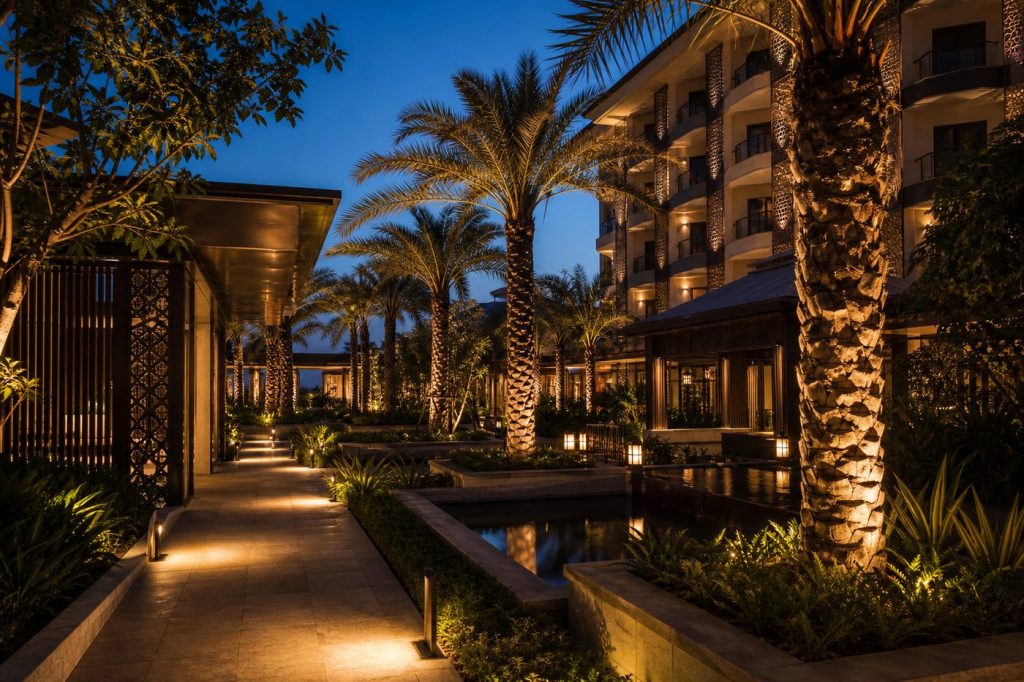
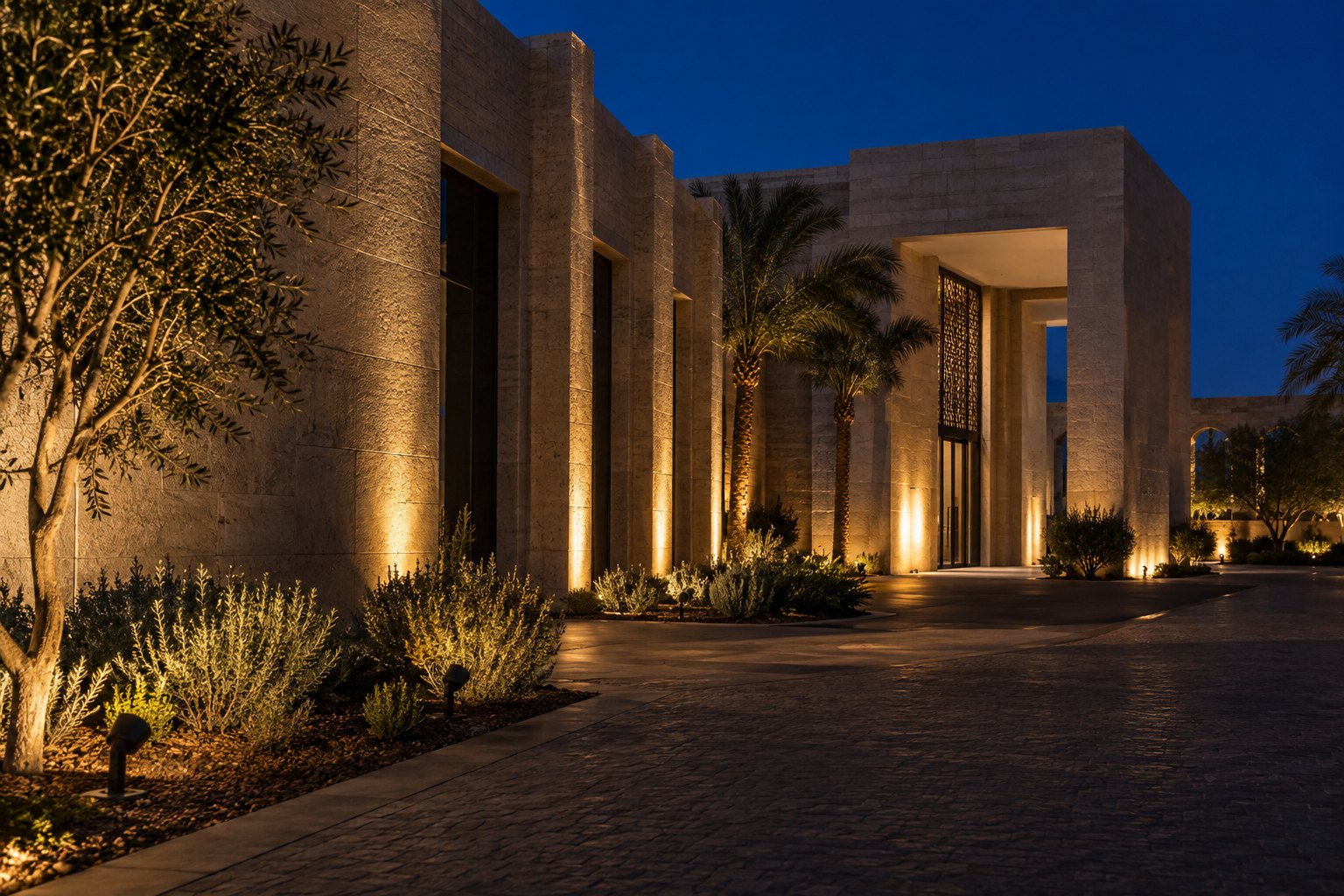
LED landscape lighting creating controlled path and planting illumination in a hotel courtyard.
1. Start With the Visitor Experience and Safety Task
A hotel arrival path needs clear pedestrian guidance. A public park needs comfortable circulation, steps, ramps, and enough visual information around changes in level. A resort courtyard may also need soft accent light on palms, water, seating, and architectural surfaces. These tasks should be separated before a fixture family is selected.
When comparing an LED landscape lighting supplier or landscape lighting manufacturer, provide a scaled plan with paths, planting beds, trees, water features, walls, entrances, service routes, and neighbouring properties. A catalogue image cannot show whether the fixture will create a dark step, a harsh hot spot, or unwanted light into a guest room.
2. Use Lux and Uniformity for Paths, Not Only Lumens
Landscape lighting lux levels should be matched to movement speed and visual risk. A decorative tree uplight may be judged mainly by beam control and appearance, while a pedestrian path needs consistent guidance. The ranges below are preliminary planning bands only; the venue owner, local authority, and safety brief control the final target.
| Landscape zone | Indicative planning range | Main design priority | Typical fixture logic |
| Pedestrian paths | 3-10 lux | Continuous guidance and step visibility | Bollards, low posts, or shielded optics |
| Hotel arrival / public plaza | 10-30 lux | Faces, entrances, and movement | Post lights plus controlled architectural accents |
| Stairs, ramps, and crossings | 10-30 lux | No abrupt dark bands | Low-glare side or integrated lighting |
| Trees, walls, and planting | Accent level by design | Beam control and visual hierarchy | Adjustable spot or wall-wash optics |
A landscape lighting DIALux design should show the path calculation plane, access points, steps, ramps, building edges, and sensitive boundaries. For a larger hotel or public park, add a circuit and control schedule so the owner can use different scenes for arrival, evening operation, cleaning, and late-night security.
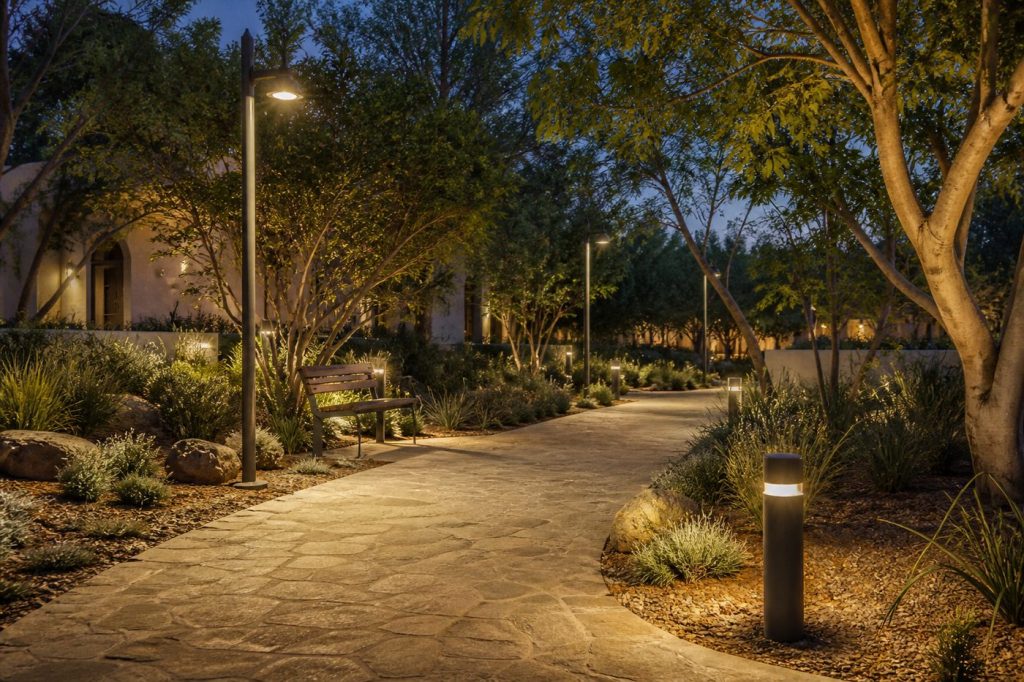
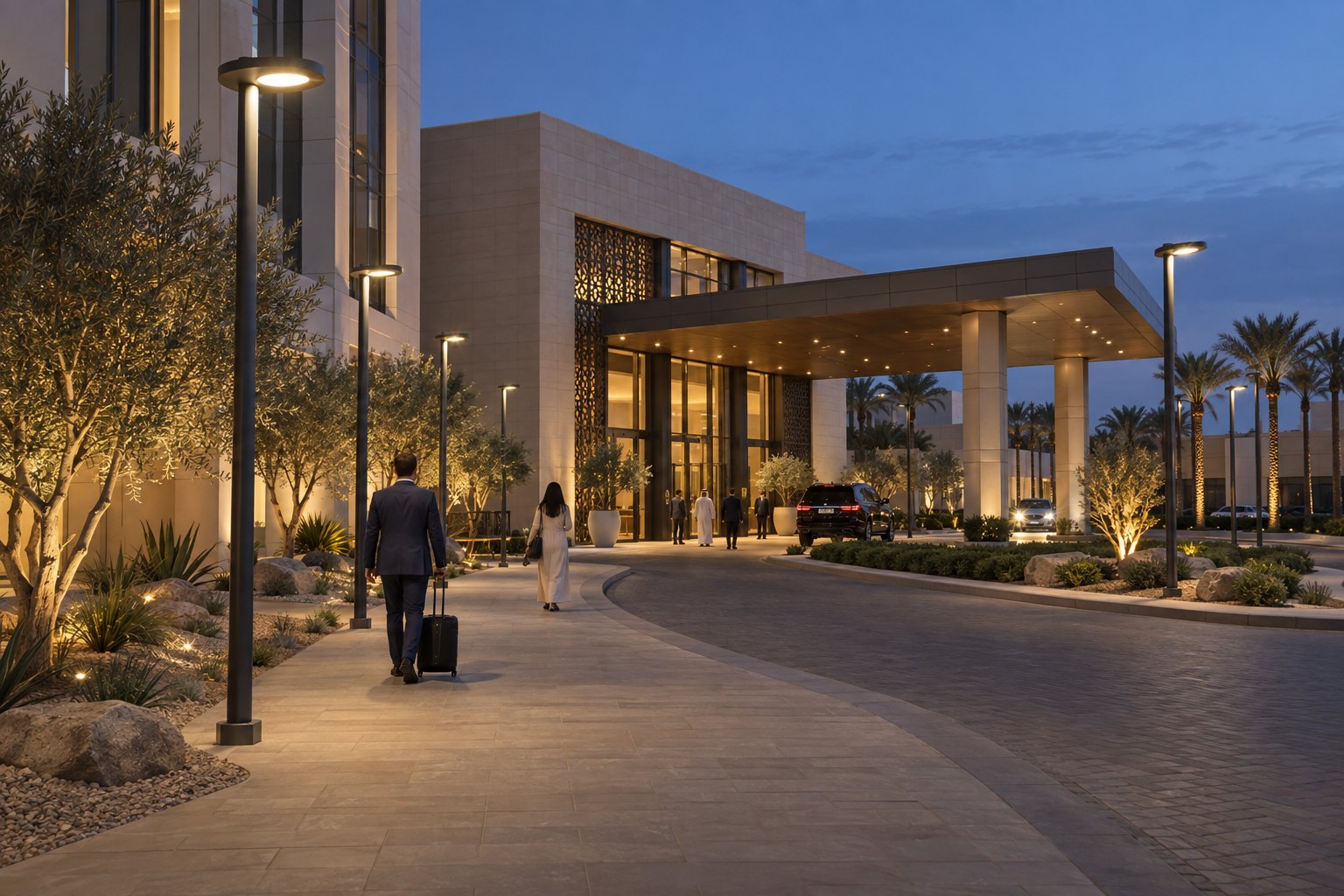
Low-glare bollards and decorative garden poles providing comfortable path lighting in a landscaped public space.
3. Select CCT, CRI, and Beam Angle by Feature
Warm light is often chosen for hospitality landscapes because it supports a relaxed atmosphere and reduces the visual harshness of exposed LED sources. Neutral white may be useful where colour recognition, security, or architectural detail is more important. Keep the colour temperature consistent within a visible zone and check how it interacts with facade materials, foliage, paving, and water.
Landscape lighting beam angle should follow the target feature. A narrow optic can highlight a tree trunk or column. A wider distribution can wash a low wall or a path edge. Avoid aiming a narrow, high-output beam directly toward a guest room, road, or seating area. Low-glare landscape lighting is achieved through the combination of shielding, aiming, height, output, and background brightness.
4. Plan for Heat, Dust, Irrigation, and Corrosion
Landscape lighting for hot climates is exposed to direct sun, dust, irrigation water, and repeated thermal cycling. Coastal hotels and parks add salt spray and humid air. The fixture body, driver, cable glands, brackets, fasteners, junction boxes, and foundations should be reviewed as one installation rather than as separate catalogue lines.
- IP65 garden lighting can be suitable for many exposed outdoor positions, but the installed cable entry and connector arrangement must preserve the enclosure protection.
- Review aluminium alloy, stainless steel, galvanised steel, or powder-coated parts against the site corrosion risk and irrigation chemicals.
- Use landscape lighting surge protection when the site has long outdoor cable runs, exposed distribution boards, or a high lightning risk.
- Check thermal dissipation and driver ambient limits for fixtures mounted in dark enclosures or directly exposed to afternoon sun.
- Provide access for lens cleaning, plant growth control, driver replacement, and cable inspection without damaging finished landscape surfaces.
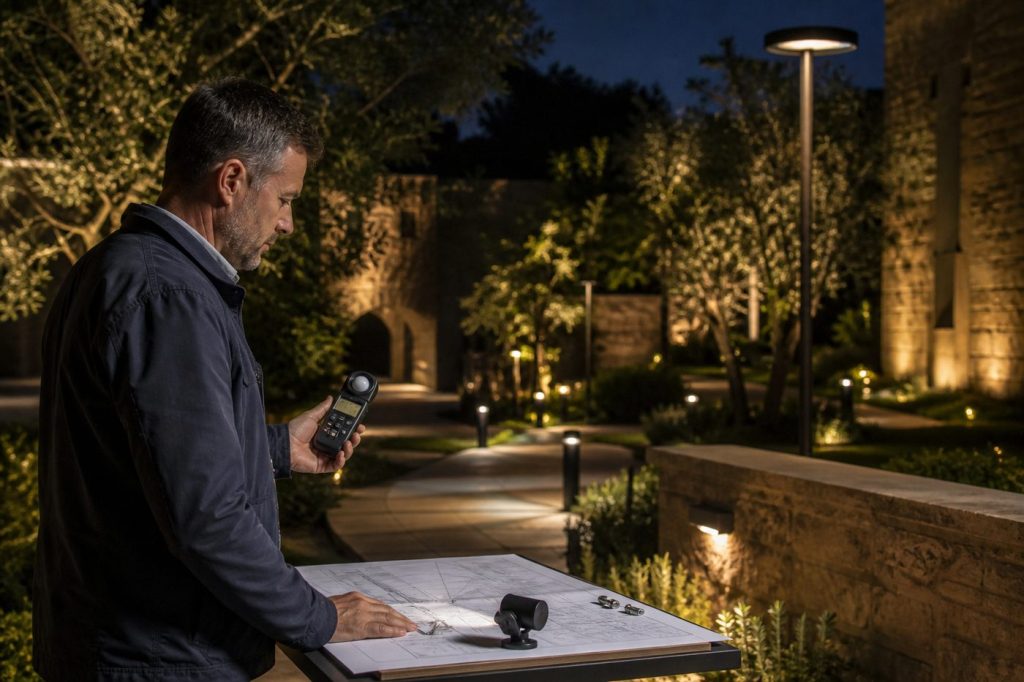
An engineer checking path illumination and fixture placement during a landscape lighting commissioning visit.
5. Compare Fixture Types for a Commercial Landscape
| Fixture type | Best use | Strength | Risk to manage |
| Bollard / low post | Paths, garden edges, and steps | Comfortable pedestrian-scale light | Plant growth and vandalism |
| Decorative garden pole | Hotel courtyards, parks, and plazas | Wider area coverage with visual identity | Foundation, wind, and consistent spacing |
| In-ground / recessed | Facade edges, decks, and feature zones | Clean daytime appearance | Drainage, water ingress, and service access |
| Adjustable spot / flood | Trees, walls, sculpture, and architecture | Precise feature emphasis | Glare, spill light, and aiming drift |
Dawn Lighting’s public Garden Landscape Light page lists a 20W-50W range, 120-160 lm/W efficacy, 4500-8000 lm output, aluminium alloy construction, AC85-265V input, and IP65 protection for a product in this category. Those published values are a reference for that product; the final project package should still be matched to the site layout and client specification.
6. Commission the Landscape at Night
- Confirm each fixture position, tilt, beam angle, CCT, circuit, and control scene against the approved plan.
- Measure path and step areas with a calibrated lux meter and review visual comfort from normal pedestrian eye height.
- Check guest-room windows, neighbouring roads, residential boundaries, and water surfaces for glare or unwanted reflections.
- Record aiming angles, driver settings, timer or photocell schedules, cable routes, and spare-part requirements.
- Hand over a cleaning and maintenance plan that considers irrigation, pruning, dust, salt, and seasonal planting changes.
FAQ: Questions Buyers Ask
What IP rating is suitable for outdoor landscape lighting?
IP65 is a common baseline for many exposed outdoor landscape positions, but the correct rating depends on rain, irrigation, cleaning, pooling water, and the installation detail. Cable glands, connectors, and junction boxes must be checked together with the luminaire.
What colour temperature is best for hotel landscape lighting?
Warm white around 2700K-3000K is often comfortable for hospitality spaces, while neutral white may help with colour recognition or security tasks. Keep the selected CCT consistent in each visible zone and verify it against the facade and planting materials.
How do I prevent glare from garden and landscape lights?
Use shielding, controlled beam angles, appropriate mounting height, lower output where possible, and careful aiming. Review the light from guest rooms, roads, seating areas, and normal pedestrian eye height, not only from the fixture location.
Can LED landscape lighting work in hot and coastal climates?
Yes, when thermal dissipation, IP protection, coating, fasteners, cable entries, and surge protection are selected for the actual heat, dust, humidity, irrigation, and salt exposure. Maintenance access should be part of the original layout.
Make the Landscape Design Serve the Site
Commercial landscape lighting is successful when guests can move comfortably, the architecture and planting read clearly, neighbours are not disturbed, and the owner can maintain the system without reopening finished paving. Treat the project as a coordinated visual, electrical, and maintenance design rather than a collection of decorative fixtures.
| ENGINEERING INQUIRY For a hotel, resort, public park, commercial plaza, or residential landscape project, send the site plan, planting and path layout, target atmosphere, operating schedule, and climate conditions through Dawn Lighting’s official inquiry page. |
Share your site plan, target lux, mounting height, operating schedule, and electrical conditions through the Dawn Lighting official inquiry page. The engineering team can review the layout, recommend a suitable fixture package, and prepare a project-specific DIALux simulation and B2B quotation review.
Dawn Lighting references
Decorative and landscape lighting category: https://www.dawnlighting.com/decorative-light/
Garden Landscape Light product page: https://www.dawnlighting.com/product/garden-landscape-light/
Residential and Garden Lighting category: https://www.dawnlighting.com/residential-garden-lighting/
- 10 Meters Lamp Post
- 10 Meters Pole
- 1000w Led Projector
- 100W LED Tunnel Light
- 12 Meters Lamp Post
- 12 Meters Pole
- 1200w Led Projector
- 15 Light Pole
- 1500w Led Projector
- 150W LED Tunnel Light
- 1800w Led Projector
- 2 In 1 Solar Flood Light
- 200w Led Tunnel Light
- 50w Led Tunnel Light
- 6 Meters Lamp Post
- 6 Meters Pole
- 8 Meters Lamp Post
- 8 Meters Pole
- 800w Led Projector
- 80w Led Tunnel Light
- Colourful Decorative Light
- Conical post
- Courtyard Lamp
- courtyard light
- courtyard lighting fixture
- Decorative Landscape Light
- Decorative road Light
- Flood Light For Courtyard
- Flood Light for Garden
- Flood Light For Outdoor
- Foot Led High Bay Lights
- high bay led lights 100w
- industrial lampshade
- industrial LED shed lights
- industrial magnifying glass with light
- Integrated Solar Flood Light
- led courtyard lamp
- led courtyard light
- led high bay light 100w
- LED Projector For Stadium
- Led UFO High Bay 150W 5000k
- Lighting Plants Mining Price
- Maintenance Free LED Street Light
- Pic Controlling Tunnel Light
- PLC controlling tunnel light
- Post Top Garden Light
- RGB Landscape Light
- Rgbw Decorative Light
- Smart Tunnel Light
- solar courtyard lamp
- solar courtyard light
- Solar LED Road Light
- Solar Street Light For 10 Meter Pole
- Solar Street Light For 12 Meter Pole
- Solar Street Light For 6 Meter Pole
- Solar Street Light For 8 Meter Pole
- Split Type Solar Flood Light
- Sporting Projector
- Stadium Led Projector
- Street Lighting Post
