
 Request A Quote

High Mast Lighting for Ports, Airports, and Logistics Parks in Hot Climates
 FACEBOOK
 TWITTER
 LINKEDIN
1. Start With the Work Task, Not the Pole Height
A port gate, container yard, airport apron, and logistics park do not need the same lighting level. Drivers need clear lane edges and container markings. Crane operators need a stable visual field with limited glare. Security teams need enough vertical illumination to identify people and vehicle movements. The right high mast lighting design begins with those tasks.
For early budgeting, many open-yard projects are assessed in the 10 to 50 lux range, with uniformity often specified separately. These figures are planning ranges, not a substitute for the client specification, local standard, traffic class, or aviation requirement. Our engineering team normally asks for an area plan, operating hours, mast positions, equipment height, and the client’s lux and uniformity target before selecting a fixture package.
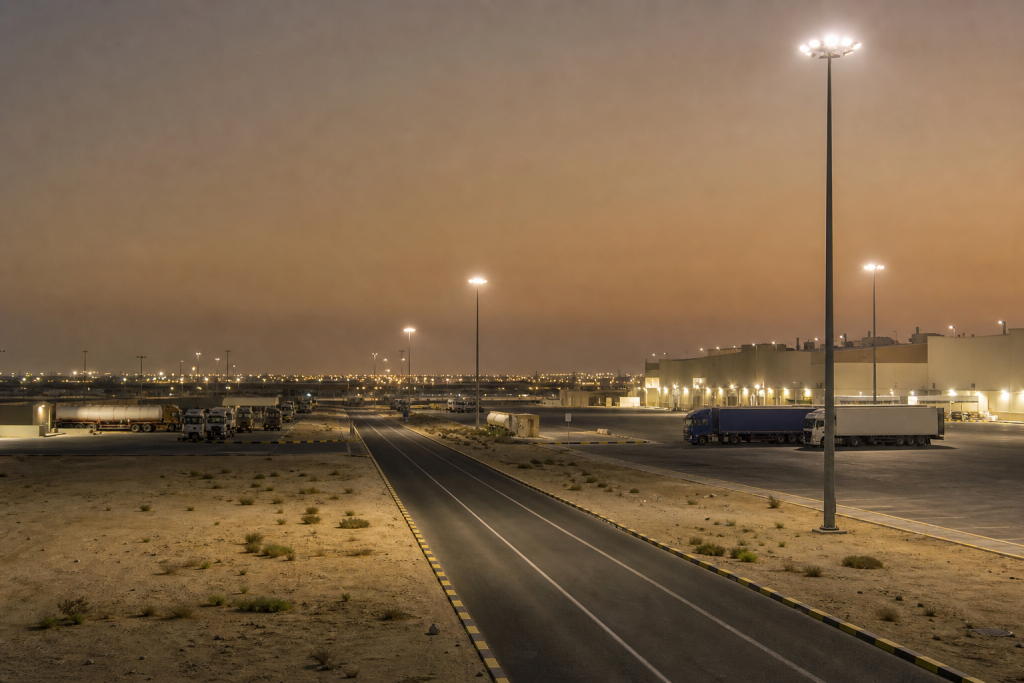
High mast lighting supporting vehicle movement across a hot-climate logistics park.
2. Match Tower Height, Wattage, and Beam Angle
A taller mast can reduce the number of foundations, but it also increases wind exposure, access complexity, and the need for accurate optical control. A shorter mast may simplify maintenance while requiring more poles and more careful overlap between light patches. Neither option is automatically cheaper after civil works, cable routing, and access equipment are included.
| Preliminary tower | Typical open-area use | Indicative fixture package | Planning lux range | Design warning |
| 12-15 m | Parking, small yards, access zones | 300-800 W per tower | 10-20 lux | Check dark areas between poles |
| 18 m | Ports, logistics parks, freight terminals | 600-1,500 W per tower | 20-50 lux | Wind load and glare need full modeling |
| 25-30 m | Large aprons, interchanges, major yards | 1,000-2,400 W per tower | 20-50 lux | Foundation, lowering and maintenance plan are critical |
The table shows preliminary engineering bands only. A 1,000 W fixture may be appropriate on one site and excessive on another because optical efficiency, aiming, mounting height, surface reflectance, and background light all change the result.
For reference, Dawn Lighting publishes an 18 m high mast pole with Q235B steel, a 5/6 mm wall thickness, hot-dip galvanizing, dynamic wind-load analysis, and applications including stadiums, airport aprons, ports, and freight terminals. See the 18 m high mast pole product page. Product selection still requires the project wind zone and foundation calculation.
3. Control Glare at the Source
Glare is not solved by simply reducing wattage. It is controlled by fixture aiming, shielding, beam selection, mounting height, tilt, and the position of the observer. In a container yard, a driver looking toward a mast can experience discomfort glare even when the horizontal lux reading looks acceptable. At an airport, stray light can also conflict with operational requirements.
Beam angles and aiming
Narrow 10° or 25° optics can project light to distant zones from a tall mast. Wider 45°, 60°, or asymmetric optics are useful when the mast sits close to a boundary or when a rectangular yard needs a controlled lateral spread. The final choice should come from a photometric layout, not from a catalogue lumen number.
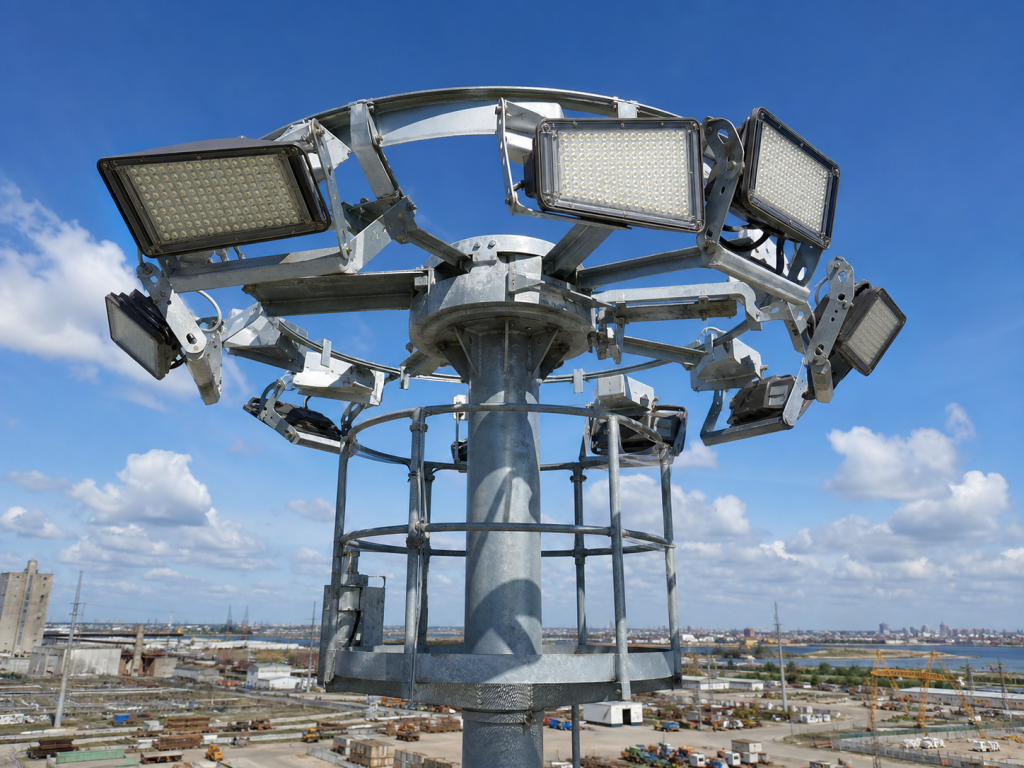
Close view of a high mast LED floodlight array with multiple optical directions.
4. Engineer for Heat, Dust, Salt, and Surges
Middle Eastern and African sites often combine high ambient temperature, dust, long operating hours, and unstable electrical conditions. Coastal Asian sites add salt spray and heavy rain. Those conditions expose weak thermal paths, poor cable glands, underspecified surge protection, and coatings that were chosen only for an indoor environment.
- Use an IP65 or IP66 enclosure according to the site exposure and cleaning method; verify the rating after cable glands and connectors are installed.
- Review the LED driver’s declared ambient temperature range, thermal derating curve, and service access. A large aluminium heat sink helps only when the heat path is continuous and unobstructed.
- Specify surge protection at the fixture and distribution level where the lightning and switching environment justifies it. Confirm the test class, discharge capacity, and replacement method.
- For coastal ports, match hot-dip galvanizing, powder coating, fasteners, and cable hardware to the corrosion category. A single painted layer is not a complete salt-spray strategy.
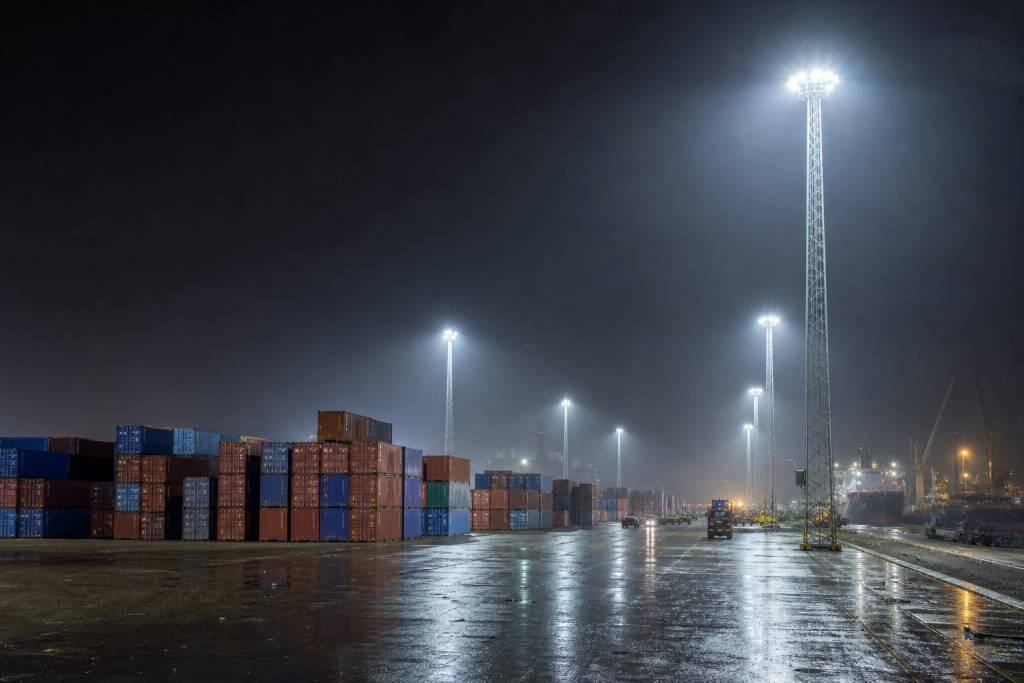
High mast lighting operating in a wet coastal port environment.
5. Compare LED High Mast Lighting With Metal Halide
Many existing yards still use metal halide or high-pressure sodium. A retrofit decision should compare delivered light, maintenance, controls, and electrical behavior rather than wattage alone. LED systems can reduce warm-up time and simplify dimming, but poor aiming can still create glare and dark zones.
| Factor | LED high mast lighting | Metal halide / HID | What the buyer should verify |
| Light output | High efficacy with directional optics | More spill light and optical loss | Delivered lux and uniformity in DIALux |
| Start-up | Immediate or controlled start | Warm-up and restrike delay | Operational restart requirement |
| Controls | Dimming, scheduling, monitoring possible | Limited and less responsive | Driver and control compatibility |
| Maintenance | Longer service interval when thermally managed | Lamp and ballast replacement | Lumen maintenance and access plan |
| Harsh climate | IP rating, SPD, coating and thermal design matter | Lamp, ballast and enclosure age faster | Ambient temperature and corrosion test data |
6. Include Maintenance in the Original Layout
A high mast can look efficient on a site plan and become expensive when every service visit needs a crane. Specify the lowering system, winch or service platform, locking hardware, cable routing, replacement access, and safe isolation points before the pole order is released. If a fixed crown is used, confirm the client’s access equipment and annual inspection method.
For remote logistics parks, the maintenance plan should also cover spare drivers, surge protectors, optical modules, connectors, and the identification of each fixture. A small stock of the right spare part often matters more than a small difference in initial wattage.
7. Buyer Checklist for a High Mast Lighting Supplier
- Share a scaled site plan with mast coordinates, boundaries, access lanes, equipment locations, and any no-light zones.
- State the required average lux, minimum lux, uniformity, glare limit, colour temperature, and operating schedule.
- Request IES or equivalent photometric files and a DIALux report that shows calculation grids, isolux lines, and aiming angles.
- Ask for structural drawings, wind-load assumptions, foundation loads, galvanizing specification, and coating system.
- Confirm IP65/IP66, IK rating where impact is possible, surge protection, driver temperature limits, and warranty conditions.
- Review lowering, access, spare parts, commissioning, aiming records, and post-installation lux verification.
FAQ: High Mast Lighting for Ports and Logistics Parks
FAQ: Questions Buyers Ask Before Ordering
How high should a high mast lighting pole be?
Common project heights range from about 12 m to 30 m, but the correct height depends on the yard dimensions, wind zone, fixture optics, maintenance method, and required uniformity. An 18 m pole can be a practical middle option for many freight and port layouts, but the final height should come from a site-specific model.
What IP rating is suitable for a coastal or dusty port?
IP65 is a useful baseline for outdoor dust and rain protection, while IP66 may provide more margin where powerful cleaning jets or severe weather are expected. The complete installed assembly matters: seals, glands, connectors, doors, and maintenance procedures must preserve the rating.
Can high mast lights operate in very hot climates?
Yes, if the LED driver, heat sink, enclosure, and control gear are selected for the actual ambient temperature and installed with adequate airflow. Ask for the driver temperature limit, thermal derating information, and a maintenance plan for dust on heat-dissipating surfaces.
How do I prevent glare from high mast lights?
Use the correct mounting height, beam angle, tilt, shielding, and aiming direction. Model observer positions such as truck lanes, crane cabins, nearby roads, and residential boundaries. Lowering the wattage without correcting the optical geometry can leave dark zones while glare remains.
Plan the Site Before You Order the Hardware
High mast lighting is a structural, optical, electrical, and maintenance decision in one package. Treating it as a simple floodlight purchase is how projects end up with glare complaints, overloaded foundations, or costly access work. A measured layout and a clear climate brief give the supplier enough information to design for the actual yard.
| ENGINEERING INQUIRY For a port, airport, freight terminal, or logistics park project, provide the site plan and performance target through Dawn Lighting’s official inquiry page. The design review can cover mast layout, optics, thermal conditions, wind assumptions, and the DIALux calculation before procurement. |
Send the project location, site plan, mounting height, target lux, operating hours, and local electrical conditions through the Dawn Lighting official inquiry page. The engineering team can then prepare a project-specific recommendation, DIALux lighting simulation, and B2B quotation request review.
Related Dawn Lighting References
High mast pole engineering reference: 18 m high mast pole product page.
Project portfolio: Dawn Lighting projects.
- 10 Meters Lamp Post
- 10 Meters Pole
- 1000w Led Projector
- 100W LED Tunnel Light
- 12 Meters Lamp Post
- 12 Meters Pole
- 1200w Led Projector
- 15 Light Pole
- 1500w Led Projector
- 150W LED Tunnel Light
- 1800w Led Projector
- 2 In 1 Solar Flood Light
- 200w Led Tunnel Light
- 50w Led Tunnel Light
- 6 Meters Lamp Post
- 6 Meters Pole
- 8 Meters Lamp Post
- 8 Meters Pole
- 800w Led Projector
- 80w Led Tunnel Light
- Colourful Decorative Light
- Conical post
- Courtyard Lamp
- courtyard light
- courtyard lighting fixture
- Decorative Landscape Light
- Decorative road Light
- Flood Light For Courtyard
- Flood Light for Garden
- Flood Light For Outdoor
- Foot Led High Bay Lights
- high bay led lights 100w
- industrial lampshade
- industrial LED shed lights
- industrial magnifying glass with light
- Integrated Solar Flood Light
- led courtyard lamp
- led courtyard light
- led high bay light 100w
- LED Projector For Stadium
- Led UFO High Bay 150W 5000k
- Lighting Plants Mining Price
- Maintenance Free LED Street Light
- Pic Controlling Tunnel Light
- PLC controlling tunnel light
- Post Top Garden Light
- RGB Landscape Light
- Rgbw Decorative Light
- Smart Tunnel Light
- solar courtyard lamp
- solar courtyard light
- Solar LED Road Light
- Solar Street Light For 10 Meter Pole
- Solar Street Light For 12 Meter Pole
- Solar Street Light For 6 Meter Pole
- Solar Street Light For 8 Meter Pole
- Split Type Solar Flood Light
- Sporting Projector
- Stadium Led Projector
- Street Lighting Post
