
 Request A Quote

How to Choose a Solar Street Light Supplier for African Road Projects
 FACEBOOK
 TWITTER
 LINKEDIN
How to Choose a Solar Street Light Supplier for African Road Projects
| Featured Snippet Answer A reliable solar street light supplier for African road projects should provide more than a lamp and solar panel. The supplier should support lux calculations, battery autonomy design, pole selection, IP/IK protection, surge protection, and project documentation. The correct system depends on road width, pole spacing, mounting height, daily operating hours, solar conditions, and rainy-season requirements. |
Why the Supplier Matters More Than the Wattage
Many buyers start with a question such as, “Should we use a 60W or 100W solar street light?” That is not the correct starting point.
In outdoor engineering projects, we first review the required illuminance, road classification, pole layout, optical distribution, and operating profile. A 60W fixture with a suitable asymmetric lens can produce better road coverage than a 100W fixture with the wrong beam angle.
Our engineering team found that three issues cause most solar street lighting problems:
- The system is selected by wattage instead of lux.
- Battery capacity is calculated without considering rainy-season autonomy.
- The product is chosen without checking thermal performance, dust protection, and maintenance access.
A qualified solar street light supplier should help solve all three issues before production begins.
1. Start With Lux and Uniformity
Lux measures the amount of light reaching the road surface. One lux equals approximately 0.0929 foot-candles.
The correct target depends on the road type, traffic level, pedestrian activity, and local project specification. The following ranges can be used as preliminary design references, but the final target should be confirmed through local standards and DIALux simulation.
| Application | Preliminary Average Lux | Uniformity Target | Mounting Height | Main Concern |
| Residential access road | 5–10 lux | 0.25–0.40 | 5–7 m | Low glare and energy use |
| Urban road | 10–20 lux | 0.35–0.50 | 7–10 m | Road coverage and safety |
| Parking area | 10–20 lux | 0.30–0.50 | 6–10 m | Dark spots between vehicles |
| Market or commercial area | 15–30 lux | 0.40–0.60 | 6–10 m | Pedestrian visibility |
| Road intersection | 20–30 lux | 0.40 or higher | 8–12 m | Conflict-zone visibility |
A solar street light supplier should provide the IES or LDT photometric file before you approve the configuration. The simulation should show average lux, minimum lux, maximum lux, uniformity, glare risk, pole spacing, and light distribution.
Dawn Lighting provides lighting design services including DIALux layouts and project-specific technical support through its LED Solar Street Light Solutions.
2. Select the Correct Solar Street Light Structure
Solar street lights are commonly supplied in three configurations.
| System Type | Best Application | Main Advantage | Main Limitation | Maintenance |
| All-in-one | Residential roads, parks, small parking areas | Compact installation and simple wiring | Less room for battery and panel upgrades | Replace the complete unit quickly |
| Semi-integrated | Municipal roads and larger project sites | Flexible panel position and component layout | More installation components | Battery and controller are easier to replace |
| Grid-connected / hybrid | Main roads and high-demand areas | Stable operation with grid backup | Needs electrical infrastructure | More complex electrical maintenance |
For African projects, semi-integrated systems are often useful when the site requires flexible solar panel positioning, larger battery capacity, or easier component replacement.
A current Dawn Lighting semi-integrated configuration lists 15–30W power, up to 180 lm/W efficacy, IP66 protection, a 6–7 meter mounting height, MPPT control, and operation designed around 12 hours with several rainy days of autonomy. Final performance still depends on the lighting profile and local solar conditions.
See the Semi-Integrated Solar Street Light product page for the published technical configuration.
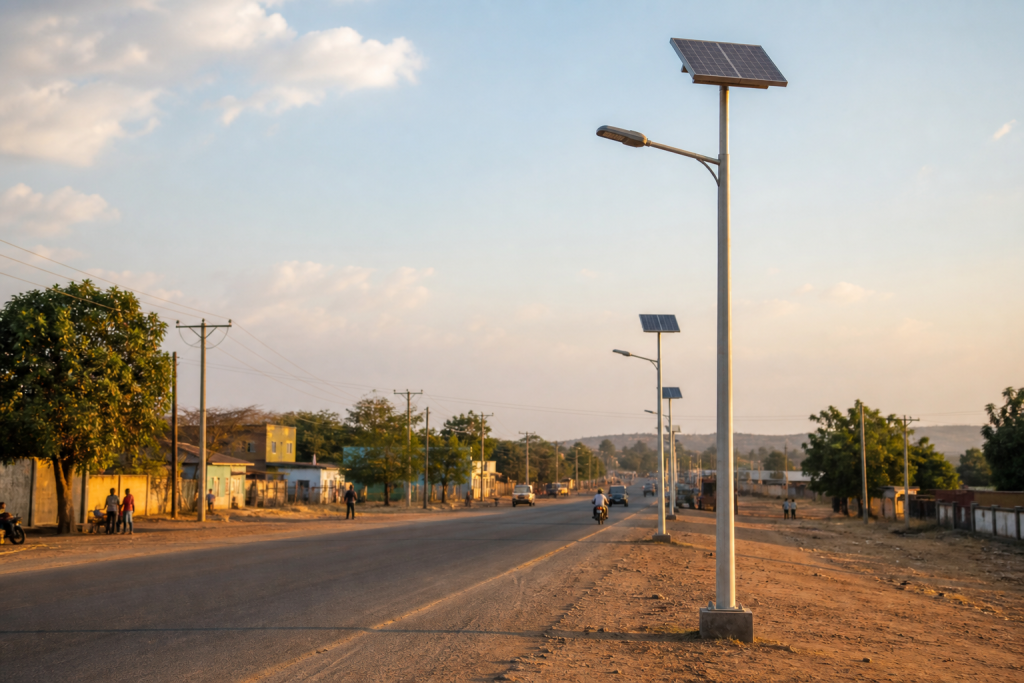
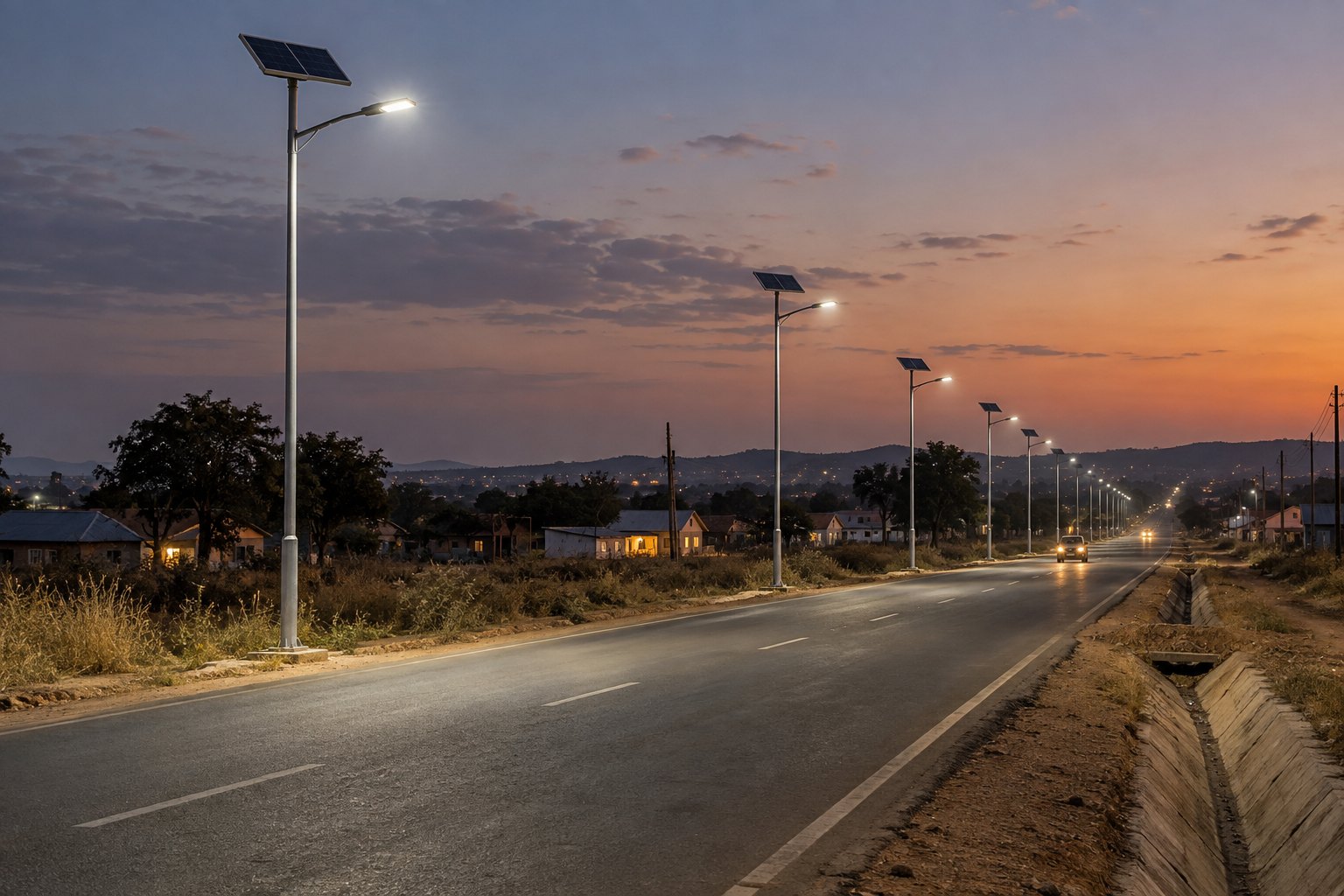
A semi-integrated solar street light installation along a wide African road.
3. Calculate Battery Autonomy for the Rainy Season
Battery sizing should be based on energy consumption, not only battery amp-hours.
| Engineering Formula Nightly energy demand = LED power × operating hours Required battery capacity = nightly energy demand × autonomy days ÷ usable depth of discharge ÷ system efficiency |
For example, a 60W light operating at full output for 12 hours uses 720Wh per night. For three cloudy or rainy days, the theoretical energy requirement becomes 2,160Wh before depth of discharge, controller efficiency, temperature, battery aging, and dimming are considered.
This point matters. A product may claim three to five rainy days, but the buyer should confirm whether that figure means full brightness for the entire night, reduced brightness after midnight, motion-sensor operation, a programmed dimming profile, or a specific battery discharge limit.
Our engineering team normally reviews the full operating profile rather than accepting a rainy-day number by itself.
Lithium iron phosphate batteries are often preferred for outdoor solar projects because they provide good cycle life and stable thermal performance. However, the battery enclosure must still be designed for high ambient temperatures and easy service access.
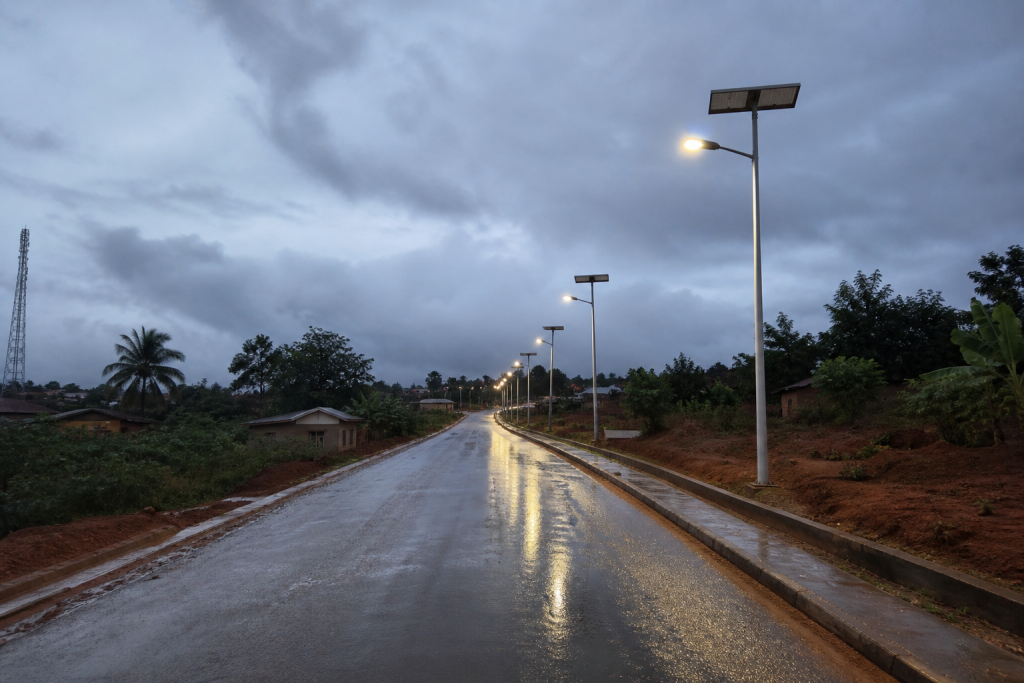
Solar street lights operating after rainfall on a municipal road during the rainy season.
4. Check Thermal Performance in Hot African Environments
A solar street light installed in a hot region may operate under direct sunlight, high LED junction temperature, and limited airflow. The housing must remove heat from the LED board and driver.
When comparing suppliers, ask for:
- Maximum ambient operating temperature
- LED junction temperature data
- Housing material and thermal conductivity
- Driver efficiency
- L70 lifetime calculation
- Thermal test report
- Battery temperature protection
- Controller derating behavior
Die-cast aluminum is widely used because it combines structural strength with heat dissipation. However, housing material alone does not prove good thermal performance. Fin design, LED board contact, thermal interface material, and driver placement also affect service life.
For reference, one Dawn Lighting solar configuration lists a working temperature range of approximately -25°C to +65°C, but the final specification must be confirmed for the selected model and project conditions.
Review the published product technical specifications before using any figure in a tender or bill of quantities.
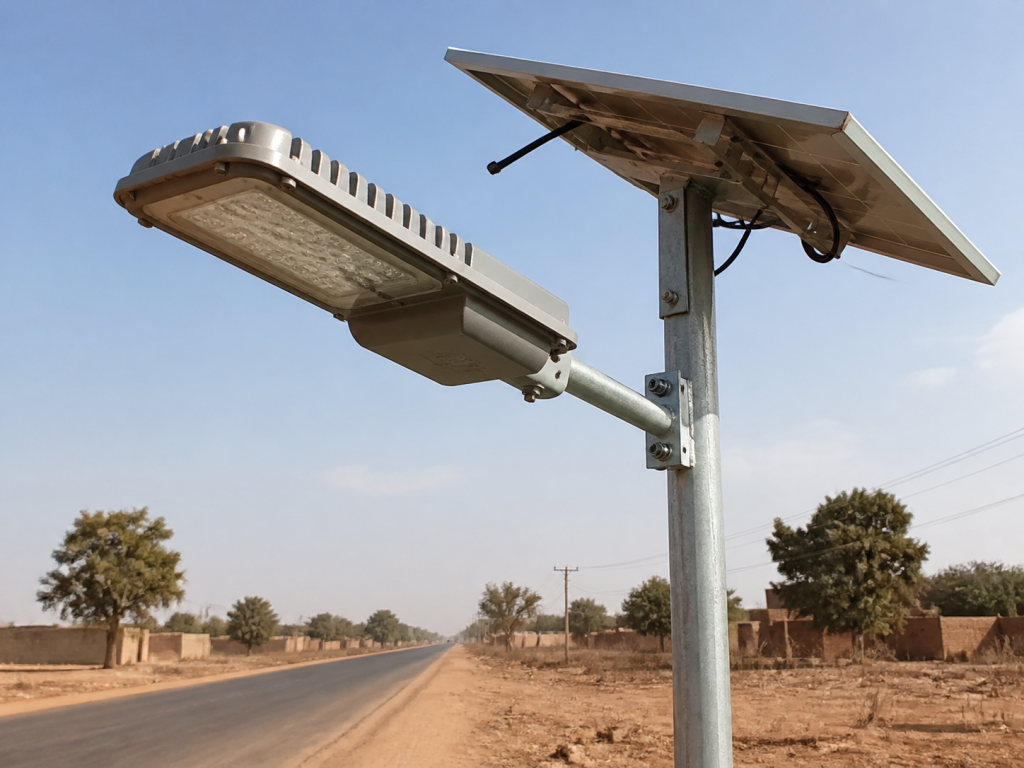
Close-up view of an aluminum solar LED luminaire, solar panel, and galvanized mounting hardware.
5. Use IP and IK Ratings Correctly
IP65 and IP66 are not interchangeable marketing terms.
- IP65: protection against dust and water jets
- IP66: protection against dust and stronger water jets
- IK08: protection against mechanical impact up to the applicable test energy
- IK10: higher impact resistance than IK08
For dusty inland roads, construction zones, and heavy rain areas, IP66 is often a sensible specification. For coastal African locations, IP rating alone is not enough. The buyer should also check:
- Salt-spray resistance
- Powder coating quality
- Stainless-steel fasteners
- Aluminum corrosion treatment
- Drainage design
- Cable gland sealing
- Battery compartment protection
A sealed lamp can still corrode if the coating system and fasteners are poorly selected.
6. Do Not Ignore Surge Protection and Grounding
Thunderstorms and unstable electrical systems can damage LED drivers, controllers, and communication components.
Grid-connected and hybrid solar street lights should normally be reviewed for:
- Surge protection device rating
- Line-to-ground protection
- Line-to-line protection
- Earthing arrangement
- Lightning protection design
- Controller reset behavior
- Replacement availability
For standalone solar lights, the LED system may be isolated from the utility grid, but the pole and electronic components can still be exposed to lightning-induced surges. Grounding, cable routing, and installation quality remain important.
Ask the supplier to state the actual SPD rating in the technical proposal. Avoid accepting only general wording such as “surge protected.”
7. Match Beam Angle to Pole Spacing
Beam angle determines how the light spreads across the road.
- Wide symmetric optics for open areas
- Asymmetric optics for roadways
- Narrow beams for longer pole spacing
- Batwing distributions for more uniform road coverage
A wider beam is not automatically better. If the pole spacing is large, the fixture may need a controlled asymmetric distribution rather than simply higher wattage.
For a typical 6–8 meter road-lighting installation, the design team should review road width, pole setback, pole spacing, mounting-arm length, tilt angle, beam distribution, average and minimum lux, and glare toward homes and drivers.
This is where DIALux or Relux simulation saves time. It allows the project team to adjust the optics before manufacturing.
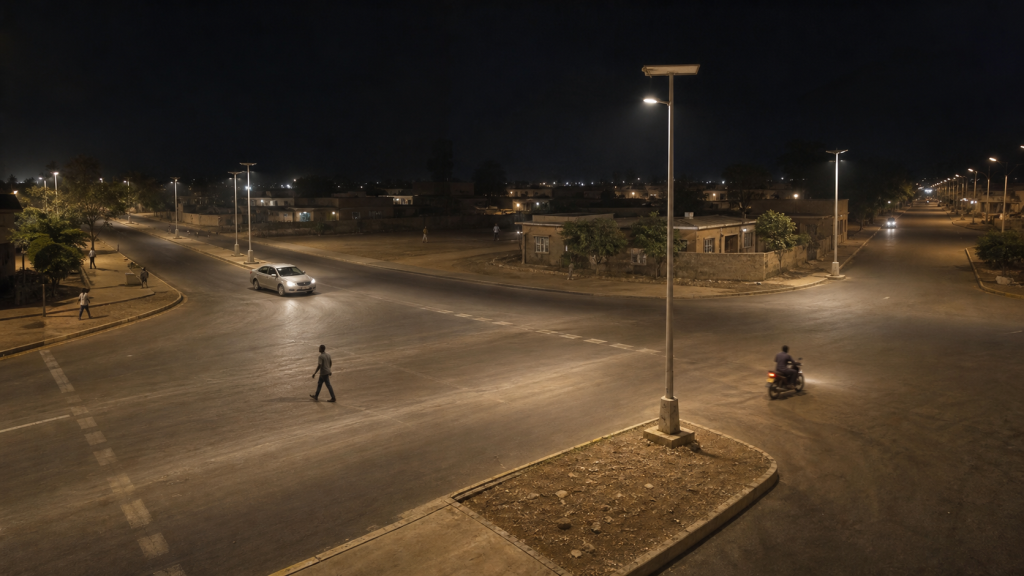
A solar LED lighting layout providing balanced illumination at an African road intersection.
8. Review the Supplier’s Technical and Delivery Capability
A serious B2B supplier should provide more than a product photograph and a price.
Before placing a bulk order, request:
- Product datasheet
- IES or LDT photometric file
- DIALux lighting calculation
- Battery and solar panel calculation
- Installation drawing
- Pole foundation information
- Warranty terms
- Spare-parts list
- Test and certification documents
- Production and delivery schedule
Dawn Lighting’s project portfolio shows support for customized lighting solutions, project design, production, testing, delivery, and installation guidance.
The supplier should also explain how quality is controlled before shipment. For a large African road project, random sampling alone may not be enough. The buyer may need to confirm battery capacity, LED output, waterproofing, controller programming, and mechanical dimensions before container loading.
Frequently Asked Questions
What wattage solar street light is suitable for an 8-meter pole?
There is no universal wattage for an 8-meter pole. A typical project may use approximately 60W–150W, but the correct selection depends on road width, pole spacing, optical distribution, target lux, and dimming schedule. A DIALux simulation should confirm the final configuration.
How many rainy days should a solar street light support?
Three to five rainy days is a common project requirement, but the meaning of “autonomy” must be clearly defined. Confirm whether the system maintains full brightness or uses scheduled dimming during cloudy weather. Battery capacity should be calculated using the worst-month solar data for the installation location.
Is IP65 enough for African outdoor roads?
IP65 may be suitable for some outdoor applications, but IP66 provides a higher level of protection against water jets. In dusty, rainy, or coastal environments, also check corrosion protection, cable sealing, salt-spray testing, and battery enclosure design.
Can a solar street light supplier provide DIALux design?
A project-focused supplier should be able to provide IES/LDT files and a DIALux or Relux layout. The design normally requires the road width, pole height, pole spacing, mounting arrangement, location, operating hours, and required lux level.
Request a Project-Specific Solar Street Light Proposal
Choosing a solar street light supplier should begin with the lighting calculation, battery profile, climate conditions, and maintenance plan.
Send Dawn Lighting your road layout, pole spacing, mounting height, project location, required operating hours, and rainy-day autonomy target through the official company inquiry page.
Use the official Dawn Lighting Contact page to request a project-specific lighting proposal, DIALux simulation, technical documentation, and B2B quotation.
- 10 Meters Lamp Post
- 10 Meters Pole
- 1000w Led Projector
- 100W LED Tunnel Light
- 12 Meters Lamp Post
- 12 Meters Pole
- 1200w Led Projector
- 15 Light Pole
- 1500w Led Projector
- 150W LED Tunnel Light
- 1800w Led Projector
- 2 In 1 Solar Flood Light
- 200w Led Tunnel Light
- 50w Led Tunnel Light
- 6 Meters Lamp Post
- 6 Meters Pole
- 8 Meters Lamp Post
- 8 Meters Pole
- 800w Led Projector
- 80w Led Tunnel Light
- Colourful Decorative Light
- Conical post
- Courtyard Lamp
- courtyard light
- courtyard lighting fixture
- Decorative Landscape Light
- Decorative road Light
- Flood Light For Courtyard
- Flood Light for Garden
- Flood Light For Outdoor
- Foot Led High Bay Lights
- high bay led lights 100w
- industrial lampshade
- industrial LED shed lights
- industrial magnifying glass with light
- Integrated Solar Flood Light
- led courtyard lamp
- led courtyard light
- led high bay light 100w
- LED Projector For Stadium
- Led UFO High Bay 150W 5000k
- Lighting Plants Mining Price
- Maintenance Free LED Street Light
- Pic Controlling Tunnel Light
- PLC controlling tunnel light
- Post Top Garden Light
- RGB Landscape Light
- Rgbw Decorative Light
- Smart Tunnel Light
- solar courtyard lamp
- solar courtyard light
- Solar LED Road Light
- Solar Street Light For 10 Meter Pole
- Solar Street Light For 12 Meter Pole
- Solar Street Light For 6 Meter Pole
- Solar Street Light For 8 Meter Pole
- Split Type Solar Flood Light
- Sporting Projector
- Stadium Led Projector
- Street Lighting Post
