
 Request A Quote

Types of Solar light in street
 FACEBOOK
 TWITTER
 LINKEDIN
The solar street lights are changing the manner in which cities, highways and rural areas are illuminating their open spaces. Since the need to find a sustainable and more cost-efficient light source is on the increase across the globe, the use of solar-powered models has become the choice of governments, contractors, and businesses.
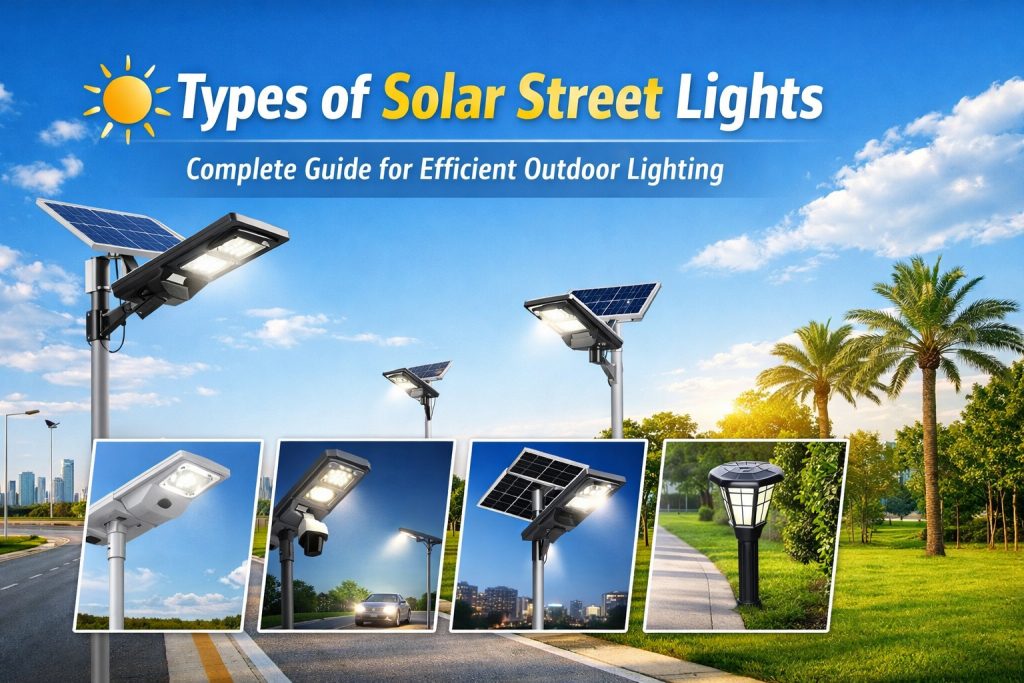
In this guide, we discuss the various categories of the solar street lights, their features, uses, and the way to select the right system to use in a project.
What Are Solar Street Lights?
Solar street lights are outdoor lighting systems that use the solar energy. They employ photovoltaic panels to transform sunlight into electricity which is stored in batteries where it is utilized to power up LEDs during night.
In the solar street lights, unlike the conventional light systems, the lighting system is not dependent on the electrical system and this lowers the costs of energy and environmental effects. Such systems are very common in the urban streets, highways, parks, and in remote areas.
Key Solar Street Lighting.
- All in One Street Lights Solar.
All-in-one solar (alternatively, integrated solar) street lights integrate all the constituent parts into a single compact unit; that is, a solar panel, a battery, LED light, and a controller.
Key Features:
- No wiring or difficult installation.
- Compact and modern design
- Inbuilt motion sensors to conserve energy consumption.
- Low maintenance
These lights can be erected within a few minutes and are suitable to be used in urban streets, pathways and households.
Best Applications:
- Residential streets
- Parks and pathways
- School campuses
- Parking lots
- Two in One (Semi-Integrated) Solar Street Lights.
All-in-two solar street lights have a detachable solar panel, whereas other parts are inbuilt.
Key Features:
- Large solar panels to increase efficiency.
- Longer lighting duration
- Adjustable angles of installation.
This design enhances performance which is particularly better in places where sunlight is minimal or where the energy requirements are high.
Best Applications:
- Highways
- Main roads
- Commercial areas
- Industrial zones
- Solar Street Lights and Camera.
These hi-tech solar street lights have inbuilt CCTV cameras to monitor and offer security.
Key Features:
- Video surveillance using WiFi or 4G.
- Motion detection and alerts
- Night vision capability
- Mobile or PC remote access.
They are particularly handy in remote or high risk localities where security is of paramount concern.
Best Applications:
- Parking lots
- Construction sites
- Remote infrastructure
- Smart city projects
- Hybrid Solar Street Lights
Solar Street lights use hybrids that combine the power of the sun with that of the grid to be able to stay lit continuously.
Key Features:
- Automatic solar and grid power.
- Good performance in the rainy season that is long lasting.
- Full night lighting.
This category is best suited in the areas that have irregular sun rays or essential infrastructure requirements.
Best Applications:
- Industrial zones
- Airports
- High-traffic roads
- Regions having a high frequency of cloudy weather.
- Solar Area Lights
The lights on solar areas are made to shine over spacious spaces with a broad beam.
Key Features:
- Broad distribution of lights (up to 120 degrees)
- Large coverage with high wattage.
- Efficient LED lens design
These lamps are ideal in a large open space where they need a lot of uniform lighting.
Best Applications:
- Parking lots
- Playgrounds
- Plazas
- Warehouses
- Garden Lights and Solar Pathway.
These are lower power small-sized solar lights which are employed in decorative lighting and practical lighting.
Key Features:
- Lower installation height
- Soft illumination
- Energy-efficient operation
They promote security and beauty in the residential and landscape setting.
Best Applications:
- Gardens
- Walkways
- Parks
- Residential communities
Major Elements of Solar Street Lights.
The knowledge of the components assists you in selecting the appropriate type:
- Solar Panel
Monocrystalline panels are high efficiency panels that transform sunlight into electricity.
- LED Light Source
LEDs are bright and consume little energy with long life spans (up to 50,000 hours).
- Battery (LiFePO4)
New lithium batteries have long lives and high capacity of energy storage.
- Controller (MPPT)
The controller maximizes energy transformation and charging performance and enhances the overall performance.
- Motion Sensor
Brightness control automatically adjusts according to movement saving power.
These are the benefits of Solar Street Lights.
- Energy Savings
By exploiting solar power, solar street lights do away with electricity bills.
- Easy Installation
No trenching or wiring is needed, which saves on cost and time of installation.
- Low Maintenance
Maintenance is less with long battery life and durable parts.
- Eco-Friendly
They minimize carbon emissions and favor sustainable development objectives.
- Independent Operation
The best in remote locations where power grid is unavailable.
How to Select the Appropriate Solar Street Light.
The following factors could be used when choosing a solar street lighting system:
- Location and Availability of the Sunlight.
Areas that have low sun exposure might need more size of panels or hybrid systems.
- Lighting Requirements
The wattages and heights of poles needed on various roads vary:
- Residential streets: 40–60W
- Main roads: 80–120W
- Large areas: 120–200W
- Installation Environment
Keep in mind weather factors, e.g., rain, wind, humidity.
- Smart Features
Advanced systems can contain IoT control, motion sensors and remote monitoring.
Future Projections of the Solar Street Lighting.
Innovations in solar lighting industry are still going on and include:
- Smart IoT-based lighting systems.
- AI-based energy management
- In-built surveillance solutions.
- More efficient solar panels and batteries.
All these developments are making solar street lights smarter, efficient and reliable than ever.
Conclusion
Solar street lights are a viable, economical, and dependable idea towards contemporary outdoor lighting. All-in-one integrated systems, hybrid and smart lighting solutions are all types of lighting which are intended to satisfy various needs.
You are going to have a municipal project, upgrading of infrastructure, or you want to light a remote area, but you will see that the right kind of solar street light could save you a lot of money and time and make it much safer.
Learning about the various types and their uses, you will be able to make better choices and take full advantage of the solar lighting technology.

- 10 Meters Lamp Post
- 10 Meters Pole
- 1000w Led Projector
- 100W LED Tunnel Light
- 12 Meters Lamp Post
- 12 Meters Pole
- 1200w Led Projector
- 15 Light Pole
- 1500w Led Projector
- 150W LED Tunnel Light
- 1800w Led Projector
- 2 In 1 Solar Flood Light
- 200w Led Tunnel Light
- 50w Led Tunnel Light
- 6 Meters Lamp Post
- 6 Meters Pole
- 8 Meters Lamp Post
- 8 Meters Pole
- 800w Led Projector
- 80w Led Tunnel Light
- Colourful Decorative Light
- Conical post
- Courtyard Lamp
- courtyard light
- courtyard lighting fixture
- Decorative Landscape Light
- Decorative road Light
- Flood Light For Courtyard
- Flood Light for Garden
- Flood Light For Outdoor
- Foot Led High Bay Lights
- high bay led lights 100w
- industrial lampshade
- industrial LED shed lights
- industrial magnifying glass with light
- Integrated Solar Flood Light
- led courtyard lamp
- led courtyard light
- led high bay light 100w
- LED Projector For Stadium
- Led UFO High Bay 150W 5000k
- Lighting Plants Mining Price
- Maintenance Free LED Street Light
- Pic Controlling Tunnel Light
- PLC controlling tunnel light
- Post Top Garden Light
- RGB Landscape Light
- Rgbw Decorative Light
- Smart Tunnel Light
- solar courtyard lamp
- solar courtyard light
- Solar LED Road Light
- Solar Street Light For 10 Meter Pole
- Solar Street Light For 12 Meter Pole
- Solar Street Light For 6 Meter Pole
- Solar Street Light For 8 Meter Pole
- Split Type Solar Flood Light
- Sporting Projector
- Stadium Led Projector
- Street Lighting Post
