
 Request A Quote

LED Part-Night Street Lighting: Balancing Energy Efficiency and Safety
 FACEBOOK
 TWITTER
 LINKEDIN
Street lighting is one of the primary innovation zones as urban areas and cities around the globe adopt the approach of ensuring safety, sustainability, and cost-efficiency. Another solution that has become extremely popular is LED part-night street lighting- a technology that aims at limiting the amount of electricity used and the amount of pollution on the environment and still ensuring that there is adequate night time visibility. It is not only a pragmatic approach but also complies with the larger objectives concerning smart cities, carbon mitigation, and sensible infrastructure management.
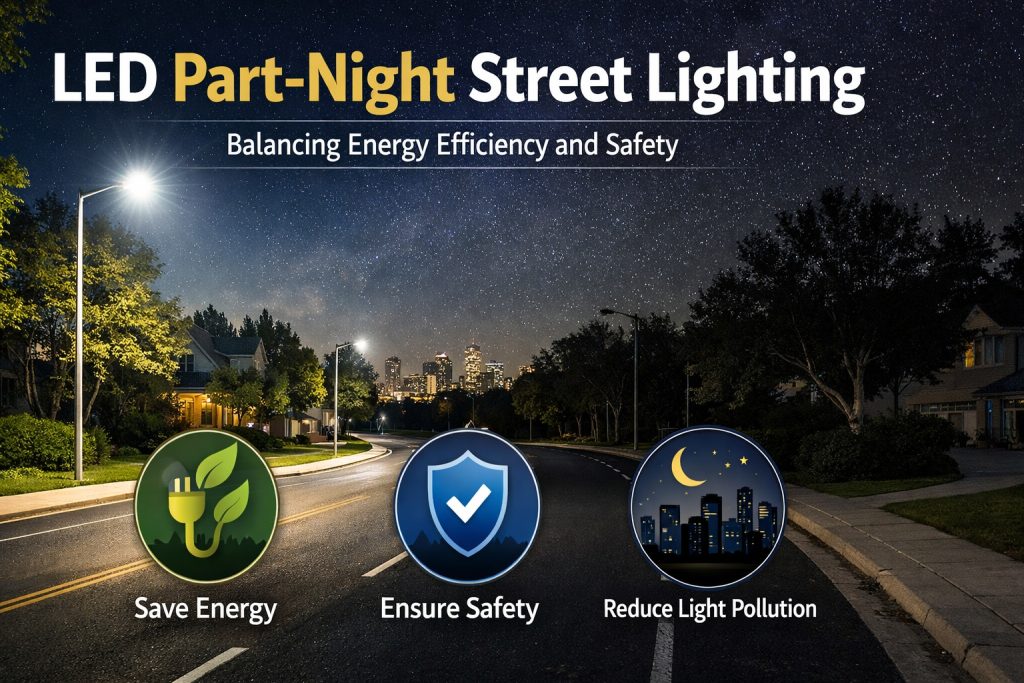
What Is LED part-Night Street Lighting?
LED part-night street lighting is one in which the streetlights are lit with lights using a low energy consuming LED technology, but which are automatically dimmed down or turned off at specific times of the night, such as when pedestrian and vehicle traffic are minimal. Part-night lighting is contrary to the conventional lighting systems, which are fully lit during dusk to dawn where smart lighting which is turned on only when its services are in demand.
The system commonly operates using one of the following: a timer system, sensors or using a centralized smart control system, which will enable local authorities to tailor the lighting schedule to the traffic patterns, seasonal changes and requirements of the community.
Why LED Technology Matters
The use of LED (Light Emitting Diode) lights has transformed the lighting systems of the masses. The LEDs have a number of benefits over older technologies, like the sodium or halogen lamps:
- Energy Saving: LEDs use enormous amounts of less electricity, which has decreased the cost of operation.
- Extended life: LED lights have a long life and hence there is reduced maintenance and replacement requirements.
- Better Light Quality: They have better visibility and light is more white which increases visibility and safety.
- Environmental Benefits: A decrease in energy consumption will translate to a decrease in carbon-emission.
These advantages are enhanced when used together with part-night operation and therefore LED lighting is a foundation of high-tech city planning.
Important Advantages of Part-Night Lighting.
- Reduced Energy Consumption
Among the strongest arguments in favor of the use of part-night lighting is the energy consumption. Municipalities can also reduce the consumption of electricity tremendously by switching off or lowering the intensity of lights when there are few people to serve. This reduces the cost besides promoting the sustainability of the environment.
- Lower Carbon Emissions
As the world struggles to fight the challenge of global warming, there is a priority to reduce carbon footprints. Part-night lighting which is directly backed by LED can help achieve this intention by minimizing the quantity of energy needed to illuminate streets to reduce greenhouse gases.
- Local Government Savings on Costs.
The cost of operation and maintenance of the street lighting systems is expensive. Part-night lighting consumes less energy, provides lower maintenance cost and this amount of money is used by the government to service other important areas like healthcare, education and transport.
- Reduced Light Pollution
Uncontrolled artificial lighting interferes with the natural ecosystem and influences human health. Part-night lighting can be used to recover darker skies, which is beneficial to wildlife and allows astronomy and sleep quality.
- Maintained Public Safety
One of the issues that come up is whether the decrease in lighting has an impact on safety. But research and practical tests have demonstrated that well considered part-night lighting does not lead to high crime or accidents. It is also through strategic positioning and timing of the areas that are important to keep lit up during the necessary time.
The mechanism of Part-Night Lighting.
The latest LED street lights systems tend to incorporate smart technologies that allow them to be controlled in an accurate manner. These may include:
- Timers: Prequalified schedules that switch lights off or dim down during specific times of the day.
- Motion Sensors: The lighting turns bright when someone moves about and this keeps the place safe and also uses less energy.
- Remote Management Systems: Centralized control systems enable the authorities to control and adjust lighting remotely.
This is flexible to allow the levels of lighting to be adjusted to the varying settings, i.e. residential streets, main roads or pedestrian areas.
Community Considerations
Part-night lighting is a process that should be well planned and involves the community. The consultation to the population is probably a valuable measure, and residents might communicate their preferences and concerns. Elements that are normally taken into consideration are:
- Local traffic patterns
- Crime statistics
- Closeness to schools, hospitals, and other social amenities.
- Resident and business feedback.
The community engagement will enable the local authorities to guarantee the system has achieved the safety and sustainability objectives.
Environmental Impact
The effect of lighting reduction of unwarranted lights on the environment is very important. Animals, especially night creatures, are dependent on dark nature of the earth. The use of artificial lights may interfere with feeding, mating and migration. Part-night lighting is a way of preserving biodiversity as it reduces the amount of light when nobody is around.
Also, the use of less energy will decrease the use of fossil fuels, which will mean cleaner air and a more healthy ecosystem.
Difficulties and Misperceptions.
Night lighting is not always received warmly even though it has some advantages. Common concerns include:
- Safety Risks: There are concerns about the possibility of getting more crime based on increased accidents but as a rule this is not true because of the way systems are planned.
- Visibility Problems: There are residents who do not like lighting that is low and in low activity sections.
- Technological Reliability: There may be concerns of the system failure, or lack of consistent performance.
The solutions of these issues include open dialogue, sound system design, and constant monitoring to make them work.
What the Future of Street Lighting holds.
LED part-night lighting is only one way of moving towards smarter urban infrastructure. With the new technology, we are likely to see new and even more advanced solutions, including:
- Real time responsive adaptive lighting.
- Smart city network integration.
- Streetlights that run on renewable energy.
- Light schedules optimization based on data.
The innovations will also promote efficiency, sustainability, and user experience.
Conclusion
The LED part-night street lighting is a proactive alternative which is a balance between safety, cost and environmental accountability. With the help of energy-saving LED technology, smart control systems and mechanisms, the communities will be able to use less energy, emit less, and produce less light pollution- and they will retain adequate visibility at night.
With urbanization on an ever-growing trend, the implementation of sustainable infrastructure development measures such as part-night lighting will be of paramount importance in establishing more environmentally-friendly, intelligent and habitable living conditions. This strategy is a viable way to a more sustainable future whether in a city or a rural area.
- 10 Meters Lamp Post
- 10 Meters Pole
- 1000w Led Projector
- 100W LED Tunnel Light
- 12 Meters Lamp Post
- 12 Meters Pole
- 1200w Led Projector
- 15 Light Pole
- 1500w Led Projector
- 150W LED Tunnel Light
- 1800w Led Projector
- 2 In 1 Solar Flood Light
- 200w Led Tunnel Light
- 50w Led Tunnel Light
- 6 Meters Lamp Post
- 6 Meters Pole
- 8 Meters Lamp Post
- 8 Meters Pole
- 800w Led Projector
- 80w Led Tunnel Light
- Colourful Decorative Light
- Conical post
- Courtyard Lamp
- courtyard light
- courtyard lighting fixture
- Decorative Landscape Light
- Decorative road Light
- Flood Light For Courtyard
- Flood Light for Garden
- Flood Light For Outdoor
- Foot Led High Bay Lights
- high bay led lights 100w
- industrial lampshade
- industrial LED shed lights
- industrial magnifying glass with light
- Integrated Solar Flood Light
- led courtyard lamp
- led courtyard light
- led high bay light 100w
- LED Projector For Stadium
- Led UFO High Bay 150W 5000k
- Lighting Plants Mining Price
- Maintenance Free LED Street Light
- Pic Controlling Tunnel Light
- PLC controlling tunnel light
- Post Top Garden Light
- RGB Landscape Light
- Rgbw Decorative Light
- Smart Tunnel Light
- solar courtyard lamp
- solar courtyard light
- Solar LED Road Light
- Solar Street Light For 10 Meter Pole
- Solar Street Light For 12 Meter Pole
- Solar Street Light For 6 Meter Pole
- Solar Street Light For 8 Meter Pole
- Split Type Solar Flood Light
- Sporting Projector
- Stadium Led Projector
- Street Lighting Post
