
 Request A Quote

Solar Street Light Basics: Components, Working Principle & Benefits
 FACEBOOK
 TWITTER
 LINKEDIN
With the current pace of urbanization of most cities across the globe moving towards renewable energy and smart cities, the use of solar street lights is rapidly replacing the traditional grid-based lighting systems. Since the days of city highways and residential streets, the solar-powered street lighting became a cost-efficient, sustainable and scalable solution to outdoor lighting.
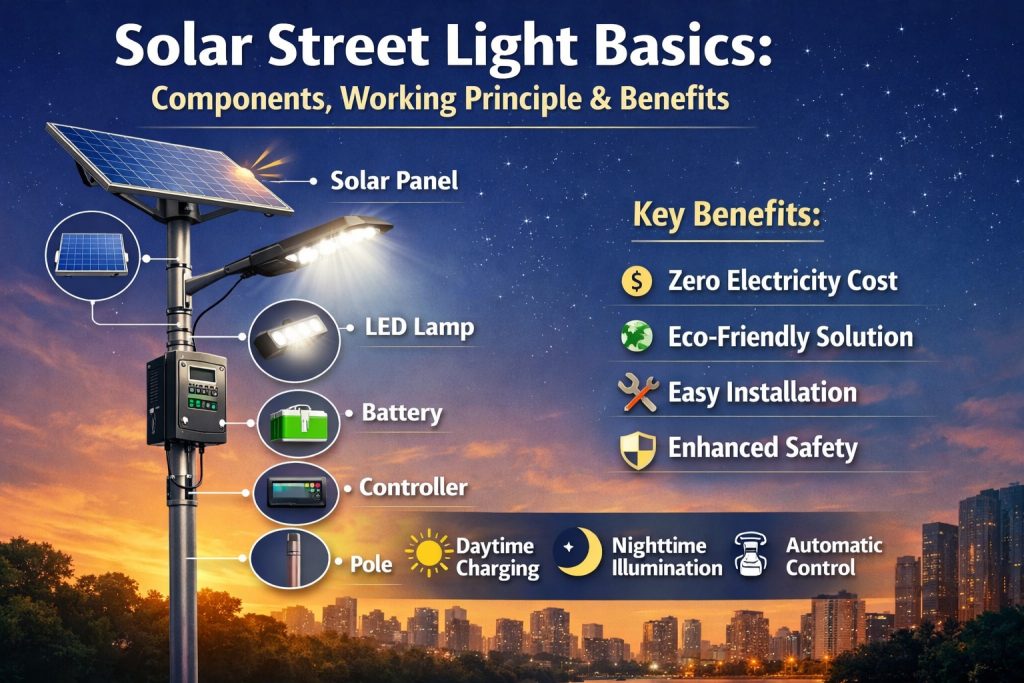
This tutorial generalizes all the essentials of solar street lights such as their functionality, main components, benefits, and uses.
What Is a Solar Street Light?
A solar street light is an independent outdoor lighting system that produces electricity by using solar energy. Solar powered street lights are independent as opposed to traditional ones which are connected to the electricity grid.
Photovoltaic (PV) panels are used to convert sunlight into electricity during the day and stored in rechargeable batteries. The system automatically switches on high-efficiency LED fixtures when it is dark enough at night and uses the stored energy.
Solar street lighting systems are good in places that have limited infrastructure or high electricity expenses because they do not need to be connected to the power grid.
Key Elements of a solar street lighting system.
The explanation of the main elements aids in defining why solar street lights are a reliable source of performance.
- Photovoltaic Module (Solar Panel).
The most important component is the solar panel. It attracts the sunlight and transforms the sunlight into the direct current (DC) electricity.
There are two common types:
- Monocrystalline solar panels -More efficient and can optimally perform in low-light environments.
- Poly crystalline solar panels-Less expensive and a little bit less efficient.
The quality of solar panels has a direct influence on the performance of the system, the speed of charging and the overall life expectancy.
Keywords: solar photovoltaic panel, PV module efficiency, monocrystalline solar panel.
- LED Lighting Fixture
Recent solar street lights incorporate the LED (Light Emitting Diode) technology because it is more efficient and durable.
LED lights have:
- Lower energy consumption
- Greater operational life (50,000+ hours).
- Instant illumination
- Better light uniformity
The LED technology contributes greatly to saving of energy and minimizing maintenance expenses.
Keywords: LED street light, energy efficient lighting, outdoor LED lighting.
- Rechargeable Battery
The battery is a storage of the electricity generated during the daytime and power is provided at night.
Types of common battery are:
- Lithium-ion batteries (Li-ion)
- Lithium iron phosphate (LiFePO4) batteries.
- Sealed lead-acid batteries
The reason why Lithium batteries are increasingly preferred is because of:
- Higher energy density
- Longer cycle life
- Improved temperature regulation.
- Reduced maintenance
The battery capacity defines the time taken by the light to work on cloudy or rainy days.
Keywords: solar battery storage, lithium battery to solar lighting, energy storage system.
- Solar Charge Controller
The brain of the system is the controller. It controls the flow of energy between the solar panel, battery and the LED fixture.
Advanced controllers can have:
- The MPPT (Maximum Power Point Tracking) technology.
- Dusk to dawn automatic mode.
- Smart dimming capabilities.
- Motion sensor integration
- Remote monitoring functions.
The high-quality controller will not allow the battery to overcharge or deep discharge which will enhance efficiency.
Keywords used: MPPT controller, smart solar lighting system, automatic light control.
- Light Pole and Mounting Structure.
The lighting and solar panel are mounted on the pole. It should be able to bear the wind, extreme weather, and environmental pressure.
Common materials include:
- Hot-dip galvanized steel
- Aluminum alloy
- Coated steel that is resistant to corrosion.
Designing of proper poles is a guarantee of structural stability and long-term durability.
The keywords that are related are: solar street light pole, outdoor lighting structure, galvanized steel pole.
The way Solar Street Lights work?
The principle of the operation of a solar street light is simple and very efficient:
1.Daytime Charging
The solar panel receives the sun and transforms the energy into a power. This electricity is sent through the controller to the battery.
2.Automatic Turning off at Night.
A light sensor will make the system switch on when the ambient light levels are lower.
3.Nighttime Illumination
During the night, the battery provides the power to the LED fixing. The advanced system can be used to turn-down during the low traffic periods and turned-up when movement is sensed to save on energy.
This is an entirely automated process that goes through day in day out.
Similar keywords: working principle of solar street lights, dusk to dawn solar lights, motion sensor solar lights.
The main Benefits to Solar Street Lights.
- Zero Electricity Cost
Solar street lights have been able to do away with monthly payments to the electricity grid since they do not require connection to the grid. This renders them particularly useful to municipalities and commercial property owners who require long term savings.
- Eco-friendly and sustainable.
Renewable solar energy is used to run solar lighting systems and they do not emit carbon as they are used. They minimize the use of fossil fuel and are involved in mitigation of climatic change objectives.
The associated words will be green lighting solution, renewable energy lighting, carbon-free street lighting.
- Easy Installation
This removes the need to trench or wire underground cabling thus, installation is quicker and less inconclusive as street lights. This saves the cost of labor and infrastructure.
- Low Maintenance
LED lamps and lithium batteries last a long time, which reduces the number of maintenance cycles. Most systems come with a 510-year life cycle with specific minimal maintenance.
- Improved Public Safety
Outdoor lighting which is reliable increases visibility, lowers the risk of crime and also increases the safety of pedestrians and traffic. The solar streetlights are usually set in parks, campuses, residential areas and industrial areas.
Applications of Solar Street Lighting.
Solar street lights can be applied in a variety of applications which include:
- Urban roads and highways
- Residential neighborhoods
- Parking areas and shopping malls.
- Parks and public spaces
- Rural and remote villages
- Construction sites
- Lighting on security perimeter.
This is because of their flexibility and the lack of grid infrastructure, which makes them especially useful in developing countries and off-grid locations all over the world.
Conclusion
Conclusion
Solar street lights are an intelligent sustainable infrastructure. With solar photovoltaic technology, highly developed battery storage and energy saving lighting, they can offer usable, green illumination to a variety of applications.
Solar-powered street lighting will be a major trend in defining smart cities and sustainable communities as more people across the world increasingly request renewable energy solutions.
Solar street lights may provide you with cost saving long term, environmental and increased safety as they are an integrated lighting system which would replace your outdoor lighting system.


- 10 Meters Lamp Post
- 10 Meters Pole
- 1000w Led Projector
- 100W LED Tunnel Light
- 12 Meters Lamp Post
- 12 Meters Pole
- 1200w Led Projector
- 15 Light Pole
- 1500w Led Projector
- 150W LED Tunnel Light
- 1800w Led Projector
- 2 In 1 Solar Flood Light
- 200w Led Tunnel Light
- 50w Led Tunnel Light
- 6 Meters Lamp Post
- 6 Meters Pole
- 8 Meters Lamp Post
- 8 Meters Pole
- 800w Led Projector
- 80w Led Tunnel Light
- Colourful Decorative Light
- Conical post
- Courtyard Lamp
- courtyard light
- courtyard lighting fixture
- Decorative Landscape Light
- Decorative road Light
- Flood Light For Courtyard
- Flood Light for Garden
- Flood Light For Outdoor
- Foot Led High Bay Lights
- high bay led lights 100w
- industrial lampshade
- industrial LED shed lights
- industrial magnifying glass with light
- Integrated Solar Flood Light
- led courtyard lamp
- led courtyard light
- led high bay light 100w
- LED Projector For Stadium
- Led UFO High Bay 150W 5000k
- Lighting Plants Mining Price
- Maintenance Free LED Street Light
- Pic Controlling Tunnel Light
- PLC controlling tunnel light
- Post Top Garden Light
- RGB Landscape Light
- Rgbw Decorative Light
- Smart Tunnel Light
- solar courtyard lamp
- solar courtyard light
- Solar LED Road Light
- Solar Street Light For 10 Meter Pole
- Solar Street Light For 12 Meter Pole
- Solar Street Light For 6 Meter Pole
- Solar Street Light For 8 Meter Pole
- Split Type Solar Flood Light
- Sporting Projector
- Stadium Led Projector
- Street Lighting Post
