
 Request A Quote

LED Street Lights Guide: Energy Efficient Outdoor Lighting Solutions
 FACEBOOK
 TWITTER
 LINKEDIN
With the modernisation of cities and their lighting systems, LED street lights are fast replacing the old high-pressure sodium (HPS) and the metal halide lighting systems. The reason behind the switch is that LED technology has been providing better energy efficiency, longevity, reduction in the cost of maintenance, and intelligent lighting features to municipalities, contractors, as well as commercial property owners.
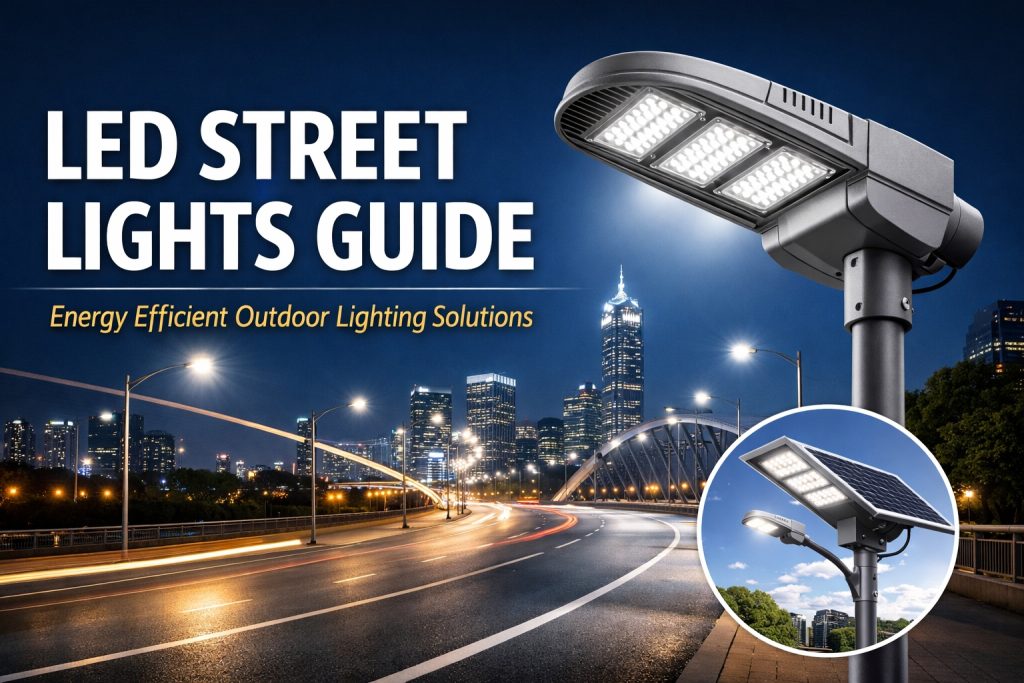
This is the ultimate guide to led street lights: we are going to discuss what they are, their main advantages, the types, installation, considerations, purchase tips, and future trends of them, and hopefully you will make a correct selection in the next lighting project you need.
What Are LED Street Lights?
LED street lights are external light lamps that utilize the Light Emitting Diode (LED) technology to light up roads and highways, parking lots, industrial sites, as well as, people open areas. Compared to the conventional bulbs, the LEDs consume much less energy since they can transform electricity into light, which is much brighter.
Due to their performance and durability, the LED street lighting systems have become the world standard when it comes to municipal and commercial outdoor lighting projects.
The major advantages of LED Street Lighting.
- Unparalleled Energy-Saving.
Energy saving is also one of the greatest benefits of LED street lights. The LED systems can save 50-80 percent of energy compared to conventional HPS or metal halide systems. This translates to paying less money in terms of electricity and creating lesser pressure on the power grids of the municipalities.
In the case of cities with thousands of fixtures, long-run cost savings are high.
- Long Lifespan
The LED street lights have a usual life of 50,000 hours or more which is way beyond the traditional lighting systems. This long life time will decrease the number of replacements, thus decreasing maintenance labor and down time of equipment.
Reduced replacements also imply reduced disturbances in the traffic and public areas.
- Improved Lighting Quality
LED fixtures provide:
- Uniform light distribution
- Reduced glare
- Instant-on functionality
- Better color visibility
Increased color rendering index (CRI) scores increase the night visibility of the drivers and pedestrians and thus the road safety.
- Environmentally Friendly
LED lighting has no toxic substances such as mercury. Also, less energy will be used which means less carbon; this will help to achieve sustainability targets and green city developments.
Government-driven and instigated LED upgrades are now promoted in many governments as environmental compliance programs.
Types of LED Street Lights
Applications have varied requirements in terms of the type of fixtures. Getting to know what you need in your project is the best way to perform.
Standard Roadway LED Lights
The most popular fixtures used to light:
- City streets
- Residential neighborhoods
- Secondary roads
- Commercial districts
They come in different wattages with regard to the pole heights and width of the road.
High Mast LED Lighting
Designed in the large scale areas like:
- Highways
- Airports
- Seaports
- Stadiums
- Industrial facilities
Taller poles under high mast systems cast a wide area of illumination.
LED Flood Lights
Flood-type LED fixtures can be utilized in:
- Parking lots
- Warehouses
- Building exteriors
- Public plazas
They offer wide beam angles and high lumen to cover wide areas.
The selection of the appropriate LED Street Light.
Choosing the right LED street light goes beyond the choice of the wattage. The most significant ones are the following ones:
- Wattage and Lumen Output
Energy consumption is defined by the wattage and brightness is defined by lumens. The recent LED lamps have a higher lumens per watt, so a low-wattage lamp could be used to create bright lighting.
Typical recommendations:
- 30W–80W: Residential streets
- 80W–150W: Main roads
- 150W+: Highways and big business districts.
The pole spacing and the height of mounting should be calculated always before settling on a wattage.
- Color Temperature (CCT)
Temperatures in colors influence the visibility and atmosphere:
- 3000 k: warm white (residential areas)
- 4000K: urban white (streets)
- 5000K: White cool (highways and business areas)
The majority of municipalities are inclined to using 4000K or 5000K to increase visibility.
- IP Rating and Durability
The outdoor lighting should be resistant to rain, dust, heat, and wind. Look for:
- IP65 or higher rating
- Corrosion-resistant housing
- Good-quality heat cooling systems.
Efficient thermal management increases the life of LED.
- LED Driver and Chip Quality
The LED driver balances the amount of power used and performs at a constant level. High-quality LED chip and premium drivers are important in enhancing reliability and efficiency.
Low quality parts can cause juttering, heating, or early breakdowns.
Overview of the Process of Installation.
The installation is performed by professionals which makes it the safest and the most efficient. An average LED street lighting system consists of:
1.Checking of the mounting hardware and the fixture.
2.Finding the mounting arm or bracket.
3.Installation of wiring based on electrical codes.
4.Focusing the light by changing the angle of the fixtures.
5.Checking the light and performance of systems.
In large town-scale projects, then always adhere to local electrical standards and safety regulations.
The Trends of Smart LED Street Lighting.
The current LED street lighting is developing beyond mere lighting. Intelligent technology is changing street lights.
The Adaptive Dimming and Motion Sensors.
The smart systems can change brightness depending on:
- Traffic volume
- Pedestrian movement
- Ambient light levels
This also minimizes the consumption of energy when there is a low traffic.
IoT integration and Remote monitoring.
Most of the LED street lights are currently being combined with centralized control systems. Benefits include:
- Monitoring of performance in real time.
- Automatic fault detection
- Scheduled dimming programs
- Optimization of energy through data.
Connected lighting networks are becoming more and more popular with smart city projects.
Solar LED Street Lights
Solar-powered LED street lights are photovoltaic-powered lights that can be used in combination with battery storage to provide:
- Off-grid functionality
- Lower infrastructure costs
- Best possible solutions to rural or developing areas.
They come in handy especially in situations where one has a limited access to grid.
Popular LED Street Lights Uses.
Examples of use of LED street light include:
- Municipal roadways
- Highways
- Residential communities
- Commercial parking lots
- Industrial facilities
- Public parks and campuses
Every app needs specifications unique to the optimum efficiency and security.
Frequently Asked Questions
Will street lights made of LEDs be worthwhile?
Yes. Even though the initial expenses might be greater than traditional light sources, power savings and more resourceful upkeep will provide so much longer-term ROI (Return on investment).
What is the duration of the LED street lights?
The quality LED fixtures have a lifetime of 50,000-100,000 hours depending on the application and environment.
Are the LED street lights dimable?
Yes. Most of the current LED systems have dimming options, motion sensors, and remote control systems.
Final Thoughts
The use of LED street lights has become the standard model of outdoor lighting in the whole world because of its efficiency, durability, and smart technology features. Regardless of whether you are modernizing municipal infrastructure, creating a commercial building, or just chalking out a big industrial project, the fact is LED street lighting will save you in the long run and make the streets safer.
As cities keep switching to sustainable and smart infrastructure, the technology of LED will be at the front of the outdoor light innovation.
- 10 Meters Lamp Post
- 10 Meters Pole
- 1000w Led Projector
- 100W LED Tunnel Light
- 12 Meters Lamp Post
- 12 Meters Pole
- 1200w Led Projector
- 15 Light Pole
- 1500w Led Projector
- 150W LED Tunnel Light
- 1800w Led Projector
- 2 In 1 Solar Flood Light
- 200w Led Tunnel Light
- 50w Led Tunnel Light
- 6 Meters Lamp Post
- 6 Meters Pole
- 8 Meters Lamp Post
- 8 Meters Pole
- 800w Led Projector
- 80w Led Tunnel Light
- Colourful Decorative Light
- Conical post
- Courtyard Lamp
- courtyard light
- courtyard lighting fixture
- Decorative Landscape Light
- Decorative road Light
- Flood Light For Courtyard
- Flood Light for Garden
- Flood Light For Outdoor
- Foot Led High Bay Lights
- high bay led lights 100w
- industrial lampshade
- industrial LED shed lights
- industrial magnifying glass with light
- Integrated Solar Flood Light
- led courtyard lamp
- led courtyard light
- led high bay light 100w
- LED Projector For Stadium
- Led UFO High Bay 150W 5000k
- Lighting Plants Mining Price
- Maintenance Free LED Street Light
- Pic Controlling Tunnel Light
- PLC controlling tunnel light
- Post Top Garden Light
- RGB Landscape Light
- Rgbw Decorative Light
- Smart Tunnel Light
- solar courtyard lamp
- solar courtyard light
- Solar LED Road Light
- Solar Street Light For 10 Meter Pole
- Solar Street Light For 12 Meter Pole
- Solar Street Light For 6 Meter Pole
- Solar Street Light For 8 Meter Pole
- Split Type Solar Flood Light
- Sporting Projector
- Stadium Led Projector
- Street Lighting Post
