
 Request A Quote

what time do street lights come on?
 FACEBOOK
 TWITTER
 LINKEDIN
The importance of street lights to the contemporary urban infrastructure is more than guaranteed, as they provide safety, visibility, and ease of transportation during the dark. But have you ever thought: When do street lights come on? It is not as straightforward as a specific hour. Rather, street lighting systems are dependent on the advanced technology and environmental indications of when to turn on.

We are going to do a guide on when the street lights are on, how they operate and what makes them operate like that, in this guide you will have a better understanding of this life necessity in a city.
What Time Do the Street Lights go On?
The street lights are usually illuminated when it is dusk and not at the set clock time. This implies that they start operating when the natural light intensity falls below a specific threshold and this normally happens at sunset.
Due to the fact that sunset varies with time of the year, the time when street lights are activated is different:
- Summer: Around 8:00 PM – 9:00 PM
- Winter: Around 4:30 PM – 5:30 PM
- Rainy or cloudy days: Earlier than usual
Stated in brief, street lights react to the dark, rather than time.
So How Do Street Lights Knew When to Switch on?
Contemporary street lights have automation, which detects the environmental conditions. The three most prevalent control means are:
- Photocell Sensors (Dusk-to-Dawn Sensors)
The photocell sensor is the most common system, and it is used to determine the ambient light levels.
- Once the light falls to a specific level the light will become ON.
- As the daylight is intensified, it switches off.
A common component in these sensors is a photoresistor which varies electrical resistance depending on the intensity of the light.
Benefits:
- Adapts automatically to weather and seasons.
- Energy-efficient
- Low maintenance
- Astronomical Timers
Certain cities have programmed timers that have been determined using geographic information of the sunrise and sunset time.
- The lights are switched on/off at pre-calculated time.
- Periodically adjusted due to changes in the season.
Benefits:
- Predictable operation
- Immunity to sensor dirt or sensor obstruction.
Limitations:
- Fails to adjust to change in weather.
- IoT-Based Smart Lighting Systems.
There is a growing trend of centralized systems of street lights that are managed through remote control in smart cities.
- Combine sensors + schedules
- Permission of dimming and remote monitoring.
- Identify errors automatically.
Benefits:
- Maximum energy savings
- Real-time control
- Better efficiency in maintenance.
Why Do not street lights at the same time everywhere turn on?
Two street lights in the same city can be put on a little bit later. This depends on a number of factors:
- Season and Latitude
The length of the daylight on the earth depends on its tilt:
- The summer days are longer, thus, the later the activation.
- The days are shorter in winter, therefore, the activation is earlier.
- Weather Conditions
Light is lost due to clouds, rain, or fog which makes lights to be turned on earlier than normal.
- Local Environment (Shading)
Objects that are close to a sensor can be blocking the light:
- Tall buildings
- Trees
- Bridges or overhangs
This is able to make certain lights on earlier than others around.
- Sensor Condition
Sensors that are dirty or damaged may not be able to read light properly:
- Dust or pollution
- Leaves or debris
- Aging components
This can result in early activation of lights- or even lights left on during the day.
Why Do We Have Street Lights on in the Daytime?
When you see street lights during the day, it is either because they have gone wrong, or it is a temporary situation:
- Blocked or dirty photocell
- Incorrect sensor placement
- Control system problems or wiring problems.
- Maintenance or manual override.
Such cases are normally temporary and are rectified in the process of maintenance.
When Do the Street Lights go off?
The lamps in the street are usually switched off at daylight, when the ambient light surpasses some critical level.
- Photocell systems are automatically switched off.
- Timer systems adhere to sunrise programs.
Similar to the activation, the time varies day in day out as determined by the season and weather.
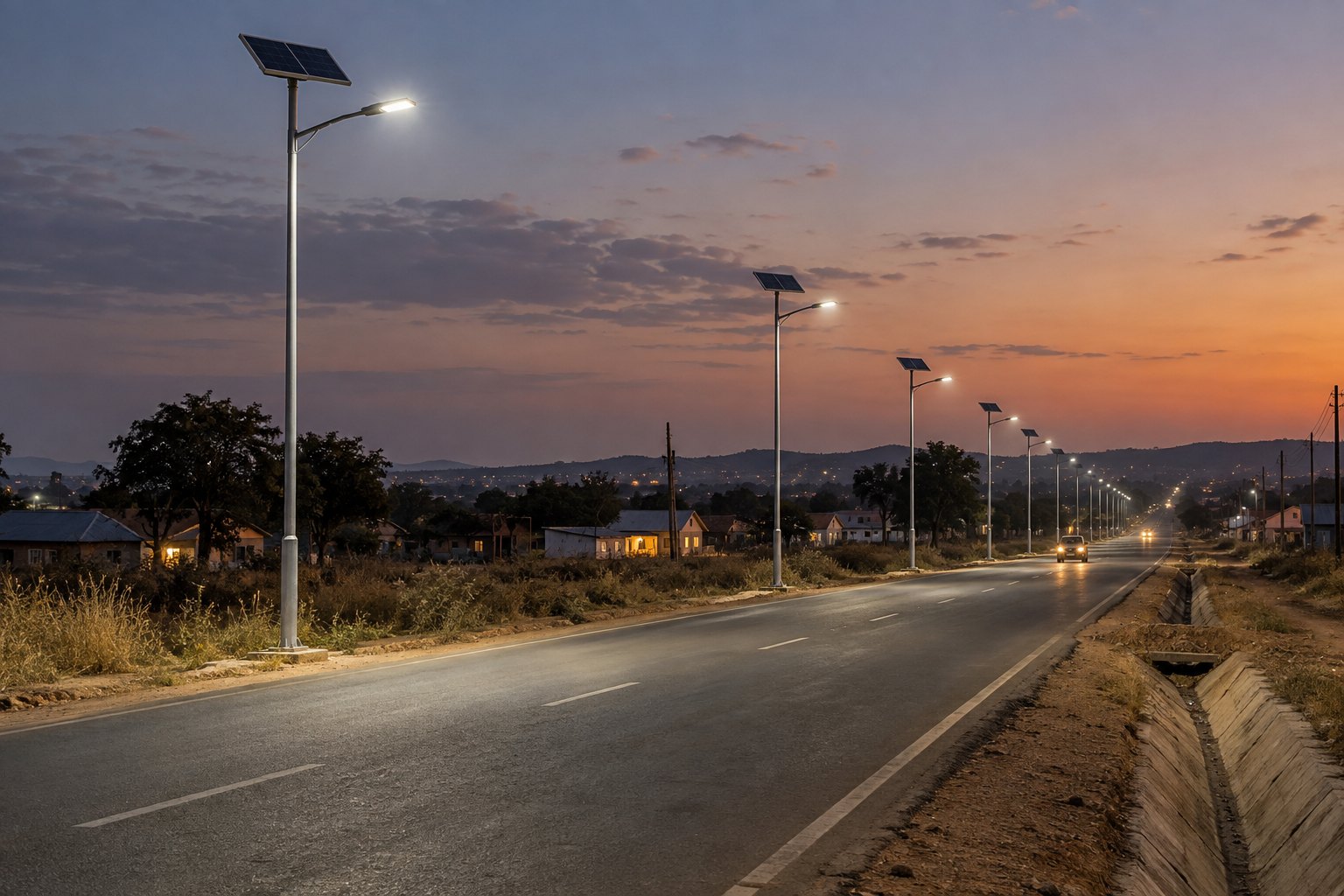
Are Solar Street Lights Turned on In a different manner?
The solar street lights are of the same type but have more intelligent elements.
- Switch on at night with light sensors.
- Store solar energy on a day-to-day basis.
- Frequently have dimming or motion detection features.
Such systems are set to trade-off between brightness and battery life and this makes them the best lighting solutions in the energy saving requirements.
Normal Light Thresholds and Delays.
The lighting systems in streets are made in a way such that they do not flicker or switch without necessity. Most use:
- ON threshold: At the minimum of the light (e.g. twilight)
- Delay Time: 15 to 120 seconds hold time.
- OFF threshold: Above the ON level to ensure that it is not switched about so fast.
This makes the change between day and night lightings to be smooth.
How Urban Cities are maximizing street lighting to save on energy.
Contemporary cities do not simply switch the lights on and off and in fact, streamline them to be more efficient:
- Dimming Strategies
The lights are dimmed during low traffic periods (e.g., midnight to early morning).
- Adaptive Lighting
There are systems that regulate the brightness depending on the movement or the level of traffic.
- Smart Monitoring
The cities make use of real-time data to identify outages and minimize maintenance expenses.
These measures allow a decrease in energy use without sacrificing security.
Key Takeaways
- Street lights are not put on at a specified time, but when it gets dark.
- The majority systems employ photocell sensors or smart controls.
- The time is typically different according to the season, weather, and location.
- The lights are usually switched off at sunrise.
- Solar and smart systems make them efficient and automated.
Conclusion
When do the street lights come on then? The easy response is: when it becomes dark enough.
Hiding behind this mere action is a blend of high technologies, the environmental condition, and intelligent city design. Street lighting is controlled by sensors, timer, or intelligent technology, but in any case, it is intended to offer safe light at the time when it is required.
The knowledge of the operation of the street lights does not only help in quenching curiosity, but also illuminates on the innovation that has been done to our daily infrastructure to ensure our roads are safe and our cities run smoothly.
- 10 Meters Lamp Post
- 10 Meters Pole
- 1000w Led Projector
- 100W LED Tunnel Light
- 12 Meters Lamp Post
- 12 Meters Pole
- 1200w Led Projector
- 15 Light Pole
- 1500w Led Projector
- 150W LED Tunnel Light
- 1800w Led Projector
- 2 In 1 Solar Flood Light
- 200w Led Tunnel Light
- 50w Led Tunnel Light
- 6 Meters Lamp Post
- 6 Meters Pole
- 8 Meters Lamp Post
- 8 Meters Pole
- 800w Led Projector
- 80w Led Tunnel Light
- Colourful Decorative Light
- Conical post
- Courtyard Lamp
- courtyard light
- courtyard lighting fixture
- Decorative Landscape Light
- Decorative road Light
- Flood Light For Courtyard
- Flood Light for Garden
- Flood Light For Outdoor
- Foot Led High Bay Lights
- high bay led lights 100w
- industrial lampshade
- industrial LED shed lights
- industrial magnifying glass with light
- Integrated Solar Flood Light
- led courtyard lamp
- led courtyard light
- led high bay light 100w
- LED Projector For Stadium
- Led UFO High Bay 150W 5000k
- Lighting Plants Mining Price
- Maintenance Free LED Street Light
- Pic Controlling Tunnel Light
- PLC controlling tunnel light
- Post Top Garden Light
- RGB Landscape Light
- Rgbw Decorative Light
- Smart Tunnel Light
- solar courtyard lamp
- solar courtyard light
- Solar LED Road Light
- Solar Street Light For 10 Meter Pole
- Solar Street Light For 12 Meter Pole
- Solar Street Light For 6 Meter Pole
- Solar Street Light For 8 Meter Pole
- Split Type Solar Flood Light
- Sporting Projector
- Stadium Led Projector
- Street Lighting Post
