
 Request A Quote

How to Size a Solar Street Light Battery and Panel for 3-5 Rainy Days
 FACEBOOK
 TWITTER
 LINKEDIN
If a solar street light works well on paper but fails after two cloudy nights, the problem is usually not the LED fixture. It is the sizing.
In real projects, you cannot size the battery and solar panel based on a sunny day only. You have to think about cloudy weather, longer nights, and whether the light still works after a few days with weak sunlight.
A practical way to size the system is to start from the load side first. Work out how much power the light actually uses every night, then size the battery and solar panel around that number. That is much safer than choosing parts by wattage alone.
If you want to compare product types while reading, you can also check our related pages for LED Solar Street Light: https://www.dawnlighting.com/led-solar-street-light/ , All In One Solar Street Light: https://www.dawnlighting.com/all-in-one-solar-street-light/ , and Grid-connected Solar Street Lighting: https://www.dawnlighting.com/grid-connected-solar-street-lighting/
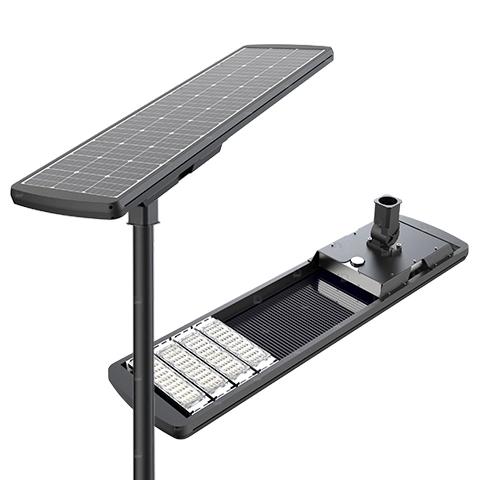
Start With the Real Load
The first thing we need to know is simple: how much energy does the light use every night?
A basic formula is:
Daily energy use (Wh) = LED wattage x working hours x dimming factor
If the light runs at full power all night, the dimming factor is 1.0.
If it dims after midnight or works with a sensor, the actual power use is lower.
For example:
- 60W light x 10 hours = 600Wh per night
- 40W light x 10 hours = 400Wh per night
This number is the starting point. It is not the final battery size yet, because the battery still needs to survive several rainy days and normal system losses.
Battery Sizing for 3-5 Rainy Days
For project use, the battery should not be sized for just one night. It should be able to support the light during a real backup period.
For most outdoor projects, 3 rainy days is a practical minimum. If the site has more cloudy weather, or if the client wants a safer margin, 5 rainy days is better.
The simple sizing logic is:
Battery capacity (Wh) = Daily energy use x Backup days / Usable depth of discharge / System efficiency
For LiFePO4 batteries, many projects use 80% to 90% usable depth of discharge. In real life, the system also loses some energy in the controller, wiring, charging process, and temperature conditions, so it is better to be conservative.
Standard Road Light
Assume:
- LED power: 40W
- Working time: 10 hours per night
- Backup days: 3 rainy days
- Battery system voltage: 25.6V
Calculation:
- Daily use = 40W x 10h = 400Wh
- Backup energy = 400Wh x 3 = 1200Wh
- With normal losses, the battery should be bigger than 1200Wh nominal
In practical terms, a 25.6V 80Ah to 100Ah LiFePO4 battery is often a reasonable starting range for this kind of project, depending on the dimming schedule and controller efficiency.
Larger Road or Parking Lot Light
Assume:
- LED power: 60W
- Working time: 10 hours per night
- Backup days: 5 rainy days
- Battery system voltage: 25.6V
Calculation:
- Daily use = 60W x 10h = 600Wh
- Backup energy = 600Wh x 5 = 3000Wh
For this type of project, the battery bank should be larger than 3000Wh nominal once losses and safety margin are included. In practical project terms, a 25.6V 150Ah to 200Ah battery is often much closer to the real requirement.
One Important Rule
Do not compare battery capacity by Ah only.
A 100Ah battery at 12.8V is not the same as a 100Ah battery at 25.6V. If you want to compare batteries properly, always look at watt-hours, not just amp-hours.
Solar Panel Sizing
The solar panel has two jobs:
- Power the light during normal operation
- Recharge the battery after cloudy days
That is why the panel should not be sized based only on the best summer day. It should be sized based on the worst practical month for the project site.
A simple way to think about it is:
Solar panel wattage = Daily energy use / Peak sun hours x safety factor
The safety factor matters because the real system always loses a bit of energy in the controller, wiring, charging process, dust, heat, and seasonal change.
If a site gets 4.5 peak sun hours on paper, do not size the panel too tightly. A panel that is just barely enough in perfect weather usually becomes a problem later.
Revisited
For the 40W road light example:
- Daily use: 400Wh
- Peak sun hours: 4.5
- Conservative system efficiency: 0.75
Basic panel estimate:
- 400Wh / 4.5 / 0.75 = about 119W
In actual project work, that does not mean 120W is enough. A more realistic choice is usually 180W to 200W, because the panel also needs to recover the battery after low-sun days.
Revisited
For the 60W, 5-day backup example:
- Daily use: 600Wh
- Peak sun hours: 4.5
- Conservative system efficiency: 0.75
Basic panel estimate:
- 600Wh / 4.5 / 0.75 = about 178W
For a real project, a 300W to 350W panel is often a better starting point if the client wants faster recovery and more stable performance in cloudy weather.
What Really Changes the Final Design
Two projects with the same lamp wattage can still need very different battery and panel sizes. Usually, it comes down to one of these:
- Pole height is different
- Working hours are different
- Road width is different
- The light is dimmed after midnight
- The local climate has more cloudy days
- The site needs faster recovery after several rainy days
- Controller efficiency is different
That is why we never recommend sizing a solar street light by wattage alone. The better question is whether the whole system can really support the required working hours under the worst realistic weather condition.
Common Sizing Mistakes
1. Choosing by lamp wattage only
A lot of people ask for a 60W or 80W solar street light as if that number decides everything. It does not. Battery voltage, panel size, working hours, and rainy-day backup are just as important.
2. Ignoring the dimming schedule
Many projects do not need full brightness from dusk to dawn. If the light can dim after midnight, the battery and panel can often be sized more efficiently.
3. Using annual sunshine instead of worst-month sunshine
Average sunshine looks good in a brochure. Projects usually fail in winter or during the rainy season, not in the best month.
4. Comparing Ah without voltage
This is a very common sourcing mistake. Always compare battery energy in Wh if you want a fair comparison.
5. Forgetting battery recovery time
It is not enough for the light to survive one cloudy night. The system also needs enough time to recharge before the next bad weather cycle starts.
What to Send Your Supplier
If you want a useful quotation, send more than just the lamp wattage.
The fastest way to get a realistic proposal is to provide:
- Road width or area size
- Pole height
- Required working hours
- Backup days needed
- Project location
- Whether dimming or motion control is acceptable
- Installation spacing
- Any drawing or site photo you already have
With that information, the supplier can recommend a battery and panel size that fits the project instead of guessing from a catalog.
Which Product Type Fits Which Project
For standard roads, communities, and parking areas, an All In One Solar Street Light is often the simplest choice because installation is easier and the system is compact.
If the project needs more flexible panel and battery sizing, a split system is usually easier to customize.
If uptime matters more than pure off-grid independence, Grid-connected Solar Street Lighting can be a better answer because it gives the project an extra layer of backup.
You can review related products here:
- LED Solar Street Light: https://www.dawnlighting.com/led-solar-street-light/
- All In One Solar Street Light: https://www.dawnlighting.com/all-in-one-solar-street-light/
- Grid-connected Solar Street Lighting: https://www.dawnlighting.com/grid-connected-solar-street-lighting/
FAQ
How many rainy days should a solar street light support?
Three rainy days is a common minimum for many projects. In cloudier areas or sites with stricter uptime requirements, five rainy days is a safer target.
Is a bigger battery always better?
Not always. A larger battery gives more backup time, but it also raises cost and charging demand. The battery should match the real working hours and recovery time of the site.
What battery type is best for solar street lights?
LiFePO4 is usually the practical choice for most modern projects because it has good cycle life, stable performance, and better energy density than older battery types.
Why does voltage matter so much?
Because Ah alone does not tell the full story. Watt-hours give a much clearer comparison between battery options.
How do I choose the panel size for a cloudy location?
Use the worst practical month, not the best month. Then leave some margin for recovery after several low-sun days.
Call to Action
If you are planning a road, parking lot, community, or industrial lighting project, send Dawn Lighting your road width, pole height, working hours, and rainy-day requirement. We can help you size the battery and panel before you place an order.
Suggested Page Layout for Website Upload
- Hero section with article title and a clear project-style image
- Short intro paragraph that explains why sizing matters
- Battery sizing section with one worked example
- Panel sizing section with one worked example
- Common mistakes section
- Product-type comparison section
- FAQ
- CTA
Editing Notes
Keep the tone practical and technical, not promotional. It should read like advice from someone who has sized real lighting projects before.
Good phrases to keep:
- worst practical month
- backup days
- working hours
- recovery after cloudy days
- battery voltage matters
Avoid generic lines like:
- best quality
- green and sustainable future
- world-class solution
- perfect for every project
- 10 Meters Lamp Post
- 10 Meters Pole
- 1000w Led Projector
- 100W LED Tunnel Light
- 12 Meters Lamp Post
- 12 Meters Pole
- 1200w Led Projector
- 15 Light Pole
- 1500w Led Projector
- 150W LED Tunnel Light
- 1800w Led Projector
- 2 In 1 Solar Flood Light
- 200w Led Tunnel Light
- 50w Led Tunnel Light
- 6 Meters Lamp Post
- 6 Meters Pole
- 8 Meters Lamp Post
- 8 Meters Pole
- 800w Led Projector
- 80w Led Tunnel Light
- Colourful Decorative Light
- Conical post
- Courtyard Lamp
- courtyard light
- courtyard lighting fixture
- Decorative Landscape Light
- Decorative road Light
- Flood Light For Courtyard
- Flood Light for Garden
- Flood Light For Outdoor
- Foot Led High Bay Lights
- high bay led lights 100w
- industrial lampshade
- industrial LED shed lights
- industrial magnifying glass with light
- Integrated Solar Flood Light
- led courtyard lamp
- led courtyard light
- led high bay light 100w
- LED Projector For Stadium
- Led UFO High Bay 150W 5000k
- Lighting Plants Mining Price
- Maintenance Free LED Street Light
- Pic Controlling Tunnel Light
- PLC controlling tunnel light
- Post Top Garden Light
- RGB Landscape Light
- Rgbw Decorative Light
- Smart Tunnel Light
- solar courtyard lamp
- solar courtyard light
- Solar LED Road Light
- Solar Street Light For 10 Meter Pole
- Solar Street Light For 12 Meter Pole
- Solar Street Light For 6 Meter Pole
- Solar Street Light For 8 Meter Pole
- Split Type Solar Flood Light
- Sporting Projector
- Stadium Led Projector
- Street Lighting Post
