
 Request A Quote

2026 Sports Lighting: How To Pick Beam Angles For HDTV
 FACEBOOK
 TWITTER
 LINKEDIN
Sports Lighting decisions for HDTV are not only about “more lumens”—they are about putting light exactly where the camera needs it, while keeping glare and spill out of the frame. In 2026, new buyers are judged by broadcast quality as much as brightness. If your beam angles are wrong, the field can look uneven, players can cast harsh shadows, and the audience may see bright hotspots or haze on screen. At Dawn Lighting, we build modular LED stadium and high-mast floodlight systems that help project teams aim with confidence, then verify results faster during commissioning.
1) Why Beam Angle Is the First HDTV Decision in 2026
When people hear “beam angle,” they often think it is a simple spec. In reality, beam angle is your steering wheel. It controls how far the light throws, how concentrated the beam is, and how much light leaks outside the target area. For HDTV, that matters because cameras amplify contrast. A small glare source can look like a white flare. A dark zone can look like a quality failure, even if the average lux is “fine.”
A practical way to think about Sports Lighting is this: your design goal is uniform visibility, not isolated brightness. You want the ball, the players, and the key lines to read clearly from every main camera position. Beam angle selection is how you shape that result before you ever mount a fixture.
2) Beam Angles Explained Simply: 10° to 90° and Asymmetric
Different beam angles exist because stadium geometries are different. Mounting height, pole location, and required throw distance change the “right” optic. Most professional projects combine multiple angles rather than relying on one.
Here is a beginner-friendly guide you can use in early planning:
• 10°: When poles are far or very tall, pick 10° to push light farther efficiently.
• 25°: For controlled reach across mid/long distances, choose 25°.
• 45°: For general mid‑field distribution without excessive spill, use 45°.
• 60°: For wide, near‑field coverage and smoother light transitions—common on training and community fields—go with 60°.
• 90° (Very Wide): Best used carefully. It can help cover near-side areas and reduce “dark bands,” but it can also increase spill and glare if aiming is not precise.
• Asymmetric Optics: A smart choice when you must push light forward while limiting backlight into stands, roads, or nearby buildings. For Sports Lighting near residential zones, asymmetric beams can be the difference between approval and complaints.
If you remember one rule: narrow beams are for distance, wide beams are for blending, and asymmetric beams are for control. That is the foundation for HDTV-friendly layouts.
3) How to Match Beam Angle to Pole Height and Throw Distance
New buyers often start by choosing wattage. We recommend starting with geometry instead. Ask two questions: “How high are my mounting points?” and “How far is the target zone from each pole?” Once you know those, beam angles become logical.
If you are lighting from tall masts or from positions far outside the field, narrow beams become your precision tools. They send usable light to the far side without oversaturating the near side. If you are lighting from closer poles or lower positions, medium and wider beams help keep uniformity high and reduce visible stripes.
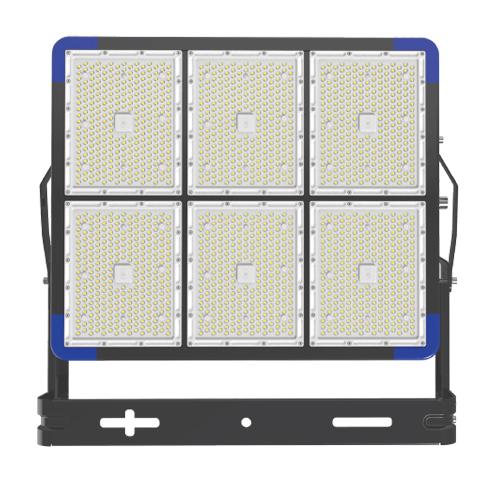
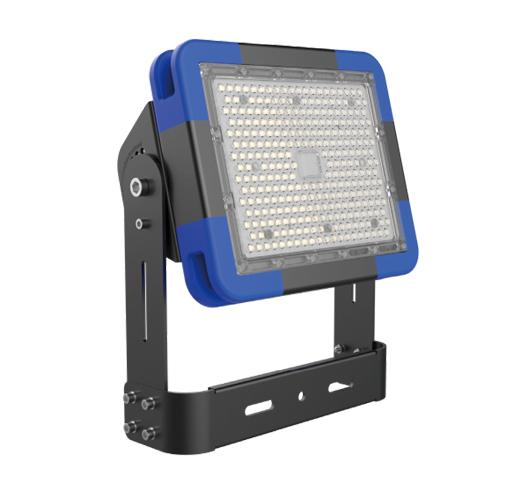
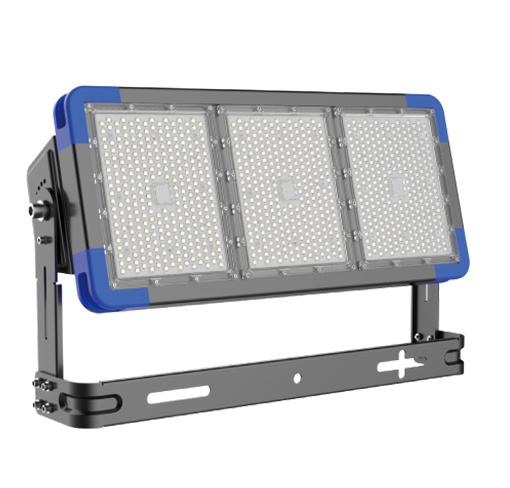
This is also where modular aiming becomes a real advantage. Dawn Lighting’s modular stadium floodlight system uses independently adjustable modules with up to 270° rotation. For the buyer, this means you can tune each module to match its job—long throw, mid-field fill, or near-side blend—without changing the whole fixture. Instead of “one beam does everything,” you create a controlled mix that looks smooth to the eye and to the camera.
4) Glare, Spill, and the HDTV Problem Buyers Miss
HDTV glare is not just discomfort. It is an image-quality issue. Cameras can capture flare, halos, and washed-out highlights that spectators might not notice in person. Glare usually comes from two sources: poor aiming (light hitting the camera path) and uncontrolled optics (light escaping beyond the intended area).
To solve this, you need two layers of control: the right beam angle and the right shielding strategy. Our system offers an optional Spill Shield visor designed to reduce light pollution and improve cut-off. In practical terms, that helps you protect nearby roads, signage, and spectator zones from stray light, while keeping more useful light on the playing surface. It also supports a cleaner broadcast image because fewer bright “edges” enter the camera frame.
This is also why Sports Lighting projects increasingly involve environmental expectations. Light spill is no longer only a technical detail. It can impact neighbor relations, compliance requirements, and operating permissions. Choosing optics with spill control is a buyer move that saves trouble later.
5) Product Data That Matters: Efficacy, Components, and Outdoor Reliability
In 2026, efficiency is not a marketing word. It is a budget lever. A high-efficacy system can reduce energy cost without sacrificing performance. Dawn Lighting’s high-power LED stadium solution is designed for professional arenas and high-mast applications, delivering up to 150 lm/W. For a project owner, this can translate into lower operating cost over the life of the installation, especially when you run long hours for training, events, and security lighting.
Component choices also matter for reliability and consistency. Our fixtures use premium Lumileds or OSRAM LED chips and reputable driver options such as Meanwell or Sosen. For buyers, the benefit is stable output and predictable performance across seasons, which is essential when you are trying to maintain the same visual standard for every match and broadcast.
Finally, outdoor sites are unforgiving. Wind, dust, and heavy rain do not “care” about your lighting plan. That is why construction quality is part of beam-angle success. Our housing uses robust die-cast aluminum and is rated IP66 for dustproof and waterproof protection, with a designed service life of over 60,000 hours. For the owner, that means fewer service calls, less downtime, and more confidence that the aiming you commission today will still deliver the intended result years later.
6) A Practical 2026 Buying Checklist and a Clear Next Step
If you are new to Sports Lighting for HDTV, you do not need to memorize standards on day one. You need a disciplined selection process. Use this checklist to reduce risk:
✓ Start with pole height, pole positions, and throw distances
✓ Combine beam angles to balance reach and uniformity
✓ Use spill control (such as a Spill Shield) where light pollution is a concern
✓ Prioritize aiming flexibility, especially for complex stadium geometries
✓ Verify outdoor protection (IP rating) and component reliability for long-term stability
If you want a faster path to a clean HDTV result, Dawn Lighting can help you choose beam angles based on your site layout and lighting goals, then match them to a modular high-power solution from 200W to 1440W. Contact Dawn Lighting to request a beam-angle recommendation, a simple application proposal, or a product configuration that fits your pole height and broadcast requirements. The right optic plan is one of the easiest ways to make your stadium look “professional” on camera—without overbuilding your power budget.
- 10 Meters Lamp Post
- 10 Meters Pole
- 1000w Led Projector
- 100W LED Tunnel Light
- 12 Meters Lamp Post
- 12 Meters Pole
- 1200w Led Projector
- 15 Light Pole
- 1500w Led Projector
- 150W LED Tunnel Light
- 1800w Led Projector
- 2 In 1 Solar Flood Light
- 200w Led Tunnel Light
- 50w Led Tunnel Light
- 6 Meters Lamp Post
- 6 Meters Pole
- 8 Meters Lamp Post
- 8 Meters Pole
- 800w Led Projector
- 80w Led Tunnel Light
- Colourful Decorative Light
- Conical post
- Courtyard Lamp
- courtyard light
- courtyard lighting fixture
- Decorative Landscape Light
- Decorative road Light
- Flood Light For Courtyard
- Flood Light for Garden
- Flood Light For Outdoor
- Foot Led High Bay Lights
- high bay led lights 100w
- industrial lampshade
- industrial LED shed lights
- industrial magnifying glass with light
- Integrated Solar Flood Light
- led courtyard lamp
- led courtyard light
- led high bay light 100w
- LED Projector For Stadium
- Led UFO High Bay 150W 5000k
- Lighting Plants Mining Price
- Maintenance Free LED Street Light
- Pic Controlling Tunnel Light
- PLC controlling tunnel light
- Post Top Garden Light
- RGB Landscape Light
- Rgbw Decorative Light
- Smart Tunnel Light
- solar courtyard lamp
- solar courtyard light
- Solar LED Road Light
- Solar Street Light For 10 Meter Pole
- Solar Street Light For 12 Meter Pole
- Solar Street Light For 6 Meter Pole
- Solar Street Light For 8 Meter Pole
- Split Type Solar Flood Light
- Sporting Projector
- Stadium Led Projector
- Street Lighting Post
