
 Request A Quote

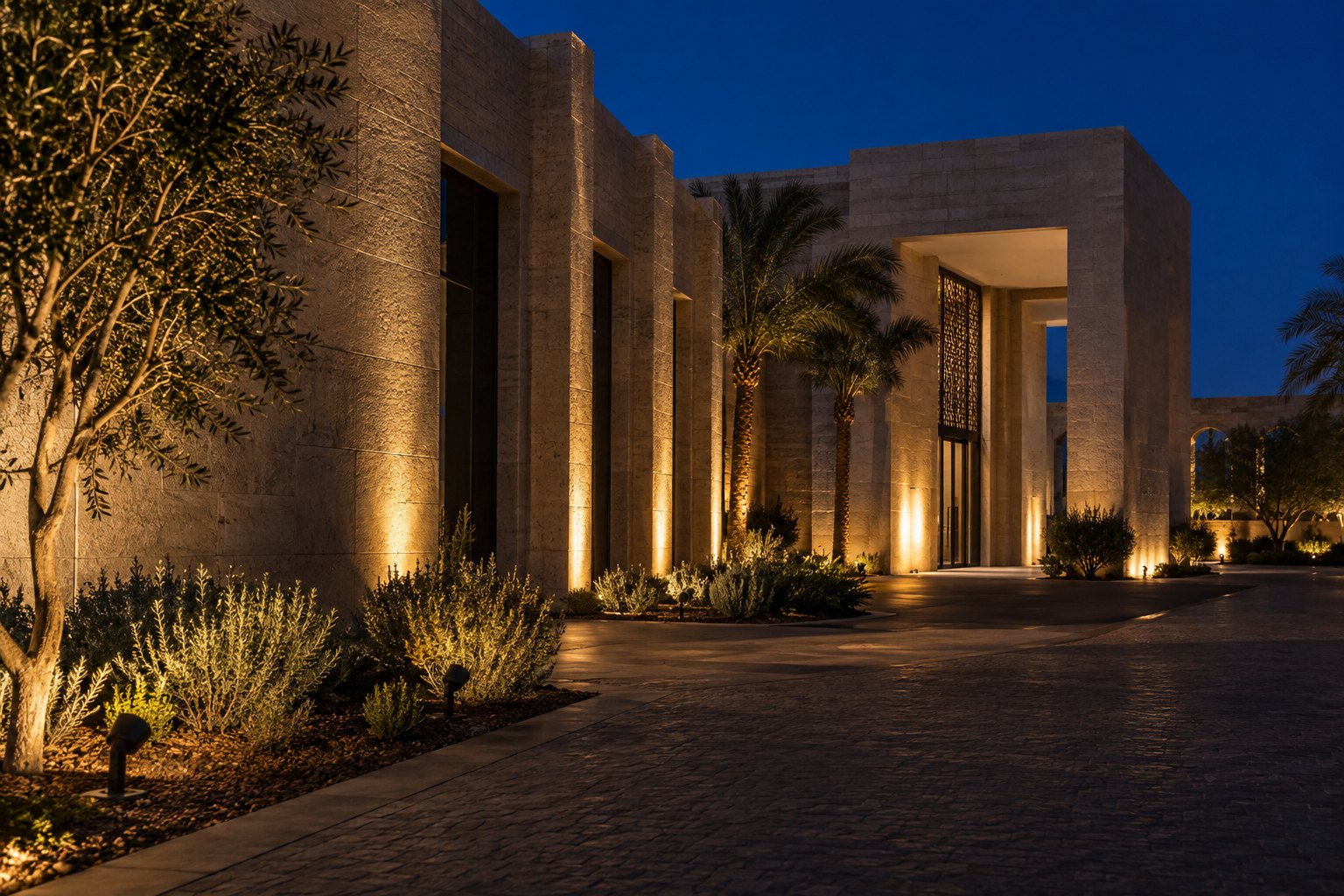
Walkway Lights for Hotels Parks and Public Spaces
 FACEBOOK
 TWITTER
 LINKEDIN
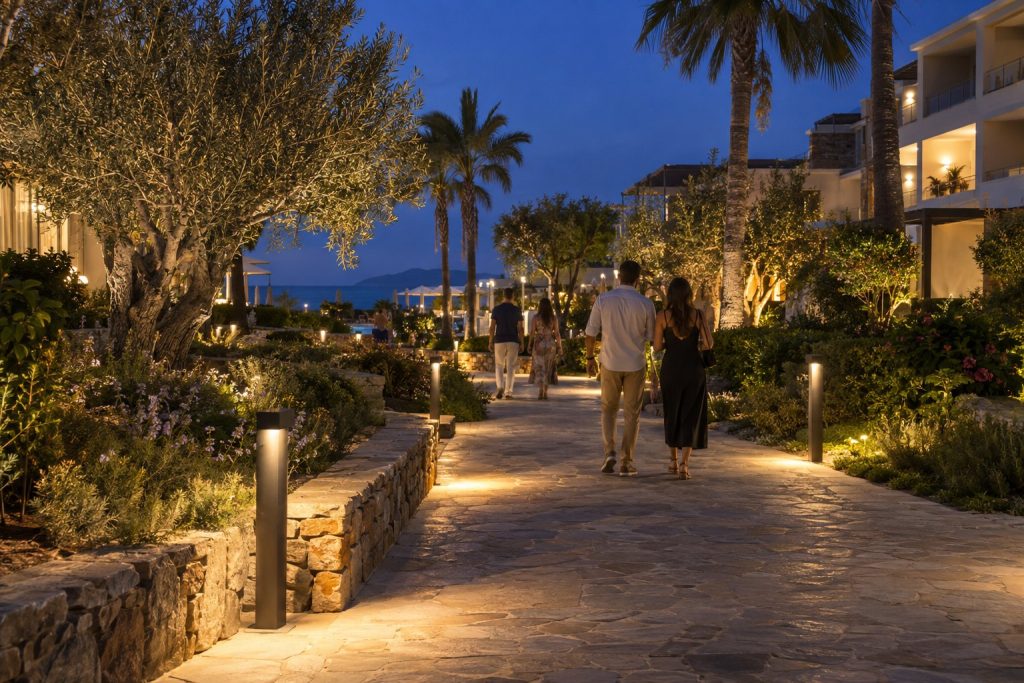
Walkway lights should reveal the route, steps, kerbs and faces without creating bright points in a pedestrian’s normal view. Good projects use several layers: shielded bollards close to the path, taller pedestrian poles at intersections and carefully aimed accent lights only where they support orientation. Spacing should come from a DIALux calculation using the real fixture distribution, not from a fixed rule based on wattage.
Direct answer. Begin with the pedestrian route and risk points. Set maintained horizontal and vertical illumination, minimum values and glare limits; then select shielded optics and mounting heights that keep light on the path. Verify IP65 or IP66 protection, IK rating, safe cabling, drainage, corrosion resistance and access for cleaning before approving the landscape plan.
Light the Route Not Every Plant
Hospitality and public-space projects often fail when decorative uplights dominate the useful path lighting. The first layer must show changes in level, path edges, ramps, crossings and decision points. Accent lighting can then identify entrances, trees or artwork. Our engineering team separates those circuits so operational lighting remains reliable even when decorative scenes change.
| Pedestrian zone | Concept range | Main risk | Design response |
| Quiet pathway | 5 to 10 lux | Dark patches and hidden edges | Shielded bollards with verified spacing |
| Busy promenade | 10 to 20 lux | Pedestrian conflict and camera contrast | Improve uniformity and vertical light |
| Steps ramps and crossings | 20 to 50 lux locally | Trips and rapid adaptation | Local reinforcement without glare |
| Entrance and wayfinding point | 20 to 50 lux locally | Faces and signs disappear | Balanced vertical and horizontal light |
These values are preliminary ranges, not universal standards. Accessibility rules, local codes and the owner’s risk assessment govern the final design.
Select Fixture Type by Mounting Position
| Fixture type | Best use | Strength | Risk to manage |
| Shielded bollard | Path edges and planted strips | Low mounting and controlled scale | Vandalism, glare and irrigation |
| Pedestrian pole light | Intersections and wider promenades | Broader coverage and vertical light | Spill, wind load and tree conflict |
| Recessed step light | Stairs and retaining walls | Direct light at the hazard | Drainage, sealing and maintenance |
| In-ground uplight | Trees or architecture only | Discreet accent source | Glare, water ingress and heat |
Calculate Spacing with Real Photometry
Two bollards with the same wattage can produce completely different spacing because the shield, optic and mounting height shape the beam. Enter the exact IES or LDT file, path width, surface reflectance, planting and level changes into DIALux. Review the maintained average, minimum-to-average uniformity and vertical illumination at face height where security or wayfinding matters.
For concept work, designers may discuss minimum-to-average uniformity around 0.20 to 0.40 on pedestrian routes, but local standards can differ. Avoid a repeated pattern of bright circles and black gaps. It feels unsafe even when the average lux looks acceptable.
Control Glare Colour and Adaptation
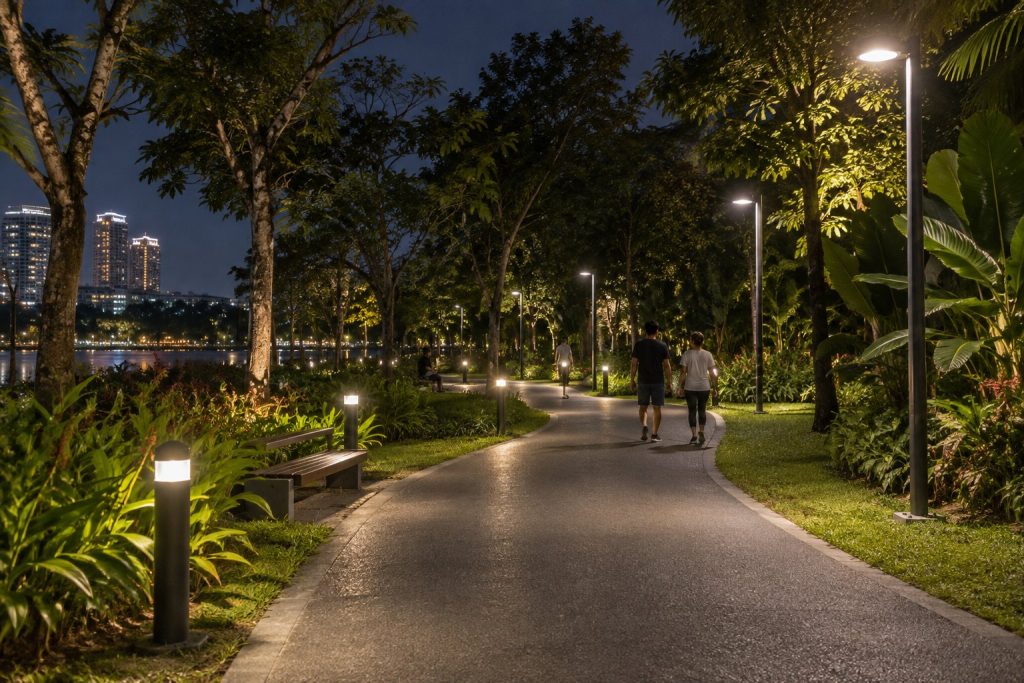
A bare LED visible at eye level can be uncomfortable at surprisingly low wattage. Use recessed or shielded light engines and check the view of children, wheelchair users and people approaching from both directions. Warm white around 2700K to 3000K often suits hotels and landscapes, while 3000K to 4000K may be selected for busier public routes. CRI 80 is a practical target where faces, materials and planting should appear natural.
Choose Mains or Low Voltage Distribution
Low voltage pathway lighting can simplify shock protection near gardens and water features, but long cable runs create voltage drop and uneven output. Mains-powered systems reduce current but need suitable burial depth, protection, glands and junction boxes. In either case, avoid buried splices in poorly drained soil. Separate irrigation routes from electrical joints and document every underground connection.
Design for Rain Irrigation Impact and Salt
IP65 may suit protected walkway lights, while IP66 provides stronger resistance to dust and water jets. In-ground fixtures face a different problem: standing water and blocked drainage can defeat a good enclosure. IK08 is useful where baggage carts, maintenance tools or vandalism are credible. Coastal resorts need compatible stainless fasteners, a specified coating system and regular fresh-water cleaning of salt deposits.
Coordinate Foundations and Landscape Work
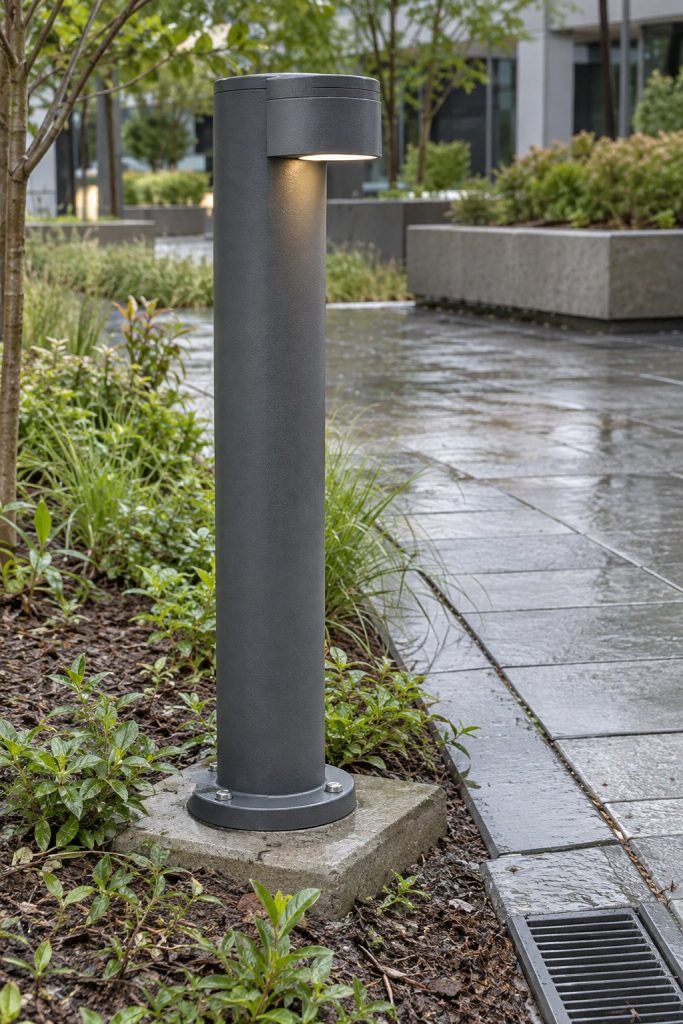
Set the bollard base above surrounding soil where possible and keep mulch away from the light aperture. Use a foundation that resists leaning without becoming a trip hazard. Confirm root zones, irrigation pipes and drainage before excavation. Trees grow; a pole position that is clear at handover may be blocked in three years.
Walkway Lighting Procurement Checklist
- Scaled route plan showing widths, steps, ramps, crossings, planting, benches and entrances
- Maintained lux, minimum lux, uniformity, vertical-light and glare criteria
- DIALux model using final photometric files, mounting heights and maintenance factor
- Fixture data for optic, CCT, CRI, IP, IK, thermal limits and service access
- Foundation, drainage, corrosion, cable, earthing and junction-box details
- Night aiming inspection, lux measurements and an agreed maintenance schedule
Mistakes That Make Paths Feel Unsafe
Common errors include spacing bollards by appearance alone, exposing the LED source at eye level, locating fittings inside the walking width and using tree uplights as safety lighting. Another problem is overlighting a feature beside the path; the eye adapts to the bright object and the route seems darker.
Frequently Asked Questions
How far apart should walkway lights be
There is no fixed spacing. Use the exact photometric distribution, mounting height, path width, maintained lux and uniformity target in DIALux.
How many lux are recommended for a walkway
Quiet routes may begin around 5 to 10 lux in concept design, while busy paths, steps and crossings may need higher local values. Confirm the applicable standard.
Are low voltage pathway lights better
They can improve electrical safety in some landscapes, but voltage drop and cable length need careful design. Mains systems can also be safe when correctly protected and installed.
What IP rating should outdoor walkway lights have
IP65 may suit protected locations; IP66 is often chosen for exposed dust, heavy rain or irrigation. Drainage and sealed connections remain essential.
Request a Project Lighting Review
For a hotel, resort, park or public-space walkway, provide the landscape plan, route widths, level changes, planting, operating hours, environmental exposure and local criteria. Dawn Lighting can review suitable products from its current landscape lighting range.
Send the site drawings and operating requirements through the Dawn Lighting official inquiry page. The engineering team can prepare a project-specific DIALux proposal and B2B quotation.

- 10 Meters Lamp Post
- 10 Meters Pole
- 1000w Led Projector
- 100W LED Tunnel Light
- 12 Meters Lamp Post
- 12 Meters Pole
- 1200w Led Projector
- 15 Light Pole
- 1500w Led Projector
- 150W LED Tunnel Light
- 1800w Led Projector
- 2 In 1 Solar Flood Light
- 200w Led Tunnel Light
- 50w Led Tunnel Light
- 6 Meters Lamp Post
- 6 Meters Pole
- 8 Meters Lamp Post
- 8 Meters Pole
- 800w Led Projector
- 80w Led Tunnel Light
- Colourful Decorative Light
- Conical post
- Courtyard Lamp
- courtyard light
- courtyard lighting fixture
- Decorative Landscape Light
- Decorative road Light
- Flood Light For Courtyard
- Flood Light for Garden
- Flood Light For Outdoor
- Foot Led High Bay Lights
- high bay led lights 100w
- industrial lampshade
- industrial LED shed lights
- industrial magnifying glass with light
- Integrated Solar Flood Light
- led courtyard lamp
- led courtyard light
- led high bay light 100w
- LED Projector For Stadium
- Led UFO High Bay 150W 5000k
- Lighting Plants Mining Price
- Maintenance Free LED Street Light
- Pic Controlling Tunnel Light
- PLC controlling tunnel light
- Post Top Garden Light
- RGB Landscape Light
- Rgbw Decorative Light
- Smart Tunnel Light
- solar courtyard lamp
- solar courtyard light
- Solar LED Road Light
- Solar Street Light For 10 Meter Pole
- Solar Street Light For 12 Meter Pole
- Solar Street Light For 6 Meter Pole
- Solar Street Light For 8 Meter Pole
- Split Type Solar Flood Light
- Sporting Projector
- Stadium Led Projector
- Street Lighting Post
