
 Request A Quote

where to place landscape lighting?
 FACEBOOK
 TWITTER
 LINKEDIN
One of the most viable methods of improving the look, security and usefulness of your home after the sun goes down is outdoor lighting. You can emphasize some decorative elements of a building, enhance the visibility of a building at night, or simply make a home cozy atmosphere; in any case, it is imperative to understand the location points of landscape lighting in order to become a professional.
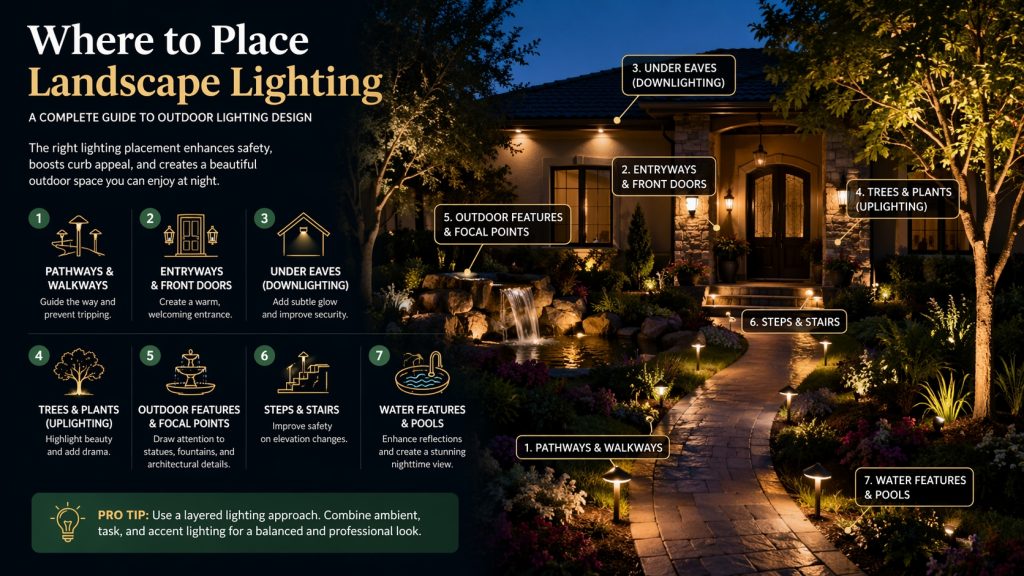
We will discuss the most effective landscape lighting placement techniques, tips of the trade, and design concepts to guide you in changing your outdoor area in this step-by-step guide.
The importance of Landscape Lighting.
It is essential to have a clue as to why outdoor lighting is a good investment before getting into placement.
- Improved Safety and Security
Lighting in the right locations will help to minimize cases of tripping along the walkways, stairs, and driveways and discourage the would-be intruders.
- Enhanced Curb Appeal
Lights will showcase the architectural elements of your house and garden, making your house shine even in the dark.
- Extended Outdoor Living
Patios, gardens and backyards can be used and welcoming at night with the appropriate lighting system.
Begin With Landscape Lighting Plan.
The greatest error that homeowners commit is the lighting installation without a definite plan. Rather, start by testing your outdoor area at nightfall.
Find three important areas:
- Functional areas (paths, stairs, entrances)
- Centres of interest (trees, sculptures, water features)
- Outdoor spaces (lawns, seating areas, patios)
Strategic plan guarantees even lighting and eliminates glare and dark areas.
The 7 Best places to install landscape lighting.
- Along Pebble-Walks and Walkways.
Pathway lights are needed in terms of security and beauty. Lighten up the walkways, driveways, and garden paths to direct movement and avoid accidents.
Best practices:
- Light up the space (usually 6-8 feet in-between).
- Placing them staggered rather than in straight lines.
- Lighting should be soft and low-voltage with a natural effect.
- Near Entryways and Front Doors.
Your front door needs to be warm and bright. It is advisable to light this area to enhance visibility and a good first impression.
Placement ideas:
- Sconces along the walls by the doors.
- Downlights above entryways
- Visibility of house numbers by lighting.
- Beneath Roof Eaves (Downlighting)
Placing lights below eaves gives a slight downward light which adds to the architectural details besides increasing security.
This technique:
- Lights up doors and garages.
- Mimics natural moonlight
- Reduces harsh glare
- Uplighting Trees and Plants (Highlighting)
Uplighting may be used to make trees, shrubs and garden beds dramatic focal points.
Tips:
- Install lights on the tree trunks.
- Tilt upwards to emphasize height and texture.
- Large trees should be cross-lit.
Uplighting gives depth and interest to your landscape.
5.Outdoor Features and Focal points are near.
Accent lighting attracts attention to the distinctive details like:
- Statues
- Fountains
- Rock formations
- Architectural details
Set position lights so as to achieve shadows and depth instead of flat light.
- Steps, Stairs, and Change in elevation.
One of the most significant areas to be lit to be safe is steps.
Recommended placement:
- Under stair treads
- Along railings
- Recessed into risers
The appropriate lighting here avoids accidents and still upholds an aesthetic design.
- Water Elements (Pools, Ponds, Fountains)
Water features can be made to be beautiful focus points in the night with suitable lighting.
Ideas include:
- Pond lights that are submersible.
- Uplighting for waterfalls
- Edge lighting for pools
Lighting is used to amplify reflections and creation of luxurious ambience.
Layered Lighting is the Best.
Layered lighting approach is used in professional landscape designs incorporating several types of lighting:
- Ambient lights- general light.
- Task lighting- functional light such as paths and stairs.
- Accent lighting – emphasizes areas of interest.
Layering gives it depth, prevents glare and results in a well balanced and attractive outdoor environment.
Popular Landscape Lighting Techniques.
To make your design higher, keep in mind such professional tricks:
Uplighting
Ground level lights with an angle-upward light- best on trees and walls.
Downlighting
Lamps placed over to give a natural light (which is commonly referred to as moonlighting).
Shadowing and Silhouetting
Produces visual effects that are dramatic through the use of lights in front or behind the objects.
Grazing
Accentuate surfaces such as stone or brick by putting lights near the surface.
These techniques add sophistication and dimension to your outdoor lighting design.
Topics: The most frequent landscape lighting errors.
With the right fixtures, bad placement will destroy your design. These are some of the mistakes to avoid:
- Overlighting the Space
Excessive lights cause glare and overlight your landscape. Pay attention to delicate, tactical positioning.
- Poor Spacing
The spacing is not even and it results in dark spots or over bright spots. Maintain consistent distances.
- Ignoring Color Temperature
Use warm white (approximately 2700K) to achieve a natural warm and welcoming appearance.
- Lighting Everything
Not all the elements require illumination. Emphasize important details and allow shadows to provide contrast.
Landscape Lighting tips.
- Use LED lights to conserve energy and increase life span.
- Cover fixtures to ensure the attention is on lit areas.
- Night test lighting prior to final installation.
- Smart controls: brightness and time.
Above all, keep in mind that the key is to place more than to quantity. Considerate placement is a professional appearance without over-the-top ornaments.
Final Thoughts
The placement of landscape lighting can make all the difference to your outdoors environment. By highlighting the routes, doorways, areas of focus, and lighting effects, you are able to develop a secure, practical, and aesthetically pleasing setting.
You can upgrade the front yard or create your backyard haven, but with good use of lighting, your house will appear as beautiful at night as it does in the morning.
- 10 Meters Lamp Post
- 10 Meters Pole
- 1000w Led Projector
- 100W LED Tunnel Light
- 12 Meters Lamp Post
- 12 Meters Pole
- 1200w Led Projector
- 15 Light Pole
- 1500w Led Projector
- 150W LED Tunnel Light
- 1800w Led Projector
- 2 In 1 Solar Flood Light
- 200w Led Tunnel Light
- 50w Led Tunnel Light
- 6 Meters Lamp Post
- 6 Meters Pole
- 8 Meters Lamp Post
- 8 Meters Pole
- 800w Led Projector
- 80w Led Tunnel Light
- Colourful Decorative Light
- Conical post
- Courtyard Lamp
- courtyard light
- courtyard lighting fixture
- Decorative Landscape Light
- Decorative road Light
- Flood Light For Courtyard
- Flood Light for Garden
- Flood Light For Outdoor
- Foot Led High Bay Lights
- high bay led lights 100w
- industrial lampshade
- industrial LED shed lights
- industrial magnifying glass with light
- Integrated Solar Flood Light
- led courtyard lamp
- led courtyard light
- led high bay light 100w
- LED Projector For Stadium
- Led UFO High Bay 150W 5000k
- Lighting Plants Mining Price
- Maintenance Free LED Street Light
- Pic Controlling Tunnel Light
- PLC controlling tunnel light
- Post Top Garden Light
- RGB Landscape Light
- Rgbw Decorative Light
- Smart Tunnel Light
- solar courtyard lamp
- solar courtyard light
- Solar LED Road Light
- Solar Street Light For 10 Meter Pole
- Solar Street Light For 12 Meter Pole
- Solar Street Light For 6 Meter Pole
- Solar Street Light For 8 Meter Pole
- Split Type Solar Flood Light
- Sporting Projector
- Stadium Led Projector
- Street Lighting Post
